
Sacred Ireland: A Guide to Monastic Sites, Holy Wells & Ancient Pilgrimages
There is a quality to the Irish landscape that defies easy description. Walk the stone paths of Glendalough at dawn, when mist rises from the two lakes and the round tower emerges like a finger pointing heavenward. Stand on the cliffs of Skellig Michael as Atlantic gulls wheel below you and the hermitage stones warm in the sun. Kneel at a holy well in a hedgerow, tying your clootie among hundreds of others left by pilgrims over centuries. Something happens in these moments. The boundary between the ordinary and the extraordinary grows thin.
Ireland has been a destination for spiritual seekers since before Saint Patrick arrived in the fifth century. The island's sacred landscape — a complex layering of pagan and Christian, ancient and modern, local and universal — offers something rare in today's world: authentic connection to traditions that have remained essentially unchanged for millennia. This is not spiritual tourism in the superficial sense. This is participation in living traditions, contact with landscapes that have shaped human consciousness for thousands of years.
The sites we cover in this guide span the full range of Irish sacred geography. Monastic sites like Clonmacnoise and the Rock of Cashel where medieval monks preserved learning through the Dark Ages. Holy mountains like Croagh Patrick where pilgrims have climbed in penance for fifteen centuries. Holy wells scattered across the countryside, still visited by local people maintaining ancient patterns. Pilgrimage destinations like Lough Derg where the medieval practice of sleep deprivation and fasting continues unchanged. And ancient royal sites like the Hill of Tara where the spiritual and political heart of Ireland beat for three thousand years.
This guide provides everything you need to explore Sacred Ireland meaningfully. We cover the history and significance of each site, practical information for visiting, and guidance on how to approach these places with the respect they deserve. Whether you are a committed pilgrim, a curious traveller, or simply someone seeking something beyond the ordinary, Sacred Ireland awaits.
The Monastic Heritage: Where Ireland Saved Civilisation
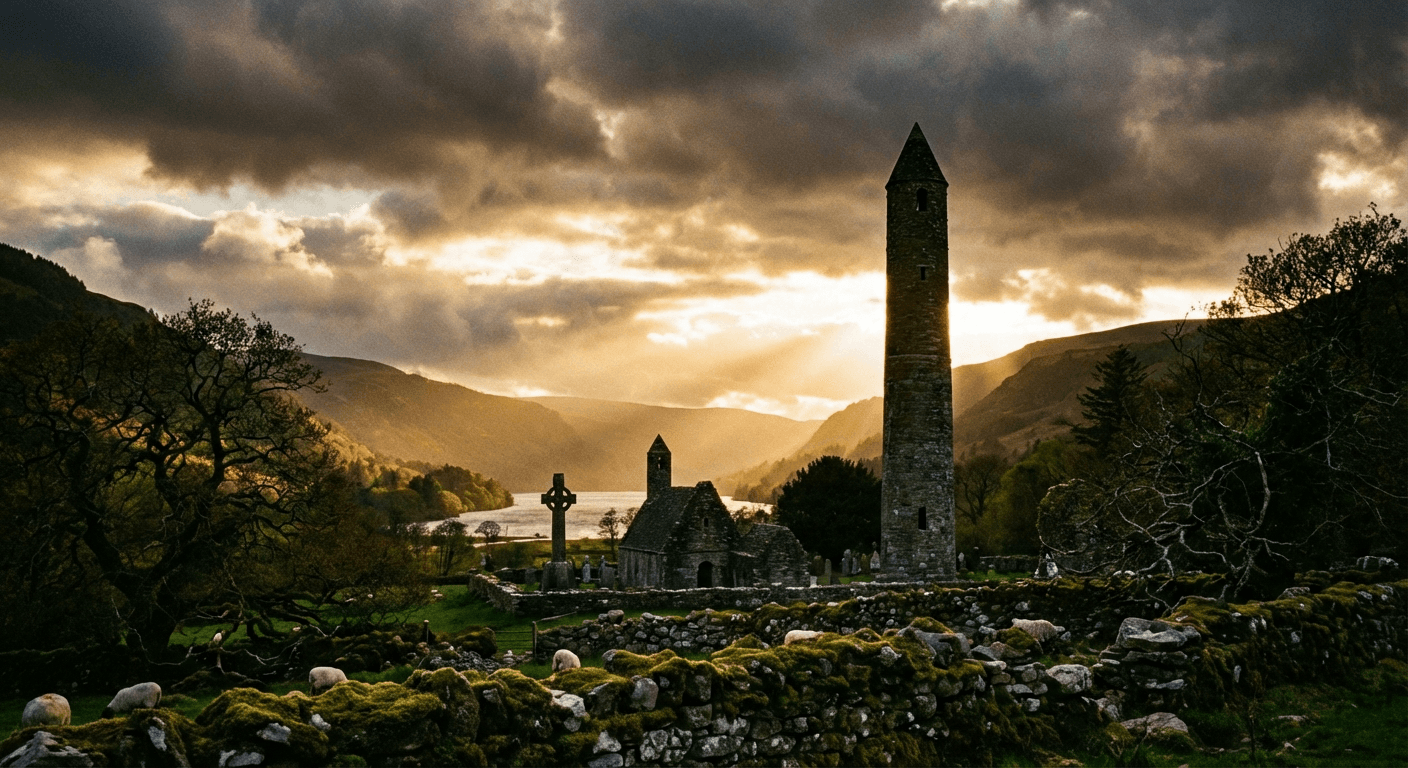
In the early medieval period, while continental Europe struggled through the chaos that followed the fall of Rome, Ireland became an unlikely centre of learning and culture. The monastic sites established by saints and scholars across the island preserved classical texts, developed distinctive artistic traditions, and created the intellectual foundation for Europe's later Renaissance.
Skellig Michael represents this tradition at its most extreme. Founded in the sixth century, this rocky outcrop thirty miles off Ireland's west coast housed a community of monks who lived in stone beehive huts, enduring Atlantic storms and isolation to be closer to God. The site is now a UNESCO World Heritage Site and one of the most dramatic sacred landscapes in Europe. Read our complete guide to Skellig Michael for details on visiting this extraordinary site.
Glendalough, the Valley of the Two Lakes, offers a more accessible introduction to Irish monasticism. Saint Kevin's monastic city, founded in the sixth century, contains a cathedral, round tower, and numerous churches spread across a glacial valley of extraordinary beauty. The site remained active for six centuries and retains its spiritual atmosphere today. See our Glendalough visitor guide for everything you need to know about this sacred valley.
Clonmacnoise, founded in 544 AD at the geographical centre of Ireland, became one of Europe's great monastic cities. Its scriptorium produced manuscripts whose beauty still astonishes. Its high crosses set the standard for Irish stone carving. Its scholars compiled the annals that remain our primary source for early Irish history. The Crossroads of Ireland continues to draw pilgrims seeking connection with this intellectual and spiritual heritage. Our Clonmacnoise guide covers the history, archaeology, and practicalities of visiting this remarkable site.
The Rock of Cashel presents a different face of Irish monasticism — the intersection of secular and sacred power. Once the seat of the Kings of Munster, the rock was handed over to the Church in 1101 and became an ecclesiastical complex that rivalled any in Europe. Cormac's Chapel, built between 1127 and 1134, is arguably the finest Romanesque church in Ireland. Our Rock of Cashel guide explores the architecture, history, and legends of this spectacular site.
The Aran Islands (Inis Mór) offer a glimpse of monastic life at the edge of the world. The Seven Churches, founded in the eighth century, served a community of monks and pilgrims for six centuries. The site's isolation preserved traditions that disappeared elsewhere. Our Aran Islands guide covers Dun Aonghasa, the Seven Churches, and the unique limestone landscape of these extraordinary islands.
Visiting these monastic sites requires more than ticking off attractions. Each demands slow exploration, imagination to see beyond the ruins to the vibrant communities they once housed, and respect for the spiritual traditions they represent. A Historical Expert who specialises in medieval Ireland can transform these visits from sightseeing into genuine encounters with the past.
Holy Mountains: Ascent and Transformation
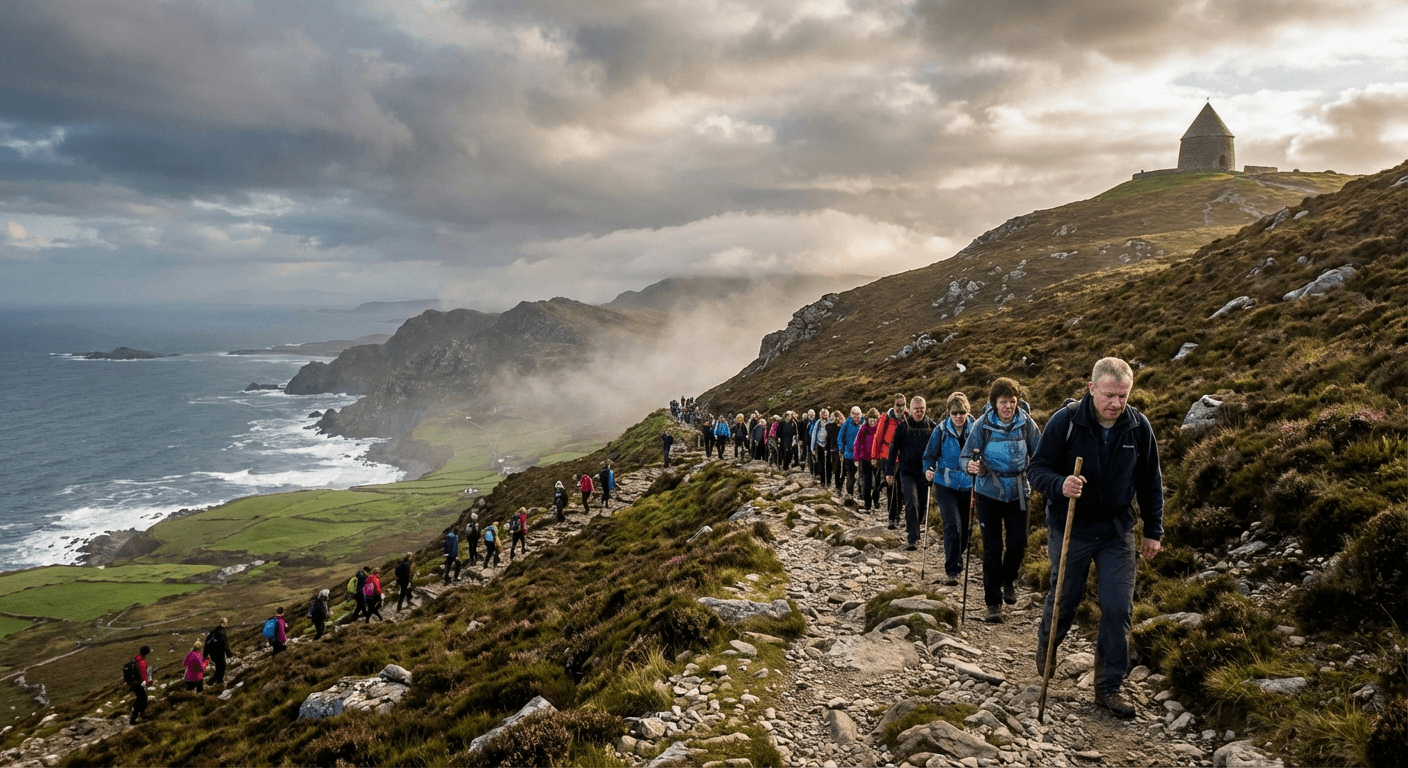
The tradition of mountain pilgrimage runs deep in Ireland. Pre-Christian peoples revered high places as portals to the Otherworld. Early Christian missionaries recognised this impulse and transformed it — the difficult ascent became a metaphor for spiritual struggle, the summit a place of encounter with the divine.
Croagh Patrick is the most famous of Ireland's holy mountains. Each year, on the last Sunday of July (Reek Sunday), over 20,000 pilgrims climb the 764-metre peak in honour of Saint Patrick, who supposedly fasted here for forty days in 441 AD. The climb is demanding — rocky, steep, and exposed to the full force of Atlantic weather. Pilgrims often undertake it barefoot, following a tradition of penance that stretches back centuries. Our complete Croagh Patrick guide covers the routes, the traditions, and what to expect from this challenging pilgrimage.

What draws people to Croagh Patrick is not just the association with Ireland's patron saint. It is the experience of the climb itself — the physical effort that clears the mind, the exposure to wind and rain that strips away pretension, the moment of arrival at the summit when the vast expanse of Mayo and the Atlantic suddenly opens below. This is pilgrimage in its most ancient form: the deliberate embrace of difficulty as a path to transformation.
Croagh Patrick pairs naturally with other western pilgrimage sites. The same day that takes you up the Reek can include a visit to Knock, Ireland's Marian shrine, or the Ceide Fields, the oldest known field system in the world. A Hiking Leader can safely guide you up the mountain while explaining the traditions and ensuring you do not underestimate the challenge.
Holy Wells: The Living Tradition
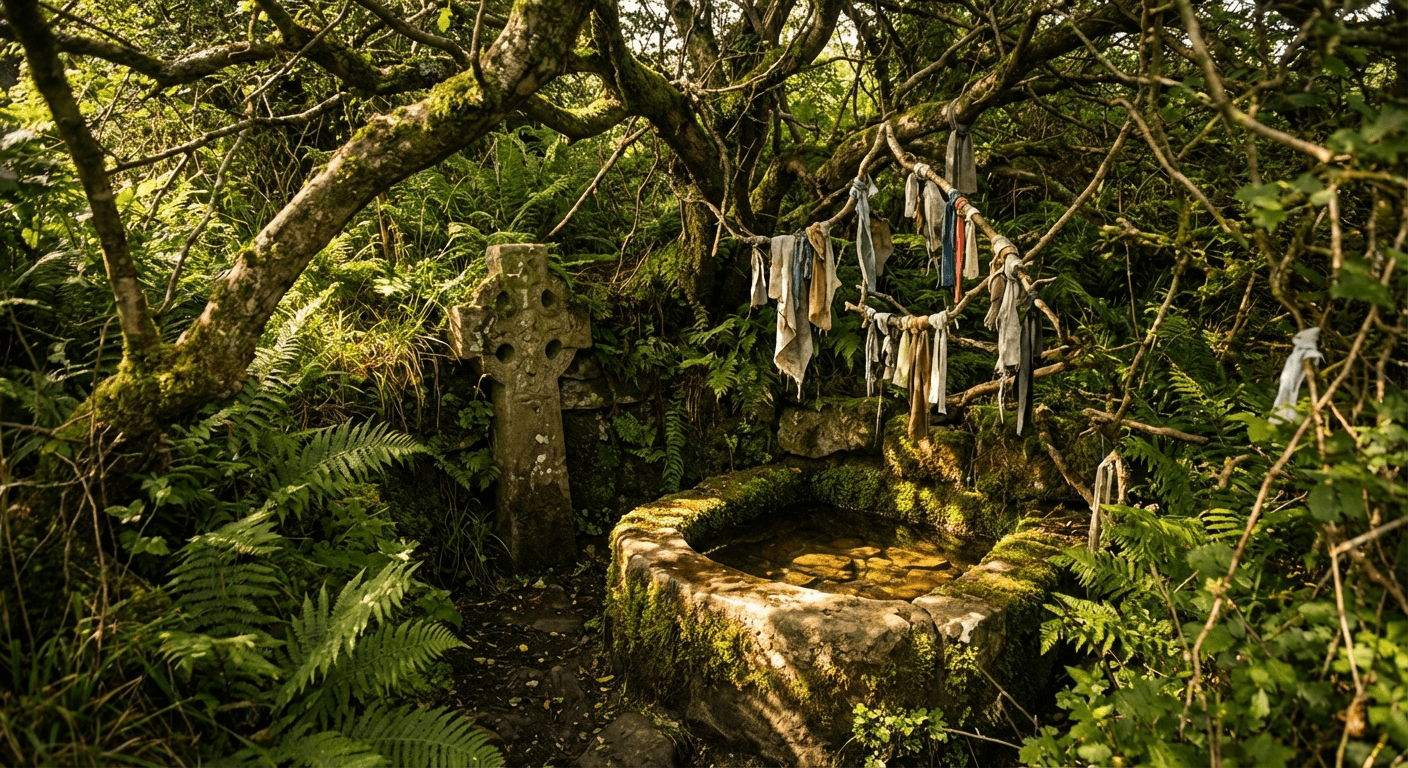
If the monastic sites represent the institutional face of Irish spirituality, the holy wells represent its folk heart. There are over 3,000 recorded holy wells in Ireland — natural springs that have acquired healing properties, usually through association with a saint. Many remain active pilgrimage sites, visited by local people who maintain traditions unchanged for centuries.
The holy wells operate on a logic that predates Christianity and has never been fully assimilated to orthodox doctrine. Each well specialises in curing specific ailments — eye problems, skin conditions, infertility, mental distress. The ritual of visiting involves paying rounds — walking sunwise around the well a specific number of times, reciting prayers, leaving an offering (usually a coin, pin, or strip of cloth), and collecting water to drink or apply to the affected body part.
What makes the holy wells extraordinary is that they are living traditions, not museum pieces. On pattern days (usually the saint's feast day), local communities gather at their wells to clean, decorate, and pray. The offerings left at wells — rosaries, holy cards, children's toys, photographs of the sick — testify to continued belief in their efficacy. Our Holy Wells of Ireland guide explains how to find these hidden sites, how to pay rounds properly, and how to visit respectfully.
Finding holy wells requires effort. Many are on private farmland, accessible only by asking permission. Others are hidden in hedgerows, marked only by a stone cross or a local's knowledge. The rewards for seeking them out are significant: solitude, connection to ancient traditions, and the sense of discovery that comes from finding something not listed in guidebooks.
Extreme Pilgrimage: Lough Derg and the Edge of Endurance
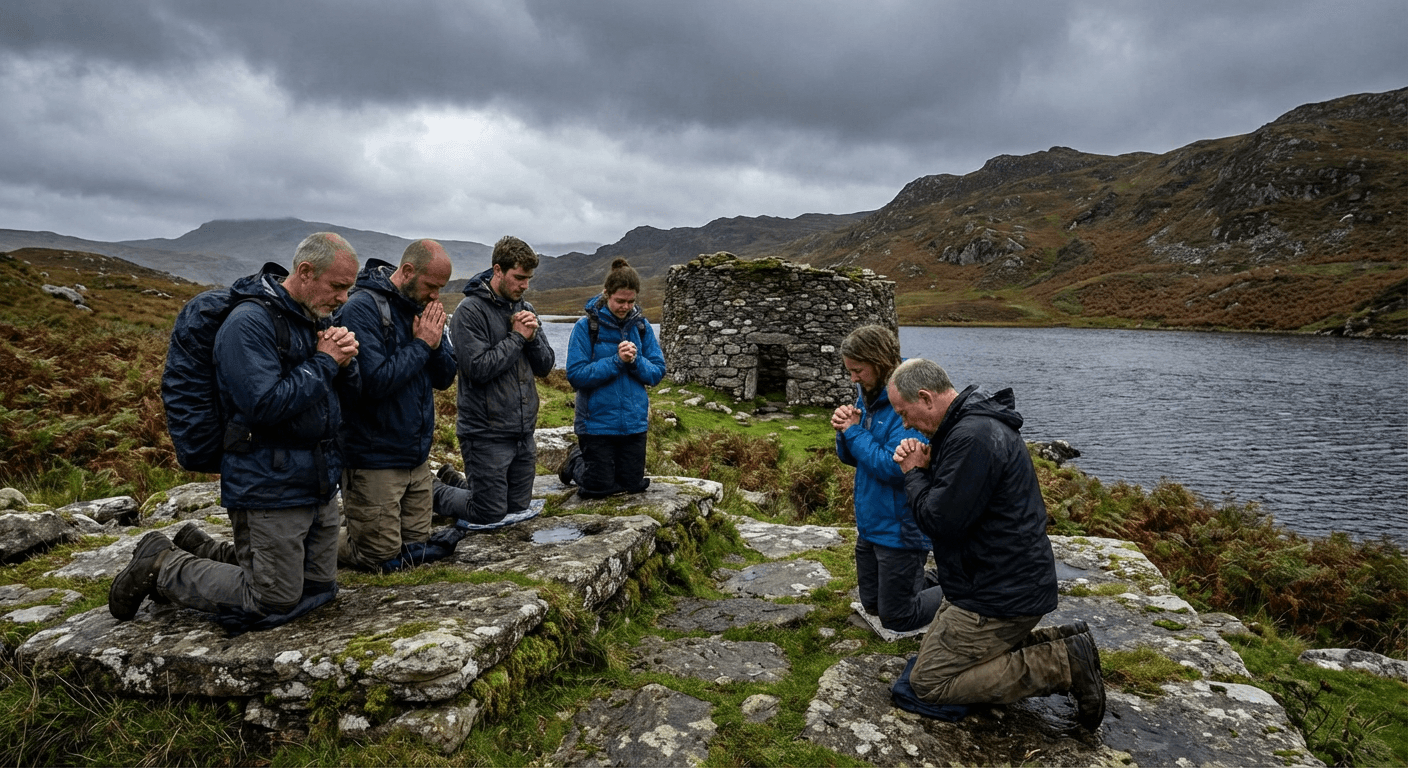
Not all Irish pilgrimage is gentle. Lough Derg (Station Island) represents the most demanding form of Christian pilgrimage in the world — a three-day retreat of fasting, sleep deprivation, and barefoot walking that has remained essentially unchanged since the Middle Ages.
The tradition dates to the fifth century, when Saint Patrick supposedly experienced a vision of Purgatory on the island. For centuries, pilgrims came to enter a cave that was believed to be an entrance to the afterlife. The cave was destroyed in the fifteenth century, but the pilgrimage continued, focusing on the beds — low stone structures that represent the stations of the cross.
The modern retreat follows a strict schedule. Pilgrims arrive by boat, surrender their phones and watches, and begin the pattern of prayer and walking. They eat one meal per day — dry toast and black tea. They sleep a maximum of four hours per night on dormitory bunks. They keep vigil through the night in an unheated basilica, singing psalms while the Donegal rain lashes the windows.
Over 10,000 pilgrims complete the retreat each summer. They come for different reasons — penance, petition, tradition, curiosity. What they share is a willingness to endure genuine discomfort for the sake of spiritual growth. Our Lough Derg guide covers everything you need to know about undertaking this challenging but potentially transformative pilgrimage.
Ancient Royal Sites: The Hill of Tara and the Seat of Kings
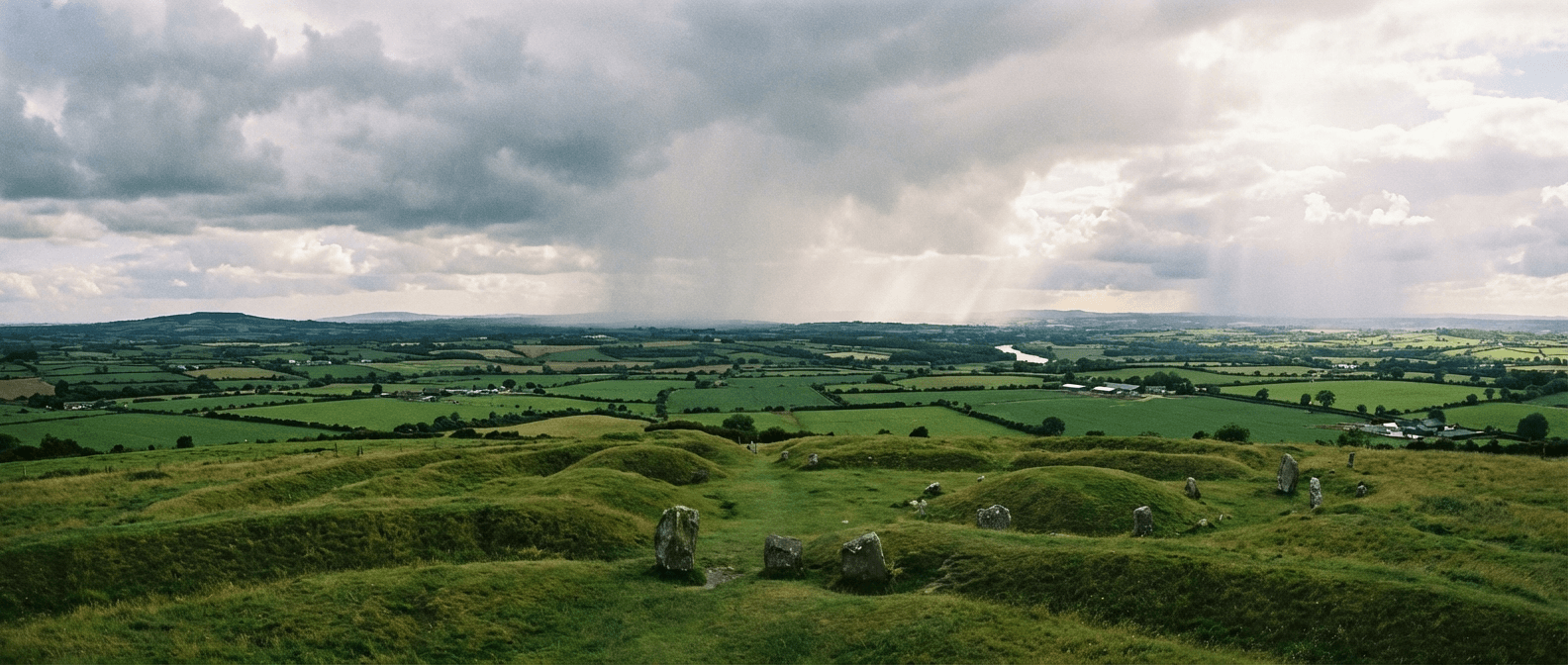
Before the monasteries, before the saints, before Christianity itself, Ireland had sacred sites of a different kind — royal inauguration places where kings claimed legitimacy through connection to the land itself. The most important of these was the Hill of Tara in County Meath.
For three thousand years, Tara was the seat of the High Kings of Ireland. The site is not spectacular in the way of medieval cathedrals — what remains are earthworks, ditches, and standing stones that require interpretation to appreciate. But the significance of Tara lies not in its architecture but in its position. From this modest hill, you can see a quarter of Ireland. Our Hill of Tara guide explains the archaeology, mythology, and continuing significance of this extraordinary site.
Tara pairs naturally with Newgrange and the Boyne Valley, about twenty minutes away. The combination — Tara as the seat of the High Kings, Newgrange as the tomb of the ancestors — provides a complete picture of Ireland's ancient sacred geography. Our Newgrange and Knowth guide covers the Boyne Valley passage tombs, including how to access the Winter Solstice sunrise at Newgrange.
Planning Your Sacred Ireland Journey
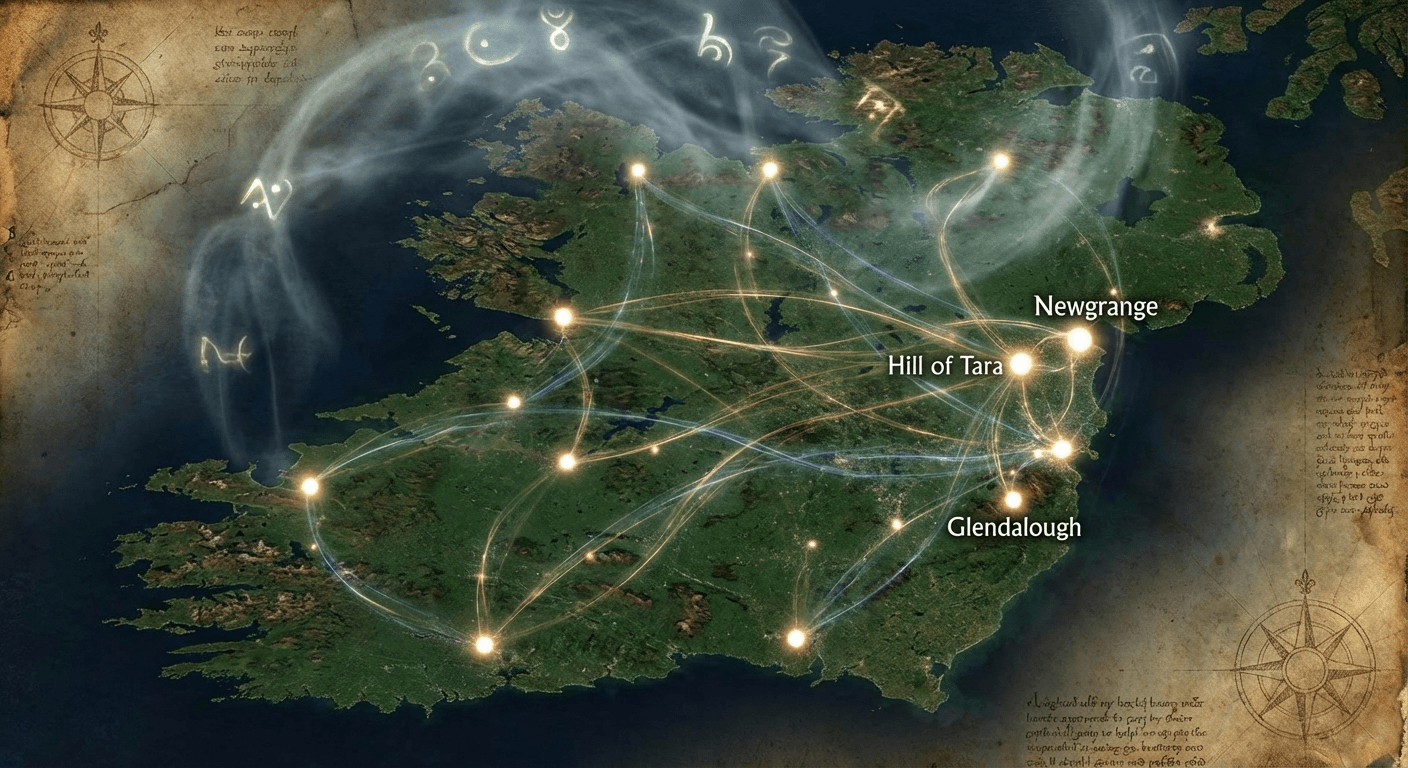
Exploring Sacred Ireland requires planning. The sites are scattered across the island, each with its own character, opening hours, and practical challenges. Here are some suggested approaches:
The Complete Pilgrimage (2-3 weeks): Start at Tara and Newgrange in the east, then work clockwise through Glendalough, Clonmacnoise, Croagh Patrick, the Aran Islands, Skellig Michael (if weather permits), the Rock of Cashel, and back to Dublin. This itinerary covers all the major sites but requires significant time and stamina.
The Western Pilgrimage (1 week): Focus on the west of Ireland, where the density of sacred sites is highest. Croagh Patrick, Clonmacnoise, the Aran Islands, and Skellig Michael can be combined into a powerful week-long journey through Ireland's most dramatically spiritual landscapes.
The Ancient Ireland Tour (5-7 days): Combine Tara, Newgrange, Knowth, and the Boyne Valley with Glendalough and Clonmacnoise for a focused exploration of Ireland's ancient and medieval heritage.
Practical Considerations: A car is almost essential for exploring Sacred Ireland efficiently. Public transport reaches some sites but not others. A Private Driver who knows the routes can transform the experience, handling logistics while you focus on the spiritual dimension.
Timing: Summer (May-September) offers the best weather and longest opening hours, but also the most crowds. Spring and autumn provide a good balance. Some sites, particularly Skellig Michael and Lough Derg, have very limited access outside the main season.
Physical Preparation: Several sites — Croagh Patrick, Skellig Michael, the climb to Dun Aonghasa — require significant physical effort. Do not underestimate the challenge, particularly if you are not used to hiking.
Why a Local Guide Makes the Difference
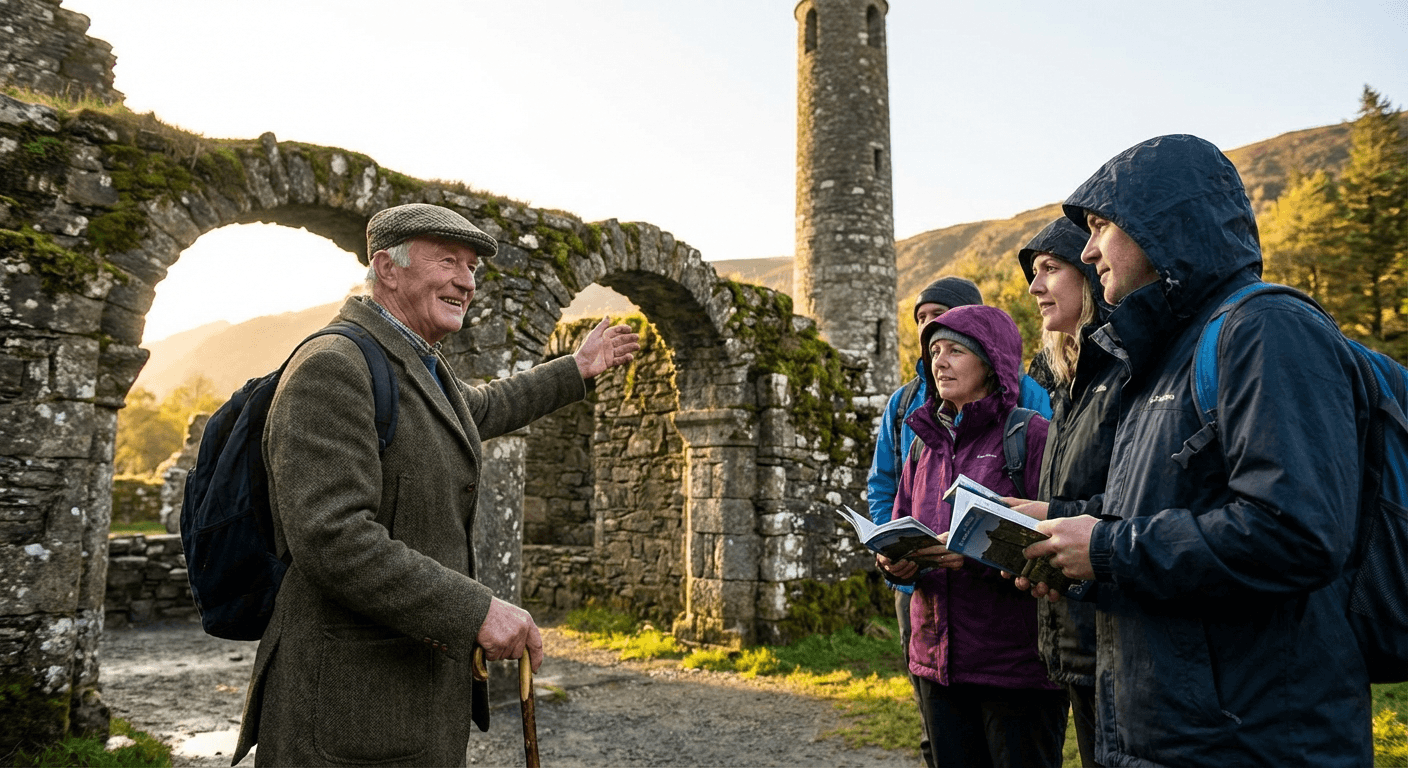
You can explore Sacred Ireland on your own. Many do, clutching guidebooks and following marked trails. But here is what you will miss: the stories that transform stones into living history, the access to sites not on tourist maps, the context that connects individual places into a coherent sacred landscape.
A Local Guide who specialises in Ireland's spiritual heritage offers: Knowledge — the archaeology, history, and mythology of each site, explained in ways that bring the past alive. Access — introductions to local communities who maintain holy wells, private visits to sites closed to general visitors, knowledge of the best times to avoid crowds.
Safety — the cliff edges at Skellig Michael and Dun Aonghasa, the demanding climbs of Croagh Patrick — these are genuinely dangerous for the unprepared. A guide knows where to walk, how to read weather signs, what to do in emergencies.
Integration — connection of individual sites into the broader picture of Sacred Ireland — how Glendalough relates to Clonmacnoise, how the Holy Wells fit into the monastic landscape, how ancient royal sites like Tara shaped the Christian pilgrimage tradition.
Conclusion: The Journey Inward
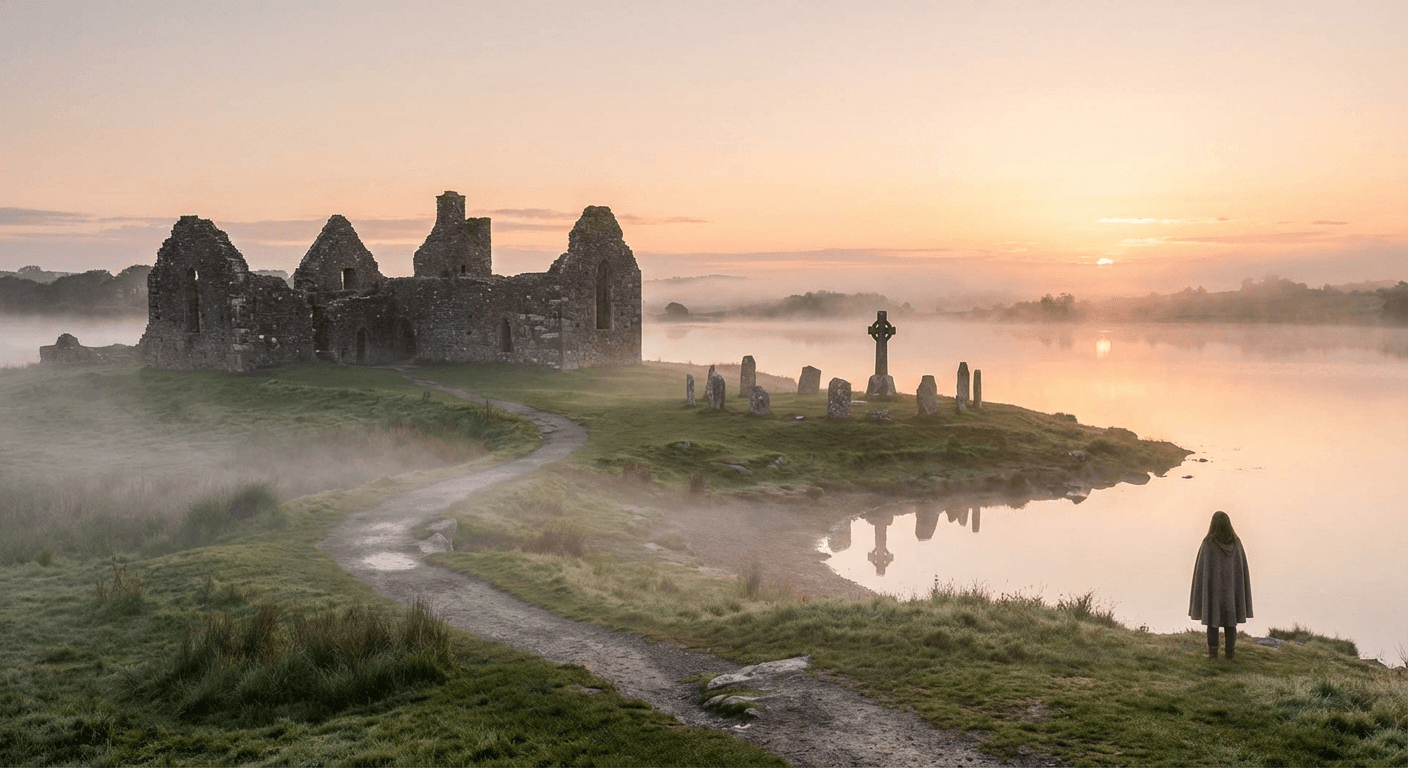
Ireland's sacred sites offer something increasingly rare in the modern world: the possibility of genuine encounter with the transcendent. Not packaged spirituality, not Instagram-friendly moments, but the real challenge of engaging with traditions that have tested human beings for millennia.
Whether you climb Croagh Patrick in penance, pray through the night at Lough Derg, kneel at a holy well in a forgotten hedgerow, or simply sit quietly among the ruins of Glendalough as the mist clears from the lakes, you are participating in practices that have shaped Irish identity since before recorded history.
What you find in these encounters depends on what you bring. The sites themselves are neutral — stone, water, earth, sky. The meaning emerges from the dialogue between place and pilgrim, between ancient tradition and contemporary seeking.
Sacred Ireland is not a destination you check off a list. It is an invitation to slow down, pay attention, and discover what emerges when you step outside ordinary time. The hermits of Skellig Michael knew this. The monks of Clonmacnoise knew this. The pilgrims climbing Croagh Patrick in the rain know this.
Explore Ireland’s Sacred Sites
This guide provides a comprehensive overview of sacred Ireland, but the real magic is in the details of each unique location. From remote island hermitages to ancient royal seats, these guides offer a deeper look into the history, mythology, and practical details of visiting each site.
- For Skellig Michael: Discover our guide to Skellig Michael.
- For Glendalough Visitor Guide: Discover our guide to Glendalough.
- For Clonmacnoise: Discover our guide to Clonmacnoise.
- For Newgrange & Knowth: Discover our guide to Newgrange.
- For The Rock of Cashel: Discover our guide to Rock of Cashel.
- For Climbing Croagh Patrick: Discover our guide to Croagh Patrick.
- For Holy Wells of Ireland: Discover our guide to Holy Wells of Ireland.
- For The Aran Islands (Inis Mór): Discover our guide to Aran Islands.
- For Lough Derg (Station Island): Discover our guide to Lough Derg.
- For The Hill of Tara: Discover our guide to Hill of Tara.
Table of Contents
Share this post
More from the Blog

Cork to Blarney Castle Day Trip: The Stone, the Gardens and What Else to See
Plan a Cork to Blarney Castle day trip. Kiss the stone, explore the Poison Garden, and add Cork city, Fota or Kinsale for a full day out.

Cork to Cobh Day Trip: Titanic, Colourful Houses and Harbour History
Plan a Cork to Cobh day trip by train, car or private driver. Explore Titanic history, St Colman's Cathedral, Spike Island and the best harbour views.

Cork to Killarney Day Trip: Lakes, Mountains and Muckross in One Day
A Cork to Killarney day trip is a longer escape into Kerry. Here's how to plan the drive, what to see in Killarney National Park, and why a private driver helps.