
Things to Do in Longford: Ireland's Most Overlooked County
Things to Do in Longford: Ireland's Most Overlooked County
There is a road in County Longford that was old before the Roman Empire existed. It runs across a bog near the village of Kenagh — eighteen metres of heavy oak planks, laid down in 148 BC by people who needed to cross ground that would swallow a horse. Two thousand years later, peat cutters found it almost exactly as it was left, the wood dark and dense and perfectly preserved in the airless wet. That single stretch of timber tells you something about Longford that no tourism website will: this is a county where extraordinary things have been happening quietly for a very long time, and almost nobody is paying attention.
Longford sits in the heart of Ireland's Hidden Heartlands: The Insider Guide to Ireland's Quietest Region, the stretch of midland Ireland that most visitors drive through on their way to the Atlantic coast. That's their loss. What they miss is a county of Iron Age engineering, medieval towers, literary heritage, and waterways so still you can hear a kingfisher before you see it. If you've already explored things to do in Roscommon or wandered the drumlins of things to do in Cavan, Longford is the natural next step deeper into the midlands — quieter still, and all the more rewarding for it.
The Corlea Trackway: Walking on 2,000-Year-Old Ground
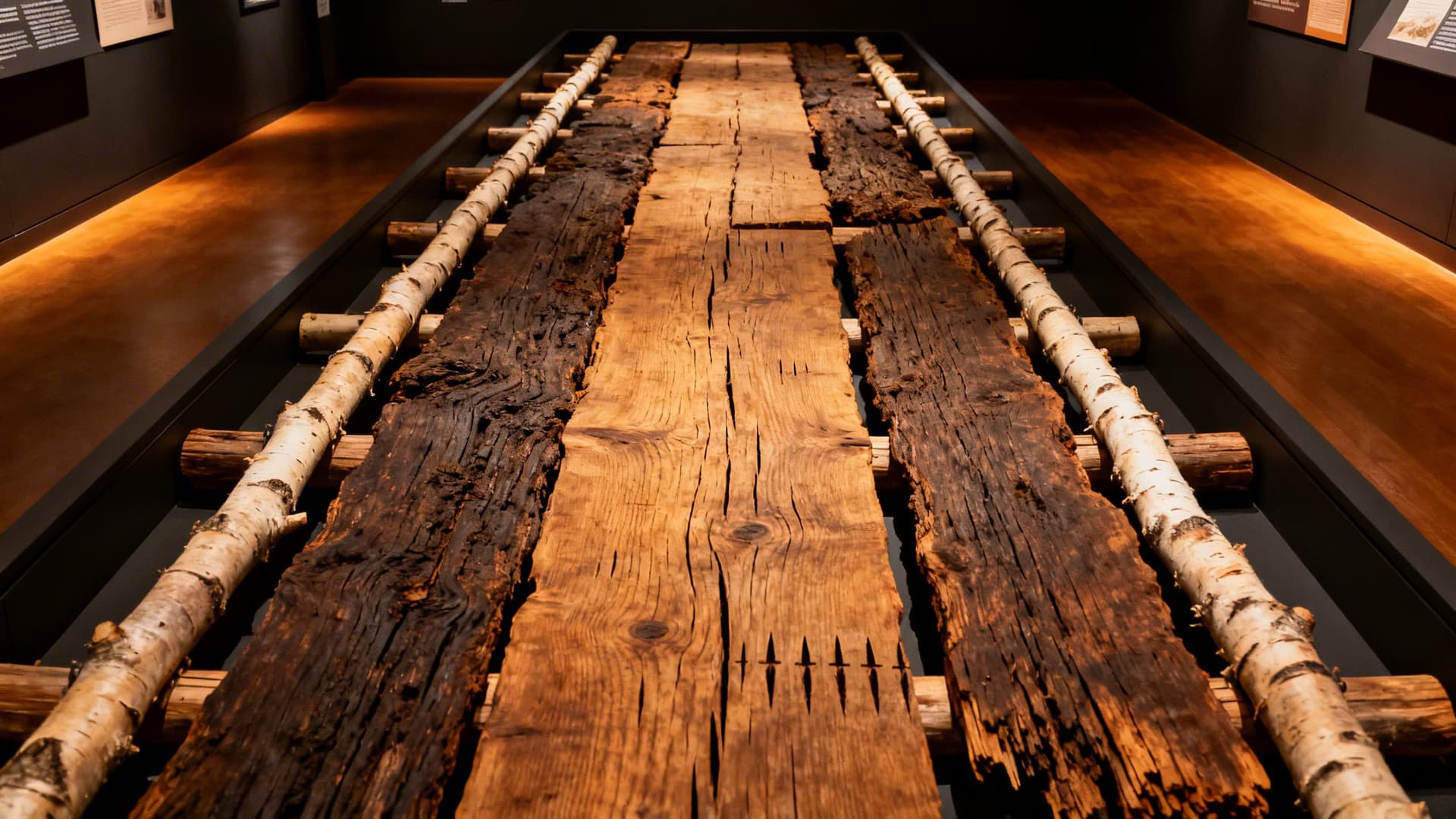
The Corlea Trackway Visitor Centre sits on a raised bog outside Kenagh, and from the car park it looks like any other midlands heritage centre — low-slung, modest, well-kept. Inside is something that stops you mid-step. An eighteen-metre section of Iron Age road, the largest of its kind ever excavated in Europe, preserved in a purpose-built humidity-controlled hall where the air feels thick and faintly sweet.
The road was built in 148 BC — dendrochronology pins it to a single year. Heavy oak planks, each one wide enough to take a cart, were laid across birch rails to bridge the soft bog between the Hill of Uisneach and Rathcroghan, linking two of the most sacred sites in ancient Ireland. The planks sank almost immediately under their own weight. The bog swallowed them, sealed them in airless peat, and held them for over two thousand years until a group of peat workers cutting turf in 1984 struck wood where there should have been none.
Standing in the hall, looking down at timber that was felled and shaped before Julius Caesar was born, the scale of it lands differently than reading about it. The grain of the oak is still visible. The tool marks are still sharp. Entry to the centre is free, and the guided tours run by local staff are worth every minute — they know the bog the way only people who grew up cutting turf on it can.
St Mel's Cathedral: Restored from the Ashes
On Christmas morning 2009, an electrical fault in the boiler room of St Mel's Cathedral in Longford town started a fire that no one noticed until it was too late. By the time the flames were out, the interior had reached 1,100 degrees Celsius. The roof was gone. The organ was destroyed. Marble cracked in the heat. Longford had lost its cathedral.
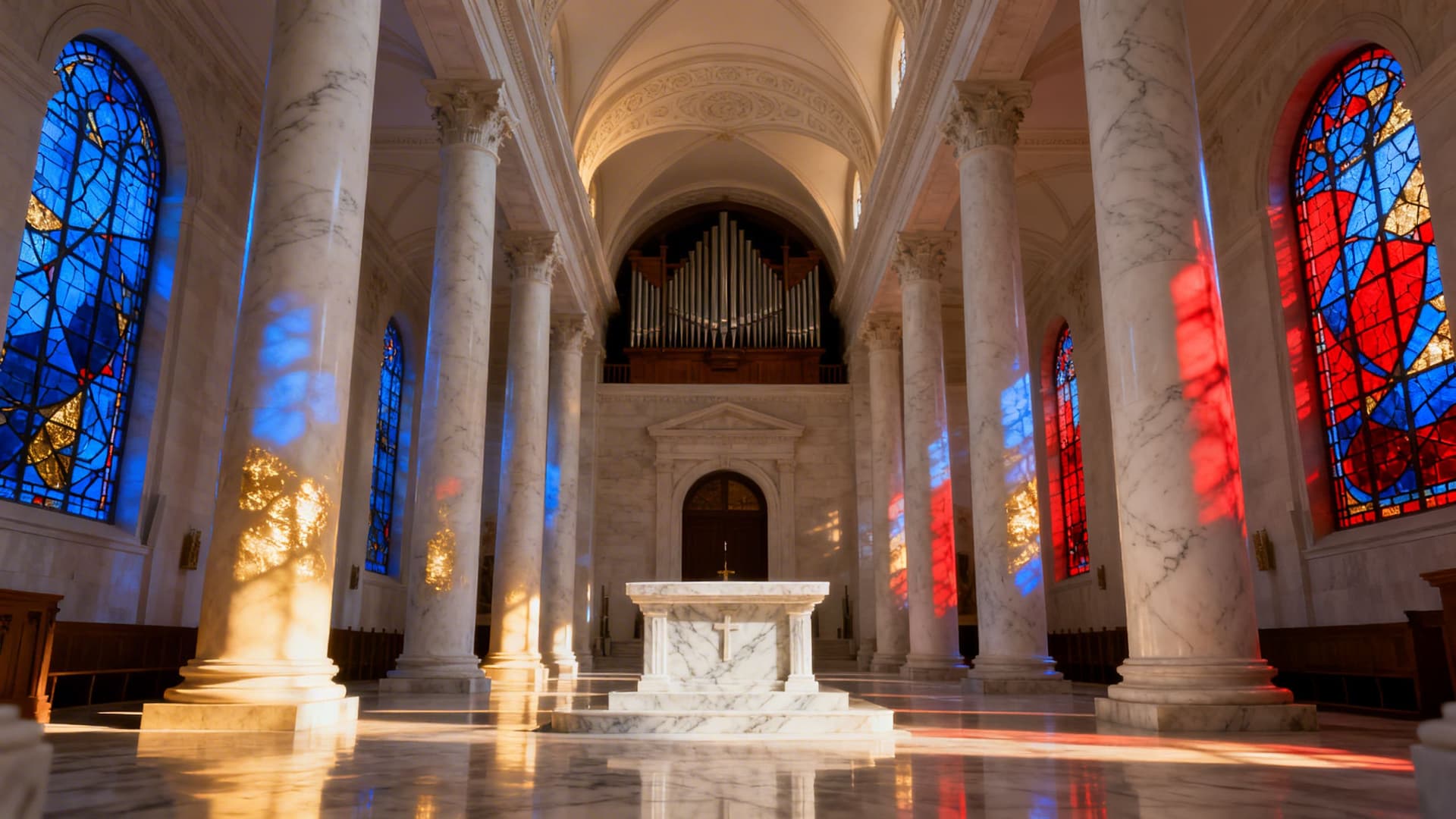
What happened next took five years and thirty million euro. The restoration of St Mel's became the largest cathedral restoration project in Europe — a distinction it held until Notre-Dame burned a decade later. When the doors reopened on Christmas Day 2014, exactly five years after the fire, Longford had something extraordinary: a neoclassical cathedral fitted with art and craft that rank among the finest in any church in Ireland.

The Carrara marble altar by Tom Glendon anchors the sanctuary. Above, Kim en Joong's abstract stained glass pours colour across the nave in a way the original Victorian windows never did. The silver tabernacle by Imogen Stuart — one of Ireland's most important sculptors — survived the fire and sits restored at the centre. Behind you, a 2,307-pipe organ built by Fratelli Ruffatti in Padua fills the building with sound you feel in your chest. The cathedral is open daily and there is no charge. Most visitors to Longford town walk past it.
Granard Motte: The Highest Norman Fort in Ireland
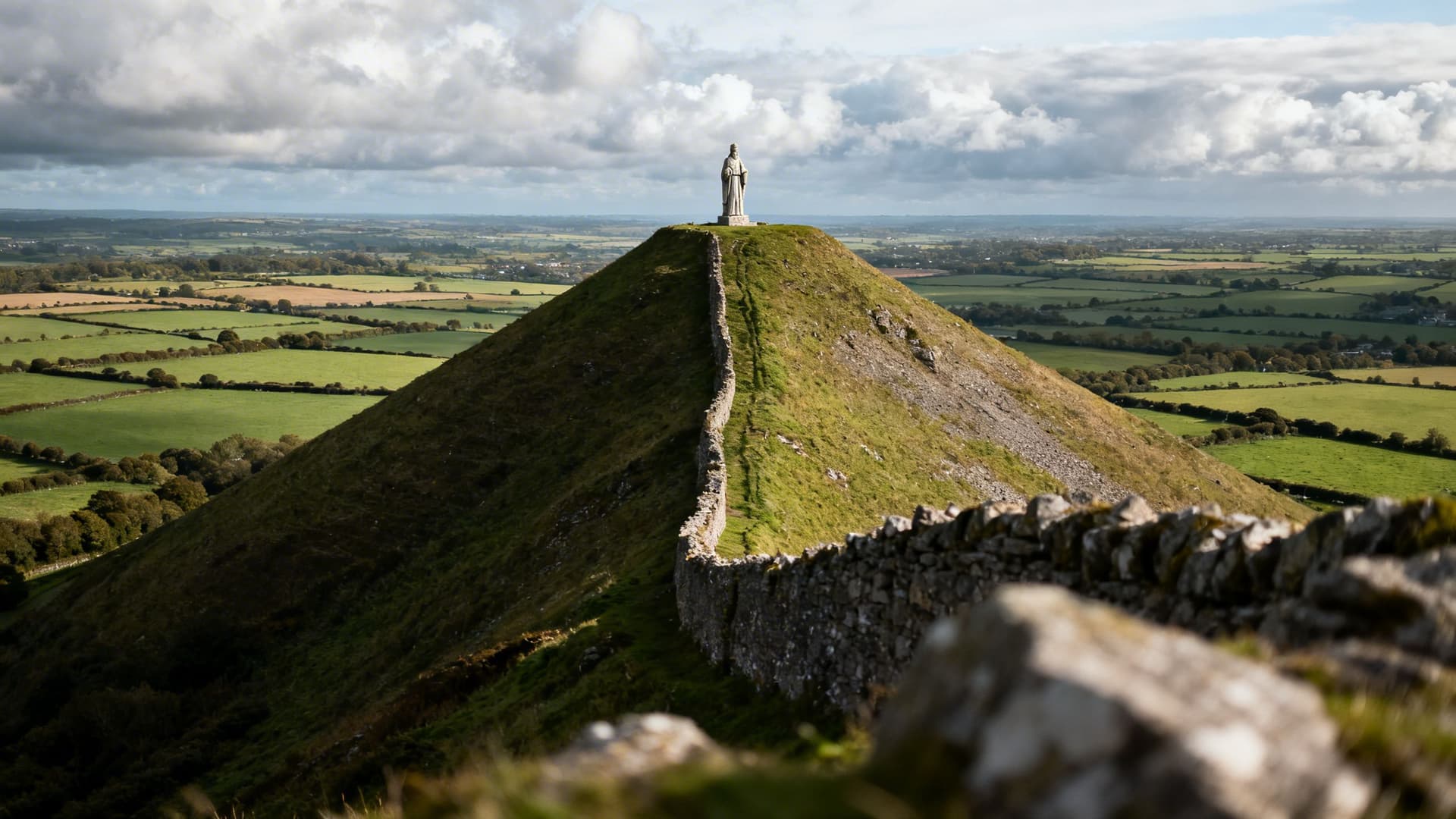
The motte at Granard is visible from a long way off, which is precisely the point. At 535 feet above sea level, it is the highest motte-and-bailey fortification in Ireland, built in 1199 by the Norman knight Richard Tuite on the site of an older Irish ringfort. The Normans understood something that the people before them also understood: whoever holds this hill controls the view in every direction.
The climb is short but steep. At the top, a statue of St Patrick — erected in 1932 for the Eucharistic Congress — stands against whatever weather is coming in from the west. On a clear day the view reaches across the midlands to counties you wouldn't think you could see from here. The Knights & Conquests Heritage Centre at the base of the motte, opened in 2018, covers the Norman period in the region with enough depth and local detail to hold your attention.
Granard itself is a market town that has kept its shape without losing its character. If you're driving through County Longford, the motte alone is worth the stop — but the town rewards a slower pace.
The Royal Canal Greenway and Cloondara
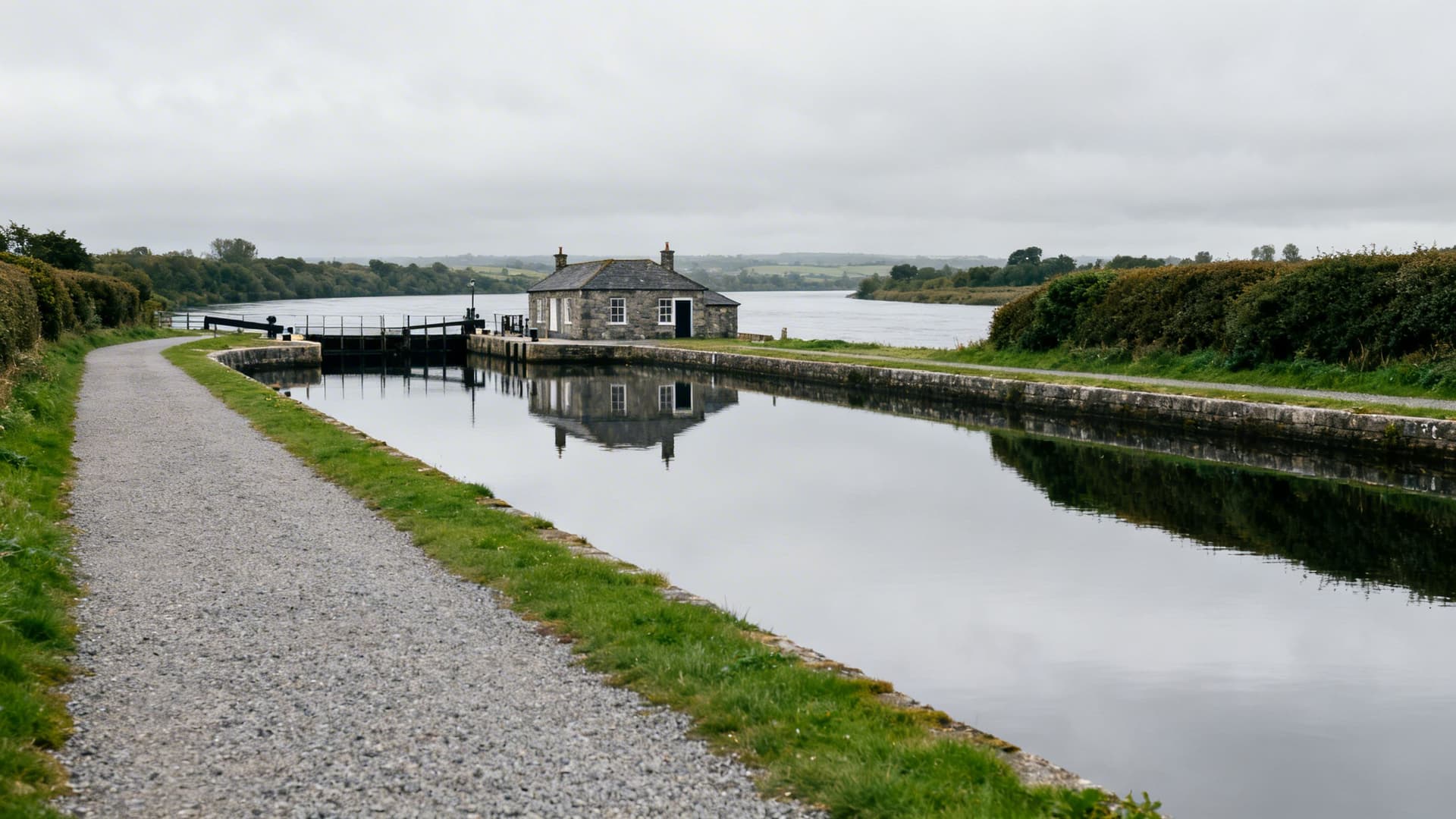
The Royal Canal Greenway runs 130 kilometres from Dublin to the village of Cloondara on a flat towpath that follows the canal's original route. By the time the path reaches Longford, the suburbs and commuter towns are long gone. What's left is water, hedgerow, and a silence that sits comfortably on the landscape.
Cloondara — Cluain Dá Ráth, the pasture of two ringforts — is where the Royal Canal meets the River Shannon, and it has the particular stillness of a place that was once busier than it is now. Richmond Harbour, at the heart of the village, was the canal's western terminus when the waterway finally reached here in 1817. The harbour is named for the Duke of Richmond, and in the 1830s a distillery nearby was producing seventy thousand gallons of whiskey a year. The distillery is long gone. The harbour remains, and so does the feeling of a village built around water and shaped by it.
The Midlands Cycle Hub operates from the greenway, offering bike hire for day trips along the towpath. The riding is flat, the surface is good, and the pace is whatever you want it to be. Cloondara makes a natural turnaround point — or a place to stop, sit by the harbour wall, and watch the light change on the water. If you've cycled sections of the things to do in Westmeath greenway trails, the Longford stretch offers the same quality with a fraction of the traffic.
The Maria Edgeworth Centre: A Literary Tradition Older Than You Think

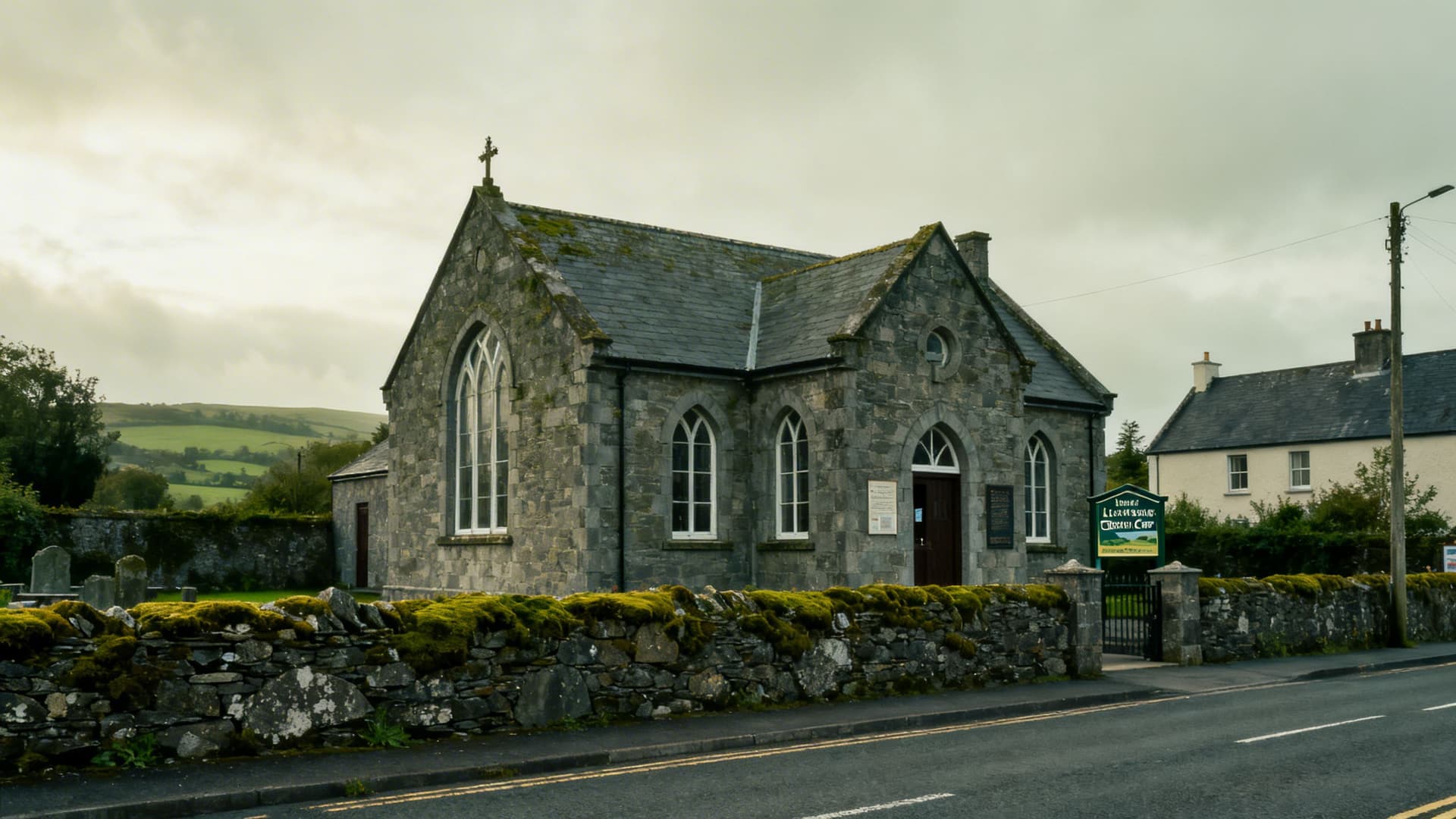
Edgeworthstown — or Mostrim, to use its older name — sits in the middle of County Longford and has been producing writers since before the word "novelist" meant what it means now. Maria Edgeworth, born in 1768, wrote fiction that was admired by Wordsworth, Walter Scott, and Jane Austen. Her novel Castle Rackrent, published in 1800, is widely considered the first regional novel in English literature. She lived and worked in Edgeworthstown for most of her life, and the town has not forgotten.
The Maria Edgeworth Centre occupies one of the oldest national school buildings in Ireland, dating to 1841. Inside, interactive displays in seven languages cover Edgeworth's life, her writing, and the wider literary connections that run through the town like roots under a road. A heritage and literary walk links the centre to sites associated with Oliver Goldsmith and Oscar Wilde, both of whom have connections to this stretch of the midlands that tend to surprise people who think Irish literary history begins and ends in Dublin.
The centre is small, personal, and run by people who care about the story they're telling. It is not a major tourist attraction. That is part of what makes it good.
Newcastle Wood and the Shannon Callows
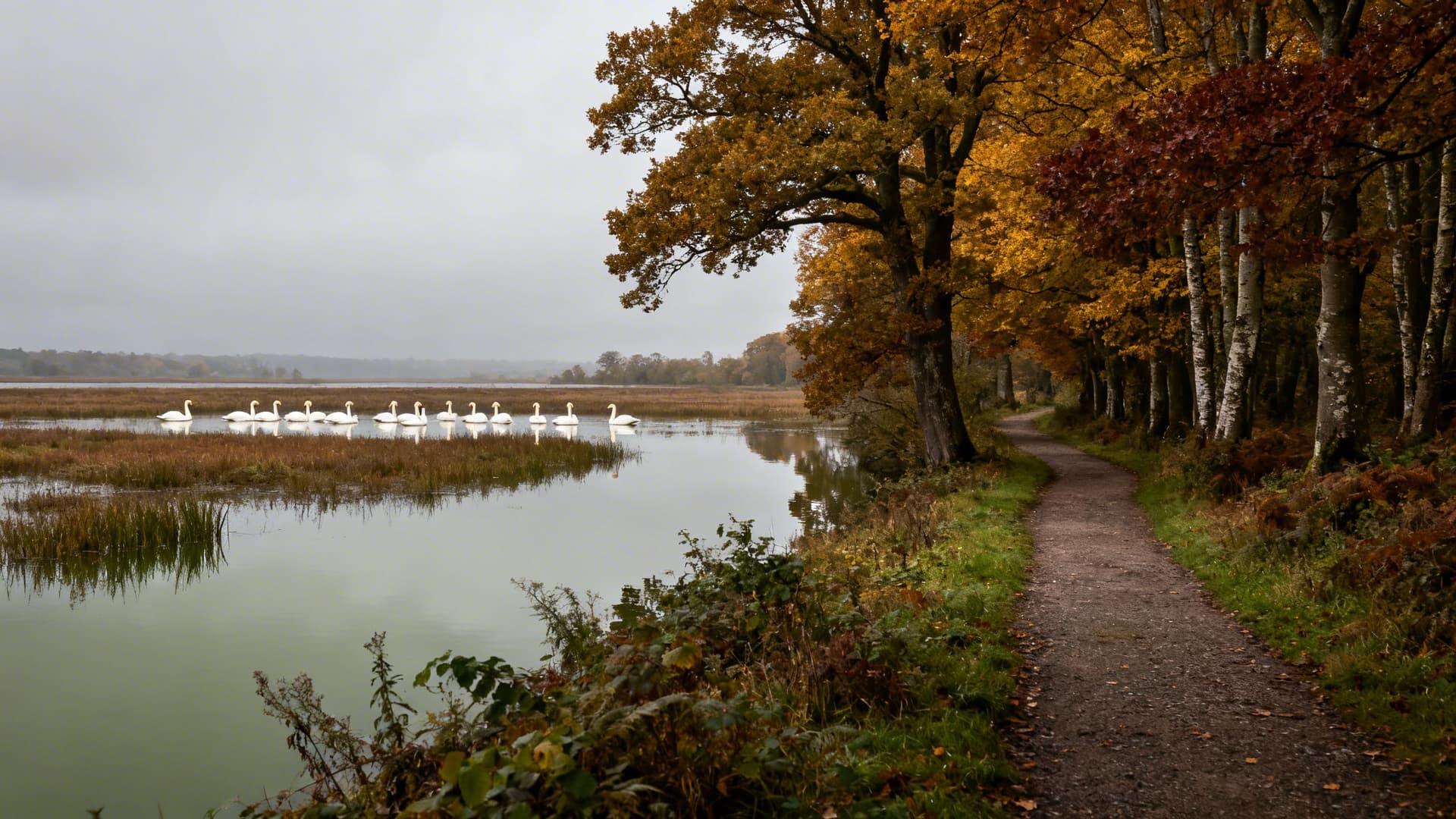
South of Longford town, Newcastle Wood rises along the western shore of Lough Ree in a tangle of oak, ash, and beech that feels older and wilder than its managed trails might suggest. The forest walks here range from short lakeside loops to longer routes that climb through the canopy and open out onto views of Lough Ree stretching south towards Athlone. In autumn, the colours are extraordinary — not in a dramatic, New England way, but in the quiet, saturated way that Irish deciduous woodland does it, where the light is always soft and the greens hold on longer than you expect.
Beyond the wood, the Shannon Callows — the seasonal floodplains that line the river — are among the most important wetland habitats in Europe. In winter, the callows flood and become a haven for whooper swans migrating from Iceland. In summer, the grasslands support corncrake populations that have vanished from most of the rest of Ireland. This is not manicured nature. It is working landscape that happens to be ecologically significant, and walking through it in the right season, with the right guide, is one of the finest things you can do in the Irish midlands.
Why You Need a Local Guide in Longford
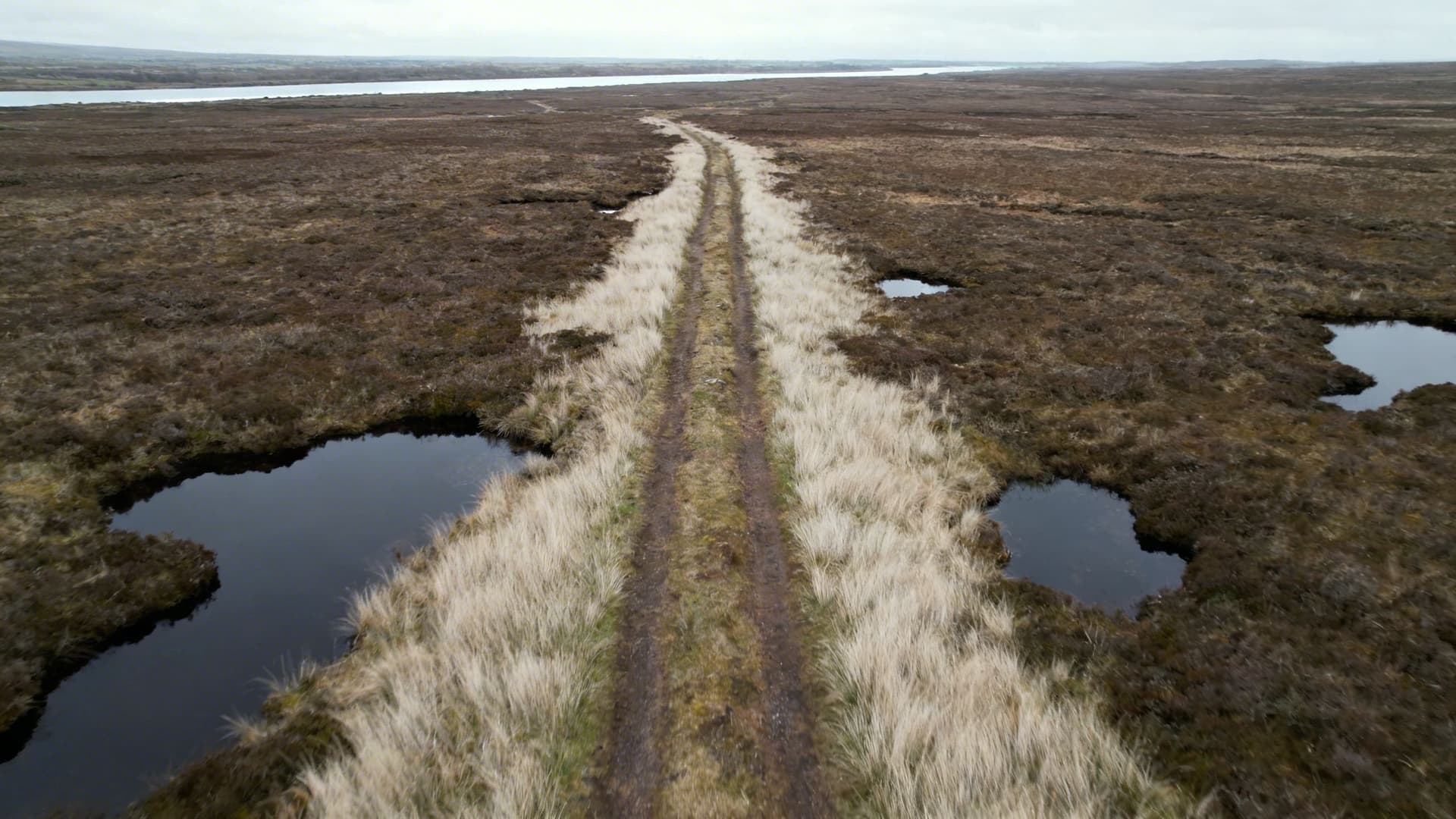
Longford's best experiences are not well signposted. The Corlea Trackway centre is easy enough to find, but the surrounding boglands — where other trackways have been discovered and where the landscape itself tells a story — are not the kind of place you navigate with Google Maps. The Shannon Callows are beautiful but unmarked, and knowing when the corncrakes are calling or where the swans gather requires someone who watches the seasons here year after year.
A local guide for Ireland's Hidden Heartlands turns Longford from a list of stops into a connected story. They know which farmer's lane leads to the best view of the callows. They know the back roads to Granard that avoid the N-roads entirely. They know the bog the way their parents knew it — not as scenery, but as ground they've walked on since they were children. That kind of knowledge doesn't appear on any app, and it is the difference between visiting Longford and understanding it.

Frequently Asked Questions
Is Longford worth visiting?
Longford is one of the most underrated counties in Ireland. It holds the largest excavated Iron Age road in Europe, the highest Norman motte in the country, a cathedral restored to standards that rival any in Ireland, and some of the quietest waterways and wetlands on the Shannon. It lacks the dramatic coastal scenery of the west, but for history, heritage, and genuine solitude, few Irish counties offer as much with as few crowds.
How do I get to Longford?
Longford town is roughly 120 kilometres west of Dublin on the N4, making it about a ninety-minute drive. Irish Rail operates direct services from Dublin Connolly to Longford station, with the journey taking around two hours. The Royal Canal Greenway also connects Dublin to Cloondara in Longford for cyclists willing to make a multi-day trip of it.
What is the Corlea Trackway?
The Corlea Trackway is an Iron Age bog road built in 148 BC, discovered by peat cutters in 1984 near the village of Kenagh in County Longford. An eighteen-metre section is preserved in a purpose-built humidity-controlled visitor centre. It is the largest excavated trackway of its kind in Europe, and entry to the centre is free.
Can you cycle the Royal Canal Greenway in Longford?
Yes. The Royal Canal Greenway passes through County Longford on its 130-kilometre route from Dublin to Cloondara. The towpath is flat and surfaced, suitable for all fitness levels. Bike hire is available through the Midlands Cycle Hub. The Longford section runs from Longford town to Cloondara, where the canal meets the Shannon at Richmond Harbour.
Your Next Step into the Midlands
Longford asks very little of you and gives back more than you'd expect. It is a county built for the kind of traveller who finds a two-thousand-year-old road in a bog more interesting than a crowded cliff walk — and who understands that the quietest places often have the most to say. Start at Corlea, end at Cloondara, and let the county fill in the space between.
For more of Ireland's overlooked midlands, explore our full guide to Ireland's Hidden Heartlands: The Insider Guide to Ireland's Quietest Region, or discover what's waiting in things to do in Leitrim — Longford's neighbour to the north, where the drumlins give way to mountains and the silence gets even deeper.
Ready to see Longford the way only a local can show it? Browse our local guide for Ireland's Hidden Heartlands and find someone who knows these bogs, waterways, and back roads like the back of their hand.
Table of Contents
Share this post
More from the Blog

Cork to Blarney Castle Day Trip: The Stone, the Gardens and What Else to See
Plan a Cork to Blarney Castle day trip. Kiss the stone, explore the Poison Garden, and add Cork city, Fota or Kinsale for a full day out.

Cork to Cobh Day Trip: Titanic, Colourful Houses and Harbour History
Plan a Cork to Cobh day trip by train, car or private driver. Explore Titanic history, St Colman's Cathedral, Spike Island and the best harbour views.

Cork to Killarney Day Trip: Lakes, Mountains and Muckross in One Day
A Cork to Killarney day trip is a longer escape into Kerry. Here's how to plan the drive, what to see in Killarney National Park, and why a private driver helps.