
Things to Do in Roscommon: 8 Reasons This Overlooked County Deserves Your Time
Things to Do in Roscommon: 8 Reasons This Overlooked County Deserves Your Time
Roscommon does not make promises it cannot keep. There are no clifftop selfie spots, no queues for famous pubs, no bus parks full of coaches with their engines running. What there is, instead, is a county shaped by cattle pasture and cut bog, by medieval monastic ruins standing open to the weather, and by a royal history so deep that the seat of the ancient kings of Connacht sits in a field outside Tulsk with barely a sign to mark it. Roscommon is where Ireland slows to a walking pace — and where the things worth finding are the things that never made it onto a postcard.
If you are planning a wider journey through the midlands, Ireland’s Hidden Heartlands: The Insider Guide to Ireland’s Quietest Region connects Roscommon to its neighbouring counties and explains why this part of Ireland rewards the traveller willing to leave the motorway.
Rathcroghan: The Ancient Royal Capital of Connacht
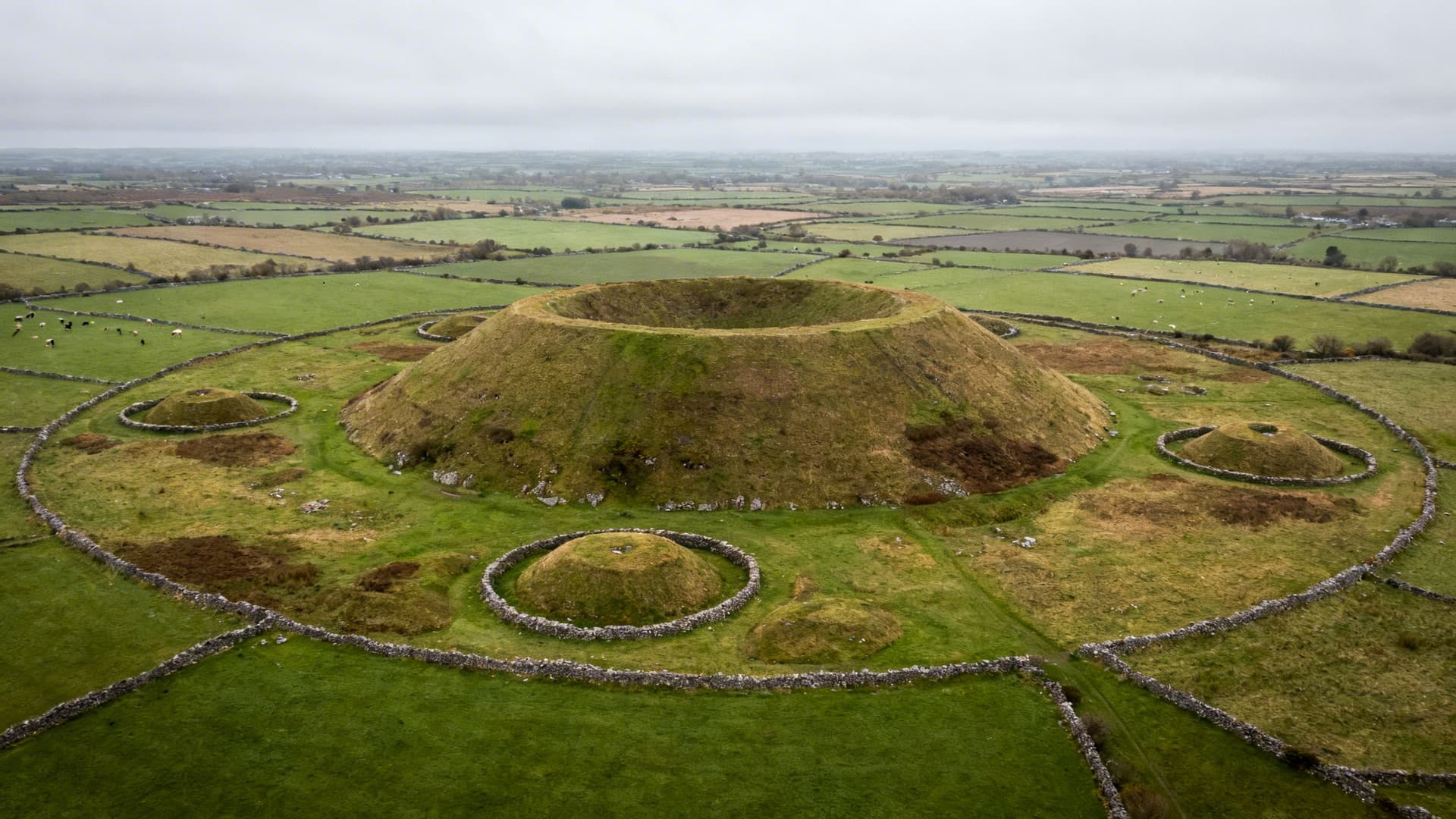
This is not a reconstructed heritage site with a visitor centre and a gift shop. Rathcroghan is a complex of over sixty archaeological monuments spread across open farmland near Tulsk — ringforts, burial mounds, standing stones, and the reputed entrance to the Celtic otherworld — and almost none of it is signposted. The site was the inauguration place of the kings and queens of Connacht for over two thousand years, and it features prominently in the Táin Bó Cúailnge, Ireland’s oldest epic.
The Rathcroghan Visitor Centre in Tulsk is the starting point. The guided tours run from here across the fields to the key monuments, including Rathcroghan Mound itself — a massive raised circular earthwork that functioned as a ceremonial platform — and Oweynagat, the Cave of the Cats, a narrow souterrain that Irish mythology identifies as the gateway to the underworld. You crawl in through a low opening in a farmer’s field and emerge into a passage grave older than the pyramids. It is not for the claustrophobic. It is extraordinary.
Roscommon Castle: The Norman Stronghold
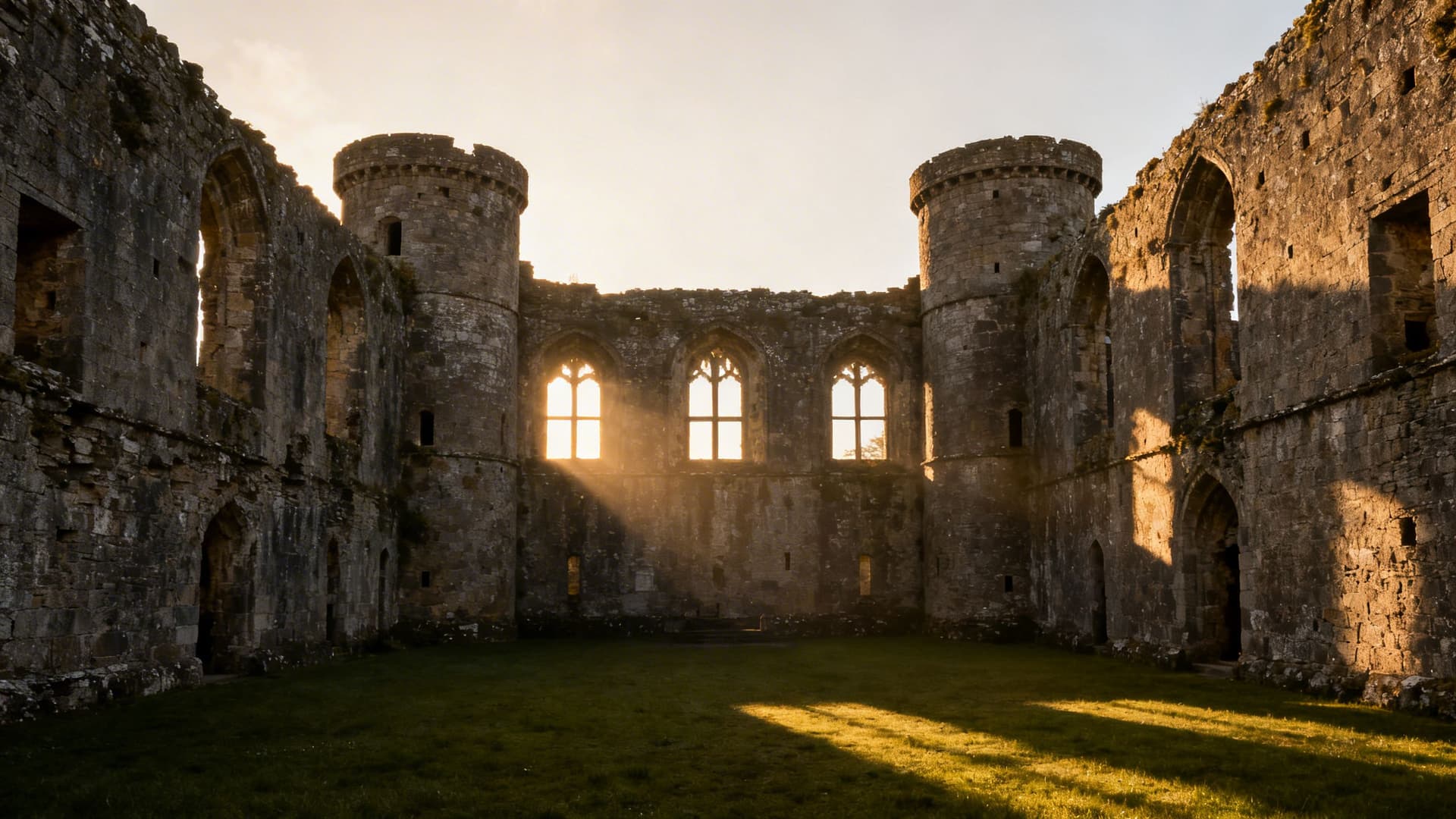
The castle sits on the edge of Roscommon town, visible from the main road but visited by surprisingly few. Built in 1269 by the Norman justiciar Robert d’Ufford, it was captured and recaptured so many times over the following centuries that its history reads like a list of sieges. The O’Connors took it. The English took it back. Cromwell’s forces finally reduced it in the 1650s.
What remains is a large quadrangular ruin with twin D-shaped drum towers at each corner — a defensive design that was advanced for its time. The interior is open to the sky, and you can walk through the gate passage and along the base of the walls with no barriers and no admission charge. In the early morning, when the light comes in low through the eastern windows and there is no one else there, it has the quality of a place that has simply been left behind by time.
Boyle Abbey: Where the Cistercians Built in Stone
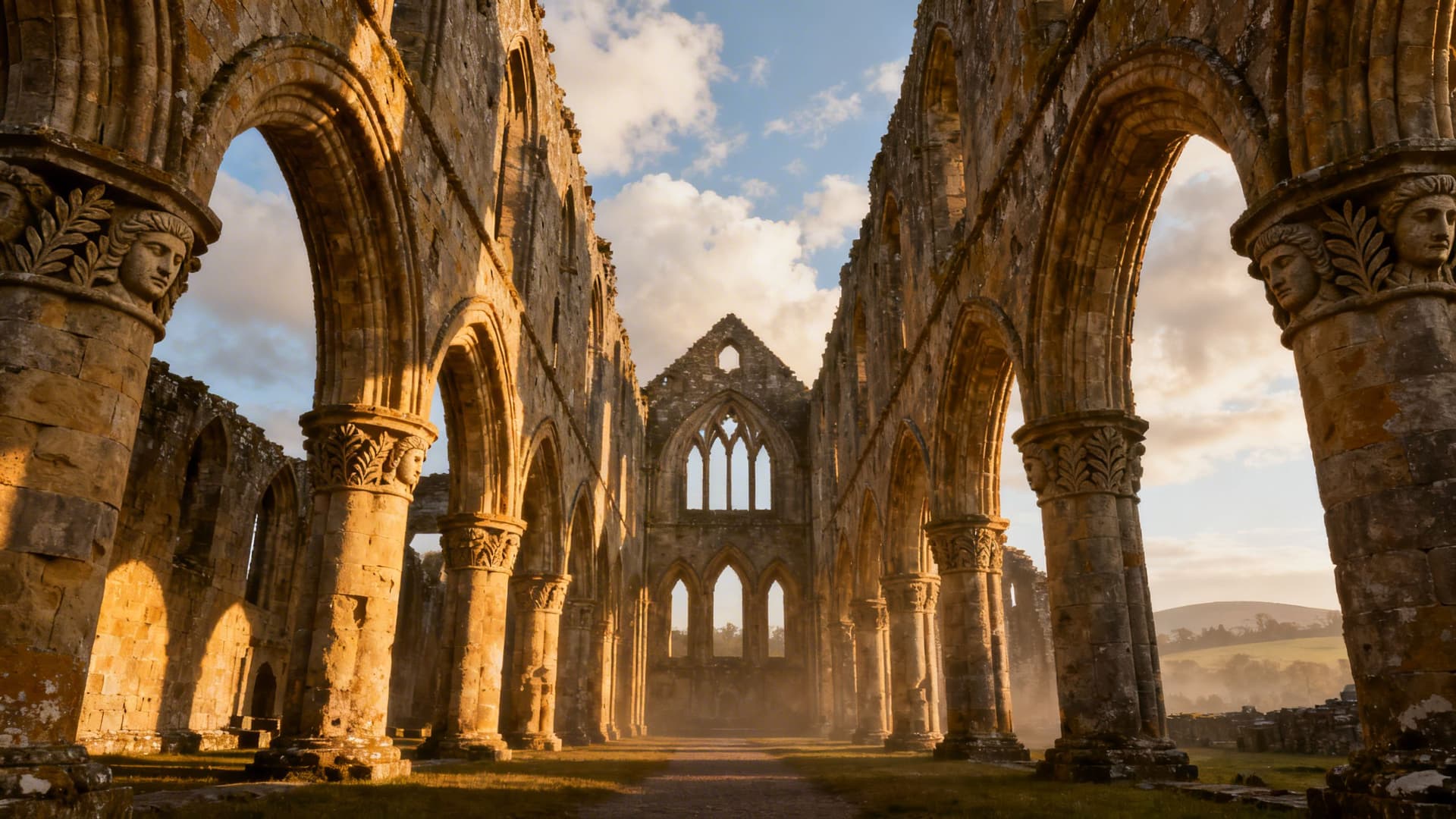
Boyle Abbey is one of the best-preserved Cistercian monasteries in Ireland, and its survival is partly due to its remoteness — it sits at the northern edge of Roscommon, on the bank of the Boyle River, in a town that most cross-country travellers pass through without stopping. The abbey was founded in 1161 and took over fifty years to build, which explains why the architecture shifts visibly from Romanesque to Gothic as you walk from the nave to the chancel. The masons changed style mid-construction. You can see the transition in the arches.
The cloister is gone, but the church itself is remarkably intact — the carved capitals on the columns include human faces, animals, and foliage patterns that rank among the finest Romanesque carving in Ireland. The OPW maintains the site, and entry is free outside peak season. In summer, a guide is sometimes present, but even without one, the building speaks clearly enough on its own.
Lough Key Forest Park: The Outdoor Centre of the County
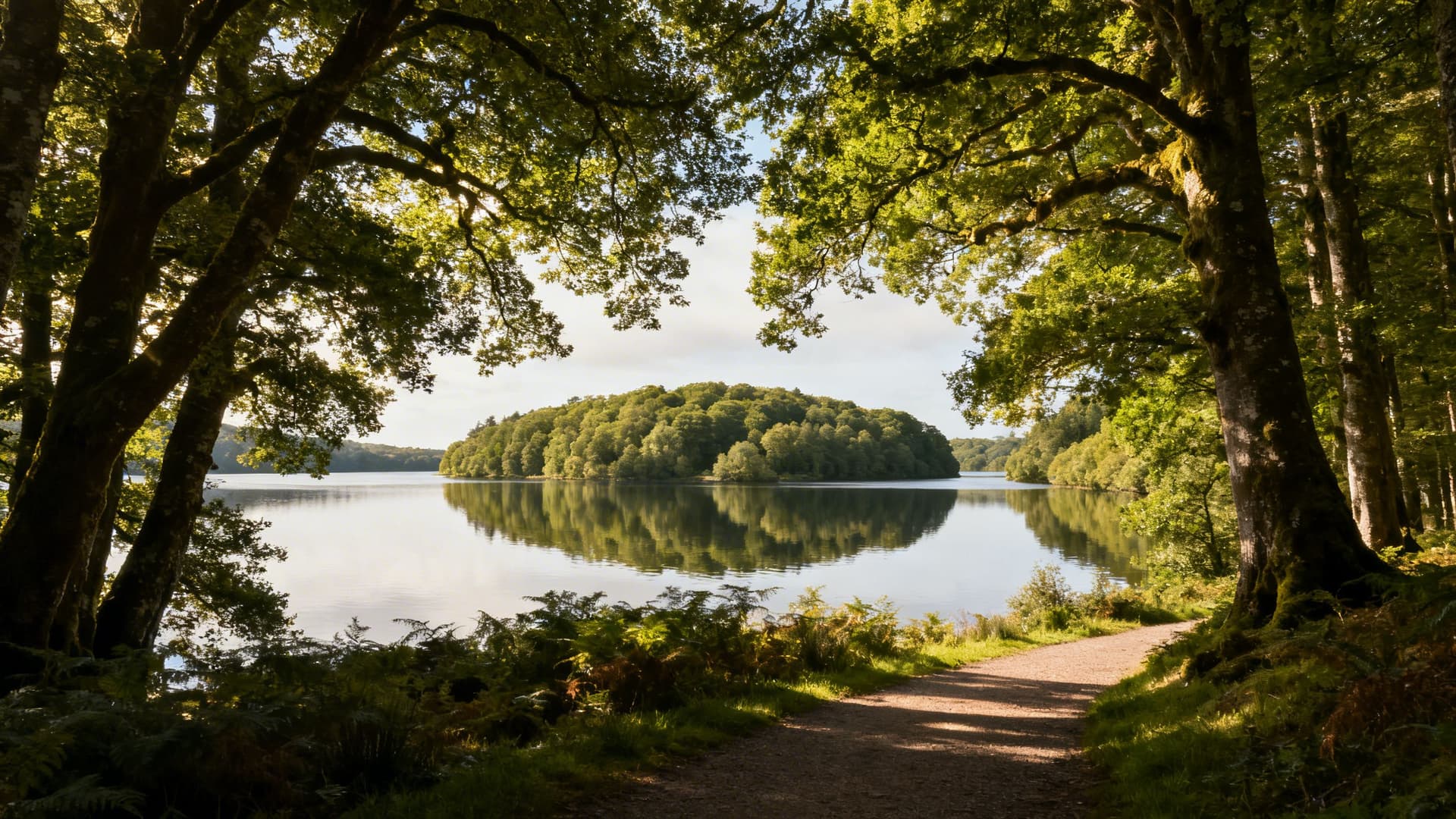
Lough Key is where Roscommon’s landscape shifts from flat pasture to wooded lakeshore. The forest park covers over 350 hectares on the shores of Lough Key itself — a large, island-dotted lake connected to the Shannon navigation system. The park has been developed with walking trails, a tree canopy walk (the only one in Ireland), adventure playgrounds, and boat hire facilities, but the scale of the place absorbs the infrastructure. Walk ten minutes from the main car park and you are alone in mature beech and oak woodland with the lake glinting through the trees.
The ruins of Rockingham House — a John Nash-designed mansion that burned in 1957 — add an unexpected architectural layer. The underground tunnels that once connected the house to the estate buildings are now part of the Boda Borg puzzle challenge. For families, it is a full day. For walkers, the lakeshore trails and the longer Moylurg Tower route give you the landscape without the crowds that gather at Killarney or Glendalough.
Strokestown Park House and the Famine Museum
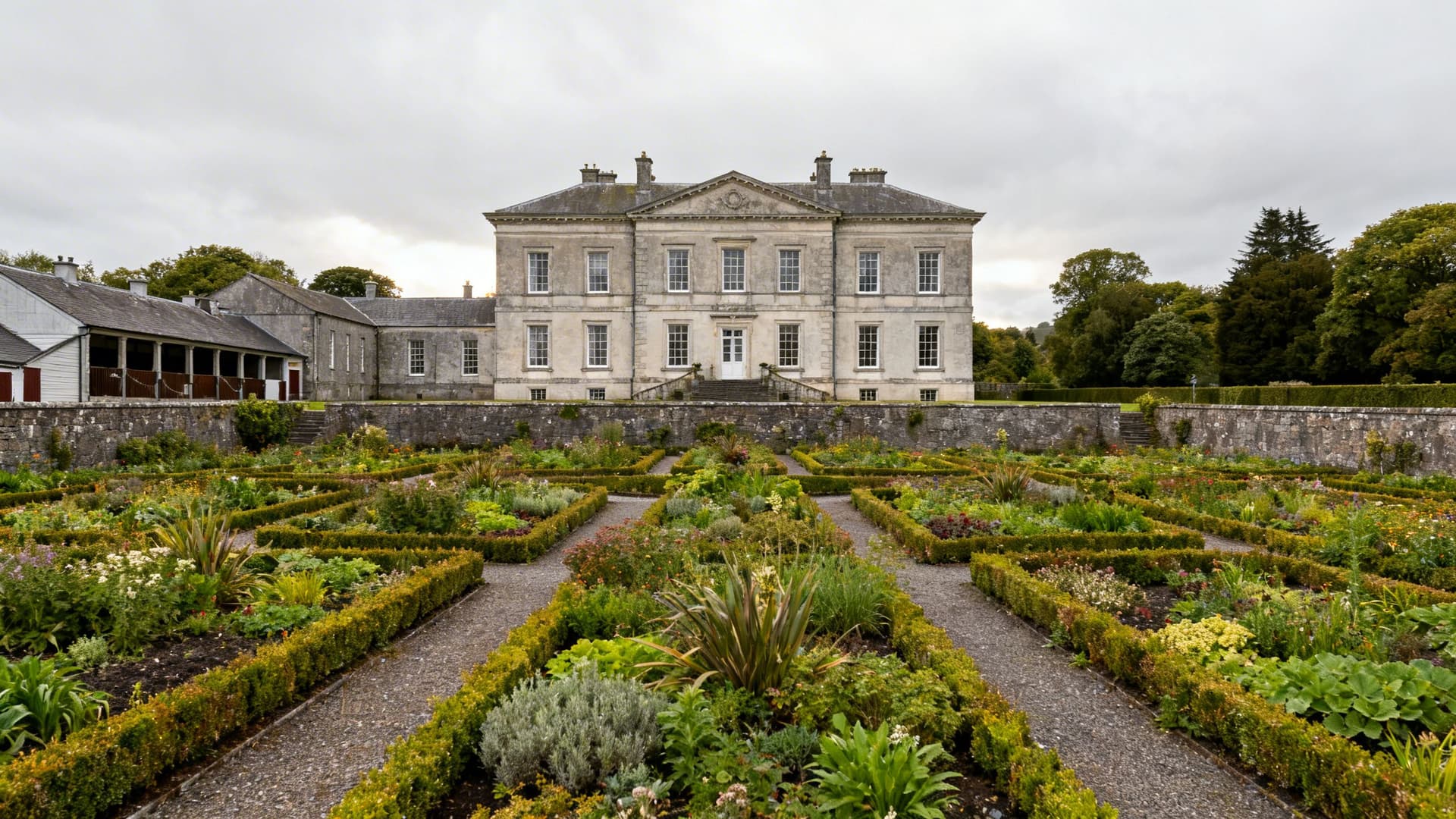
Strokestown Park is an original Palladian mansion with a documented link to one of the darkest chapters in Irish history. The house itself is impressive — the kitchen still has its gallery where the lady of the house could observe the servants without descending, a detail that says more about the Anglo-Irish class divide than any exhibition panel could. The walled garden, recently restored, is one of the longest in Ireland.
But it is the National Irish Famine Museum, housed in the stable yards, that gives Strokestown its real weight. The museum uses documents from the Strokestown estate archive — landlord correspondence, eviction notices, rent ledgers — to tell the Famine story not through statistics but through the actual paper trail of a single estate. For diaspora visitors tracing family history through the midlands, this is one of the most important heritage sites in Ireland. It connects the personal to the political in a way that no general history museum can.
Derryglad Folk and Heritage Museum
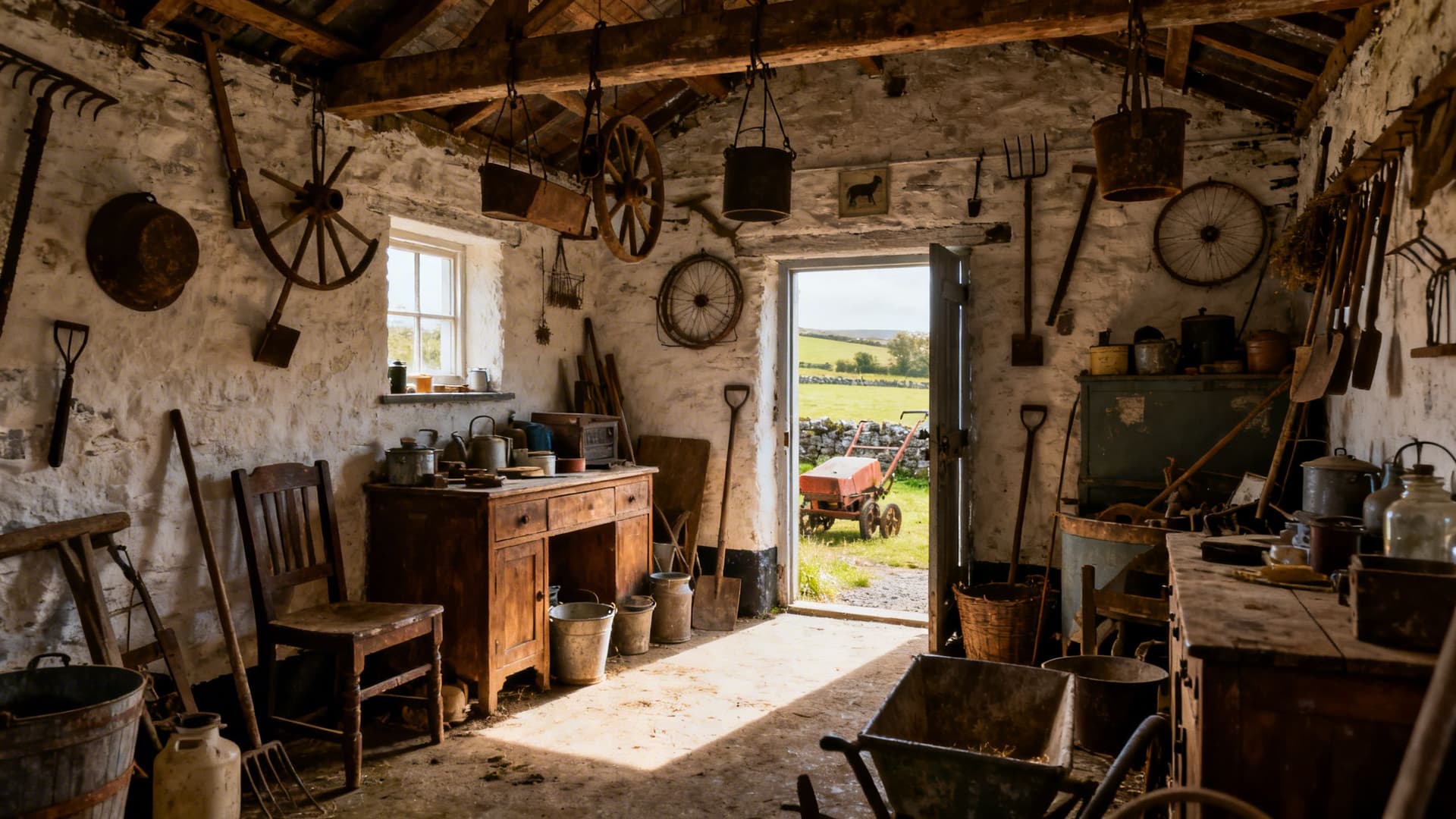
Just outside Curraghboy, on a quiet road south of Athlone, the Derryglad Museum sits on a working farm and contains one of the most eccentric and comprehensive private collections of rural Irish life you will find anywhere. Farm implements, domestic objects, forge equipment, bog butter containers, handmade furniture — thousands of items collected over decades by one family, displayed in a series of restored outbuildings.
There is no slick presentation here. The charm is in the accumulation — the sense that nothing was thrown away, and everything meant something to someone. For visitors interested in how ordinary rural Irish people lived before electrification and mechanisation, Derryglad is a quiet revelation. Ring ahead — it is family-run and opens by arrangement.
Walking the Suck Valley Way
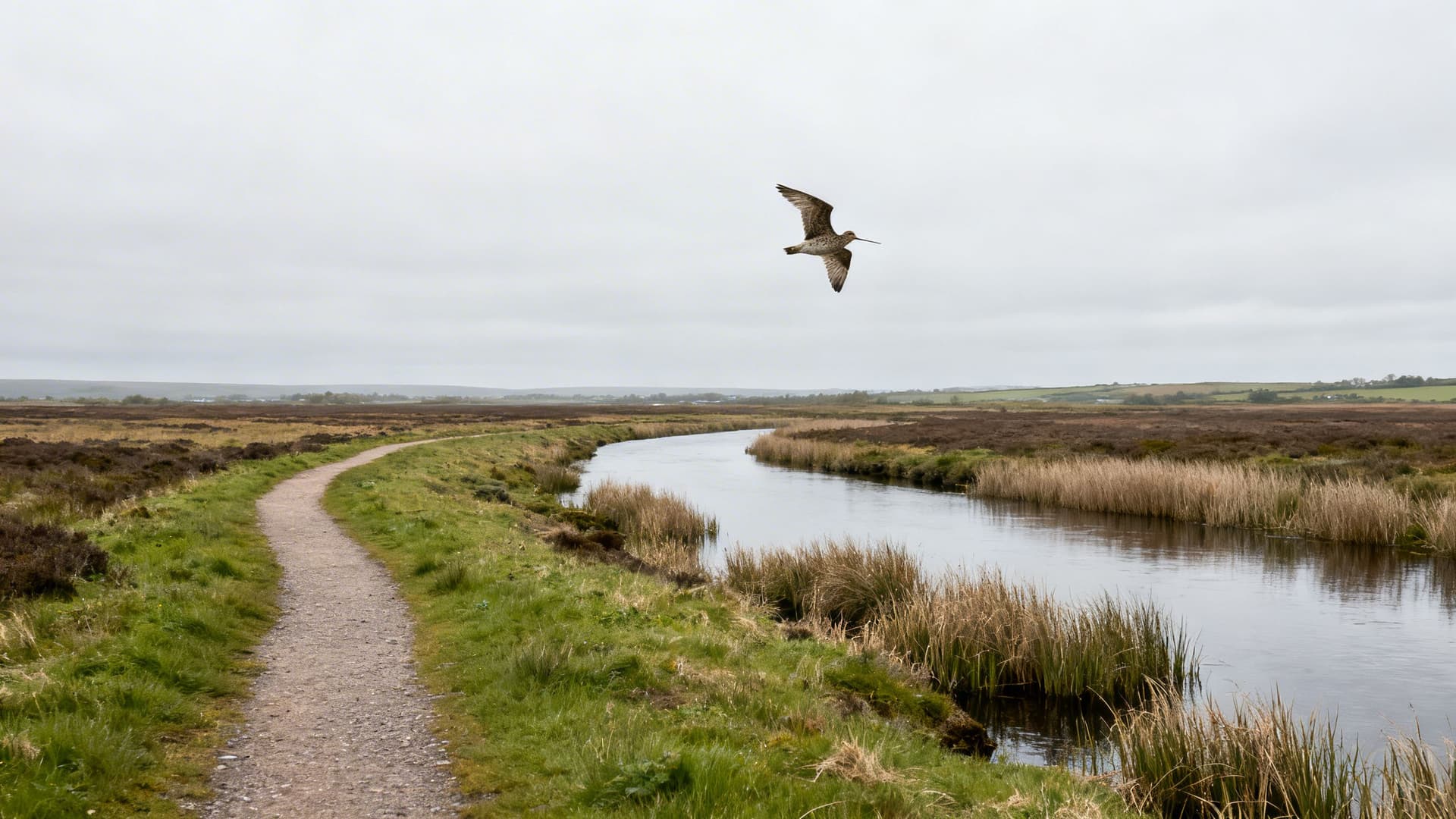
The River Suck — the name is Old Irish, meaning “sedge” — forms the eastern boundary of Roscommon, flowing south to meet the Shannon at Shannonbridge. The Suck Valley Way is a waymarked walking trail that follows the river through flat bogland, riverside meadows, and small farming communities. It is not dramatic walking. There are no mountains, no cliff edges, no dramatic elevation changes. What there is instead is the particular beauty of a flat landscape under a wide sky — the kind of walking where the horizon stretches in every direction and the only sound is curlew and water.
The full trail is over 70 kilometres, but shorter sections between Castlerea and Ballaghaderreen or along the riverbank near Athleague make for manageable day walks. This is walking for people who find peace in open space, not adrenaline in altitude.
Why You Need a Local Guide in Roscommon
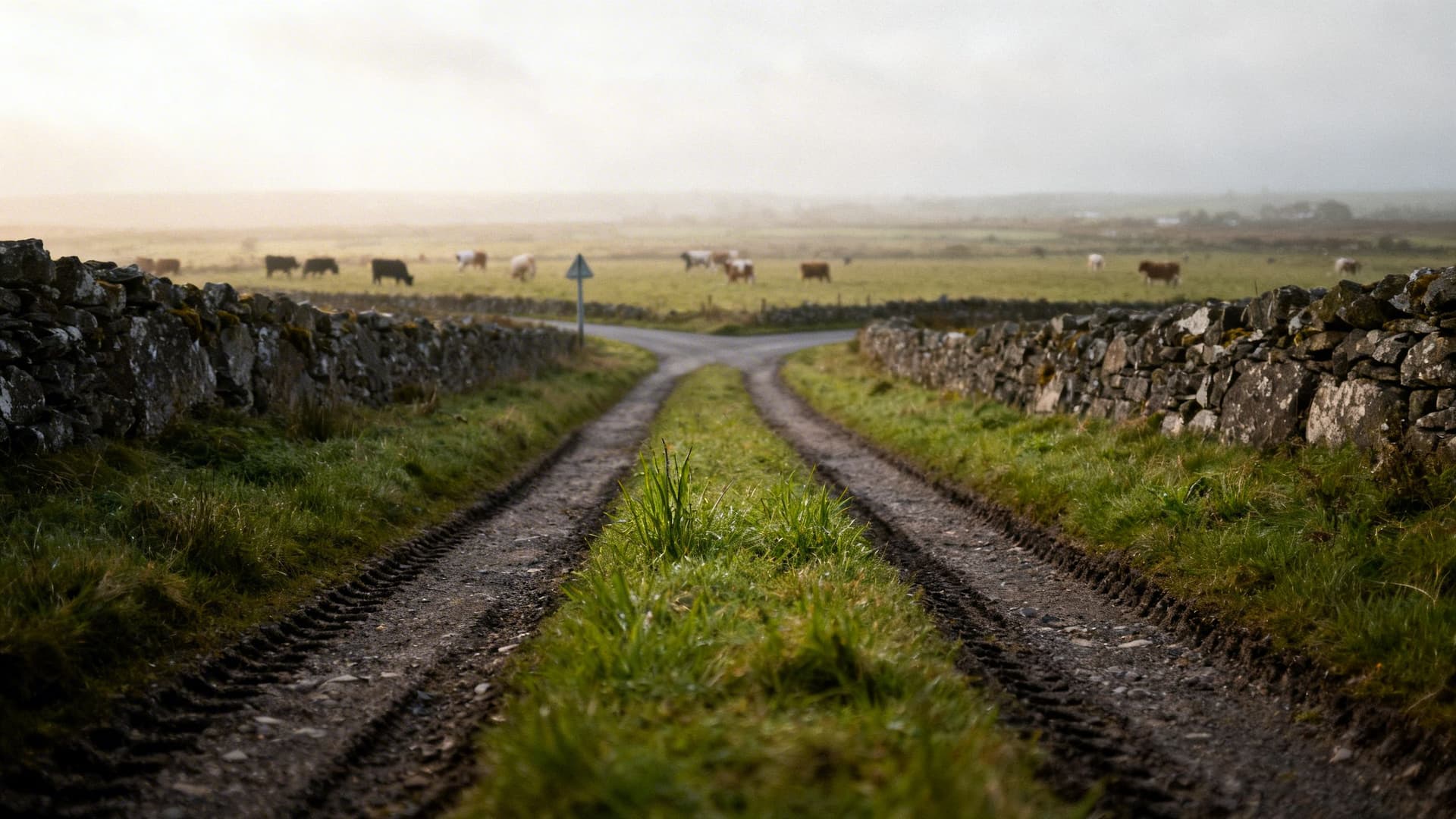
Roscommon’s best sites are not arranged for easy touring. Rathcroghan’s sixty monuments are spread across private farmland with no public access paths. The smaller ring forts and holy wells scattered throughout the county do not appear on any map. The boreens between villages were not designed for rental cars, and the roads that look like shortcuts on Google Maps are often single-track lanes with grass growing up the middle.
A local guide for Ireland’s Hidden Heartlands carries the knowledge that no satnav has — which field gates are open, which farmers welcome visitors, and which back roads connect you from Boyle to Strokestown without touching a main road. They also carry the stories that turn a field with a mound in it into the inauguration site of kings.
Frequently Asked Questions

What is Roscommon best known for?
Roscommon is known for its deep historical heritage, including Rathcroghan — the ancient royal capital of Connacht — and the National Irish Famine Museum at Strokestown Park. The county also offers Boyle Abbey, one of the finest Cistercian monasteries in Ireland, and Lough Key Forest Park with its tree canopy walk and island-studded lake.
Is Roscommon worth visiting?
Yes, particularly for travellers interested in Irish history, heritage, and uncrowded landscapes. Roscommon has major archaeological sites, well-preserved medieval ruins, and one of the most important Famine museums in the country — all without the crowds that gather at more famous destinations. It rewards curiosity and slow travel.
How many days do you need in Roscommon?
Two days is ideal. One day for the northern half — Boyle Abbey, Lough Key Forest Park, and the Suck Valley — and one day for the central and southern sites including Rathcroghan, Roscommon Castle, and Strokestown Park with the Famine Museum.
Can you visit Oweynagat (the Cave of the Cats)?
Yes, but only with a guide from the Rathcroghan Visitor Centre in Tulsk. The cave entrance is on private farmland and the passage is narrow, dark, and unlit. Guided tours run regularly during the season and are included in the visitor centre admission. It is a genuinely unique experience — mythology made physical.
A County That Remembers
Roscommon is not a county that performs for visitors. It does not dress up its ruins or light its castles for evening tours. What it offers instead is direct contact with layers of Irish history — royal, monastic, colonial, famine — in places where you are often the only visitor. The ancient capital at Rathcroghan. The famine archive at Strokestown. The Cistercian silence at Boyle.
For a wider view of this part of Ireland, Ireland’s Hidden Heartlands: The Insider Guide to Ireland’s Quietest Region maps the connections between these overlooked counties. And if Roscommon’s royal history has you curious about what lies across the borders, things to do in Leitrim continues north into a landscape defined by water and mountain, while things to do in Longford follows the Shannon south through the literary heartland of the midlands.
Start with a local guide for Ireland’s Hidden Heartlands who knows the back roads and the landowners. In Roscommon, the best things are not signposted — they are remembered.
Table of Contents
Share this post
More from the Blog

Cork to Blarney Castle Day Trip: The Stone, the Gardens and What Else to See
Plan a Cork to Blarney Castle day trip. Kiss the stone, explore the Poison Garden, and add Cork city, Fota or Kinsale for a full day out.

Cork to Cobh Day Trip: Titanic, Colourful Houses and Harbour History
Plan a Cork to Cobh day trip by train, car or private driver. Explore Titanic history, St Colman's Cathedral, Spike Island and the best harbour views.

Cork to Killarney Day Trip: Lakes, Mountains and Muckross in One Day
A Cork to Killarney day trip is a longer escape into Kerry. Here's how to plan the drive, what to see in Killarney National Park, and why a private driver helps.