
Natural Tidal Pools in Ireland: Swimming in Nature's Infinity Pools
There is a highly specific, fleeting type of magic that occurs twice a day along the rugged fringes of the Irish coastline. As the immense gravitational pull of the moon drags the Atlantic Ocean away from the shore, the violent, crashing waves retreat to reveal a hidden, temporary landscape. Embedded within the exposed bedrock, protected from the open ocean by jagged reefs and natural breakwaters, lie nature’s ultimate luxury: the natural tidal pools.
Unlike the vast, intimidating expanse of the open sea or the dark, fathomless depths of the inland loughs, tidal pools offer a completely unique wild swimming experience. They are essentially nature's infinity pools—perfectly contained, crystal-clear aquatic sanctuaries that exist strictly on borrowed time. For a few brief hours, you can float in perfectly calm, slightly sun-warmed water while watching the chaotic, white-capped waves of the Atlantic crashing harmlessly against the protective rock walls just a few feet away.
Swimming in a tidal pool is a sensory immersion into marine geology. The water clarity is often unparalleled, allowing you to observe vibrant kelp forests, darting fish, and brightly colored sea anemones directly beneath you. It is a wildly different experience from hunting down the remote sandy beaches we covered in our Secret Swimming Spots in West Cork & Kerry: Hidden Coves guide. While hidden coves are about isolation and geography, tidal pools are fundamentally about geology, marine biology, and above all else, the meticulous, uncompromising science of timing.
"A tidal pool is a completely different beast than the open sea. It feels safer, more contained, but it is entirely temporary. You can be swimming in ten feet of gorgeous, clear water, and three hours later, that entire pool is buried under ten feet of violent, crashing ocean. You don't just swim a tidal pool; you borrow it from the Atlantic for a very specific window." — Orla, Coastal Geologist and Sea Swimmer
In this comprehensive guide, we will explore the fascinating mechanics of how these coastal phenomena are formed and replenished. We will journey to the most spectacular tidal pools across the island, from the legendary Pollock Holes in County Clare to the striking Belmullet pool in Mayo. Most importantly, we will decode the complex tidal charts you must master to find them, and explain why handing your itinerary over to a local expert is the only way to ensure you do not arrive to find your infinity pool completely submerged.
(This guide is a specialized chapter within our master resource: Wild Swimming in Ireland: Sea Coves, Tidal Pools, Saunas & Everything You Need to Know. Because understanding the ocean's movement is critical here, you must read our foundational Wild Swimming Safety in Ireland: How to Read Tides, Rip Currents & Weather guide before planning your trip).
1. The Geology of the Tidal Pool: How They Form
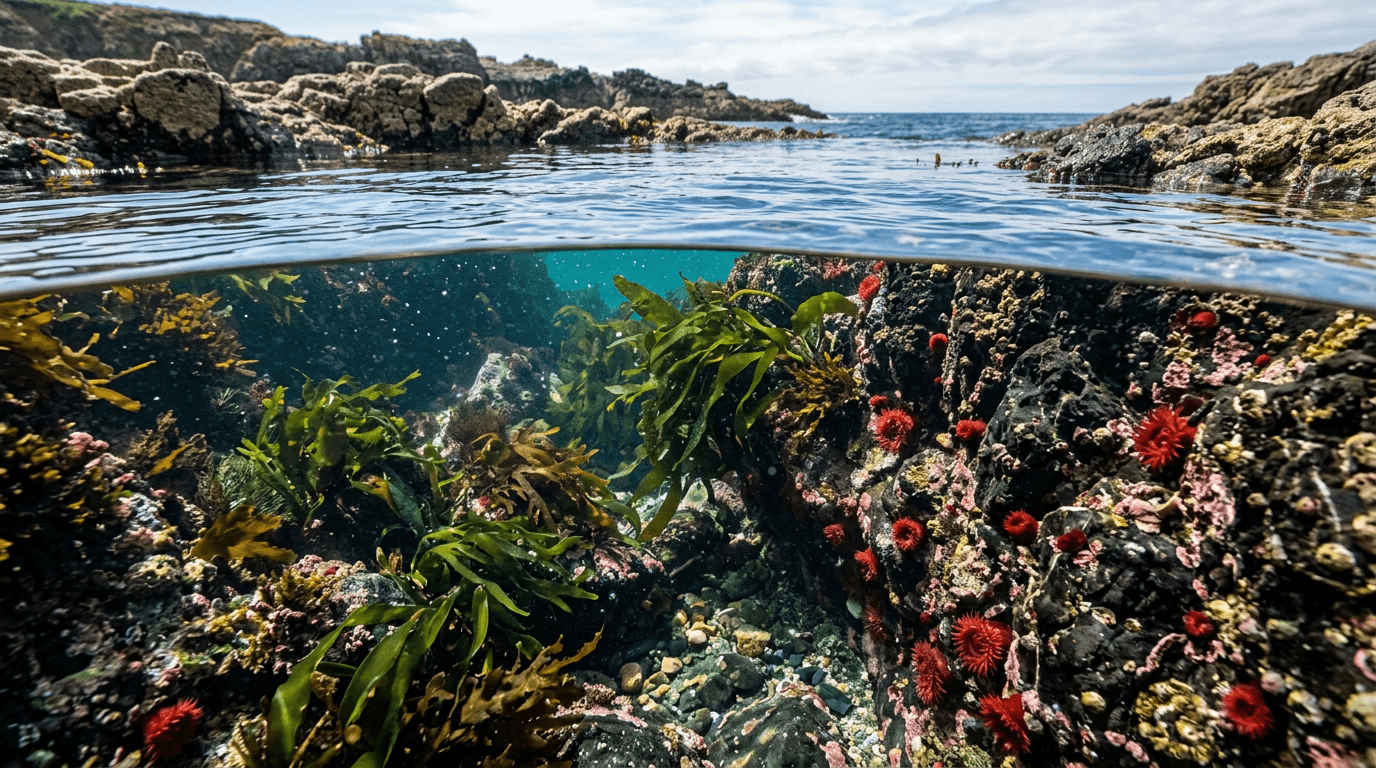
To understand the allure of the tidal pool, you have to look at the violent geological history of the Irish coastline. The western seaboard is not a smooth, sandy gradient. It is a fractured, battered battleground of limestone, basalt, and ancient sandstone that has been relentlessly hammered by the Atlantic Ocean since the last Ice Age.
Tidal pools are formed in areas where the bedrock extends outward from the cliffs in a relatively flat, horizontal shelf, known as a wave-cut platform. Over thousands of years, the relentless pounding of the waves, combined with the chemical weathering of the salt and the abrasive action of rocks and pebbles swirling in the currents, scours out deep depressions in this stone shelf.
The Daily Flushing Mechanism: What makes these pools safe and hygienic for swimming is their constant connection to the ocean. Unlike stagnant inland ponds, true tidal pools are aggressively flushed out and replenished twice every single day. When the high tide rolls in, the ocean completely engulfs the rock shelf, bringing with it a massive influx of fresh, highly oxygenated seawater, along with marine life and fresh kelp. When the tide retreats, it leaves the depressions filled to the brim with pristine, newly exchanged Atlantic water.
The Thermal Advantage: One of the most celebrated features of the tidal pool is the slight thermal advantage it offers over the open ocean. Because the volume of water in the pool is relatively small and temporarily isolated from the frigid deep-sea currents, it responds much faster to ambient air temperatures. If a low tide coincides with a bright, sunny afternoon in July, the dark rock surrounding the pool absorbs the solar radiation and transfers that heat into the shallow water. While it will never be bathwater-warm, a sun-baked tidal pool can often be two or three degrees warmer than the open sea—a massive, highly appreciated difference when you are swimming in Ireland.
2. The Science of Timing: The Two-Hour Window

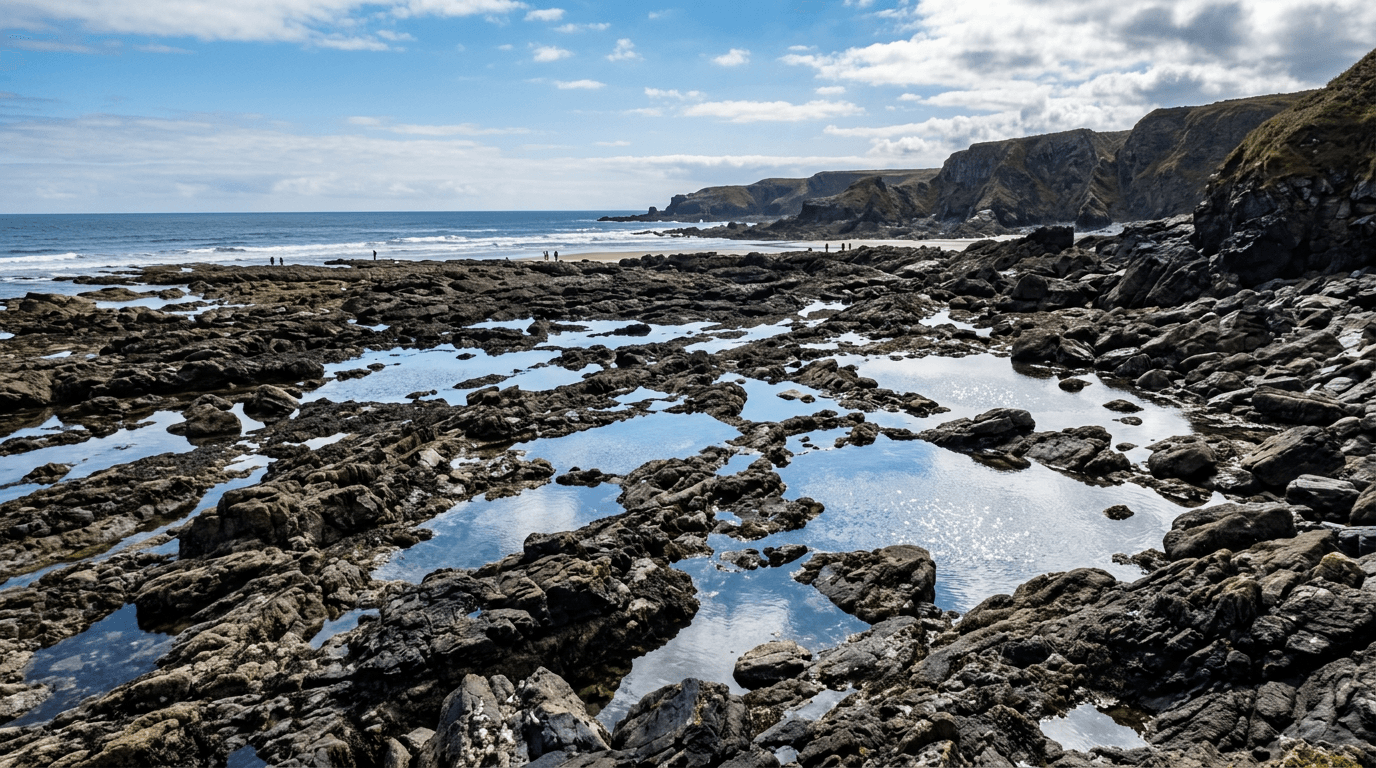
If you want to swim in a tidal pool, you must become a student of the lunar cycle. The absolute most important factor in this type of wild swimming is timing. You cannot simply pull up to the coast at 2:00 PM and expect the pool to be there.
Tidal pools operate on a strict, narrow window of accessibility. For the vast majority of the pools in Ireland, this window opens approximately two hours before the absolute lowest point of the tide (Low Water) and closes abruptly two hours after it.
- The High Tide Disappointment: If you arrive at a tidal pool location at high tide, or even mid-tide, you will see absolutely nothing but the open ocean. The reefs, the rocky shelves, and the pools themselves will be entirely submerged under several meters of crashing waves. Attempting to swim in the general area during high tide completely negates the safety and calmness of the pool, exposing you to the full, dangerous force of the coastal swell and hidden, submerged rocks.
- Spring Tides vs. Neap Tides: To experience the pools at their absolute best, you need to align your visit with a "Spring Tide." These occur just after a full moon and a new moon, when the gravitational pull is at its strongest. Spring tides create the highest high tides, but more importantly, they create the lowest low tides. A low spring tide pulls the ocean further back than normal, exposing the deepest, largest pools and completely isolating them from the ocean waves, providing the ultimate, glass-like infinity pool experience.
3. The Crown Jewels: The Pollock Holes of Kilkee
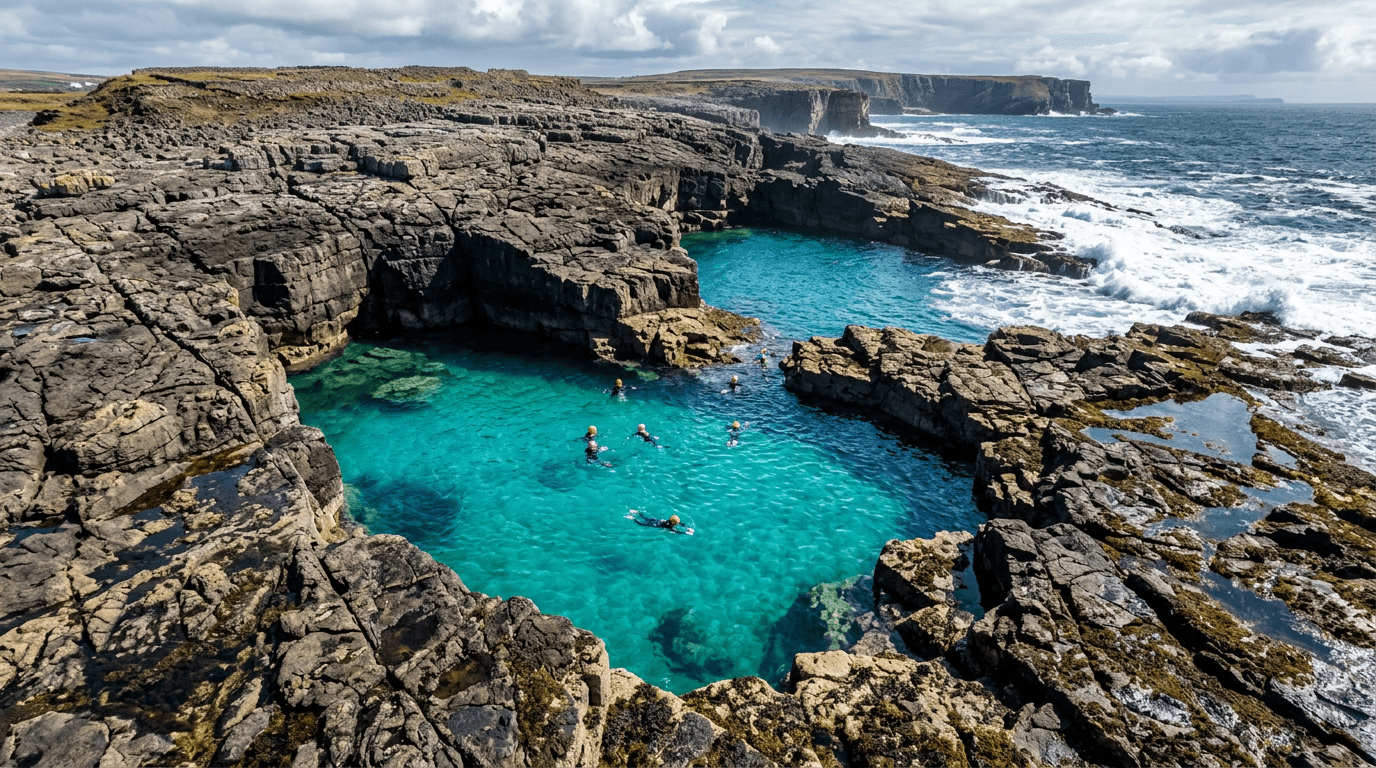
When discussing natural tidal pools in Ireland, the conversation must always begin in County Clare. As we briefly touched upon in our Galway & Clare Sea Swimming: Salthill, Blackrock & Pollock Holes guide, the Pollock Holes in the Victorian seaside town of Kilkee are the undisputed crown jewels of Irish coastal geology.
Located just beyond the main horseshoe bay of the town, at the edge of the Duggerna Reef, this is not a single pool, but a sprawling, complex network of massive, interconnected deep-water basins.
- The Scale and Depth: The sheer scale of the Pollock Holes is staggering. These are not ankle-deep rock pools; they are vast aquatic arenas. Some of the main pools are deep enough that you cannot touch the bottom, allowing for proper, uninhibited front-crawl swimming. The water clarity is so profound that even in the deepest sections, you can count the individual sea urchins resting on the limestone floor twenty feet below you.
- The Natural Breakwater: What makes Kilkee so spectacular is the massive ridge of dark, jagged reef that stands between the pools and the open ocean. At low tide, you can float on your back in absolute, dead-calm silence, while thirty feet away, massive Atlantic waves explode violently against the outer reef, sending huge plumes of white sea spray into the air. It is a thrilling juxtaposition of serene safety and raw danger.
4. The Belmullet Tidal Pool (County Mayo)
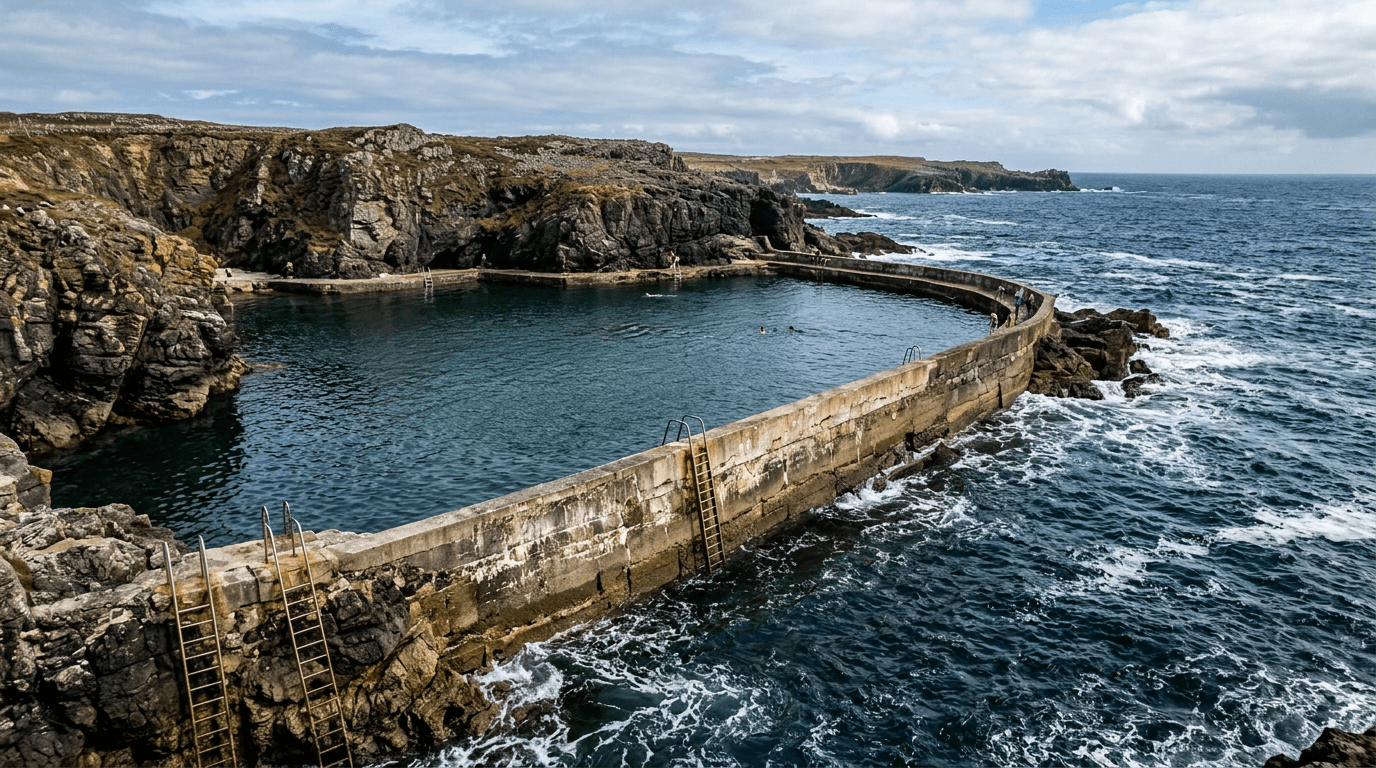
If you travel further north along the Wild Atlantic Way, deep into the rugged, remote Gaeltacht (Irish-speaking) region of the Erris Peninsula in County Mayo, you will find a completely different interpretation of the tidal pool.

The Belmullet Tidal Pool, located near the stunning Annagh Head, is a brilliant hybrid of natural geology and human engineering. In the mid-20th century, the local community identified a massive, naturally occurring depression in the coastal bedrock. To enhance it, they constructed a low concrete wall across the seaward opening.
- The Mechanics: The genius of the Belmullet pool lies in this concrete lip. At high tide, the massive swells of the North Atlantic completely submerge the wall, flushing out the pool with fresh seawater. As the tide recedes, the concrete wall acts as a dam, trapping a massive, deep body of clean water while the ocean falls away beneath it.
- The Experience: The result is a spectacular, massive outdoor swimming pool perched right on the edge of the cliff. It features metal ladders for easy entry and exit, making it significantly more accessible than scrambling over slippery, kelp-covered rocks. Swimming here provides sweeping, uninterrupted views of the Mullet Peninsula and the wild, churning ocean, all from the safety of a deep, contained basin. Because it is located in one of the most remote, windswept corners of Ireland, braving the Belmullet pool requires the heavy thermal protection we discussed in our What to Wear Wild Swimming in Ireland: Dryrobes & Gear article.
5. The Ladies Bathing Place & The East Coast Pools
While the West Coast boasts the most dramatic, massive tidal basins, the East Coast of Ireland features its own delicate, historically significant rock pools, intricately tied to the bathing culture of Dublin and Wicklow.
In the southern suburbs of Dublin and the northern edges of County Wicklow (near Bray and Greystones), the coastline features softer, more fragmented rocky shores. Historically, during the Victorian and Edwardian eras, societal norms dictated that men and women must bathe separately. While the men famously congregated at the deep-water Forty Foot, the women were often relegated to shallower, more secluded rock pools along the coast, leading to the creation of several spots known affectionately as "The Ladies Bathing Place."
While these pools are generally smaller and shallower than the massive basins of Clare and Mayo, they offer a beautiful, intimate swimming experience. They are highly sought after by local "dippers" who want a quick, bracing immersion without the intense commitment of open-water sea swimming. The rocks here are often smoother, and the pools warm up much faster on a sunny East Coast morning. Today, of course, these historic pools are completely desegregated and enjoyed by everyone, serving as vital, calm sanctuaries when the Irish Sea is otherwise too rough to navigate safely.
6. Ecological Etiquette: Swimming in a Living Ecosystem
When you swim in a tidal pool, you are not swimming in a sterile, chlorinated leisure center. You are temporarily invading a highly sensitive, fiercely competitive micro-ecosystem. The creatures that survive in tidal pools are incredibly resilient, having adapted to withstand massive fluctuations in temperature, salinity, and oxygen levels twice a day, but they are highly vulnerable to human interference.
- Look, Do Not Touch: The walls of the tidal pools are often blanketed in Beadlet Anemones (which look like dark red blobs when closed, and beautiful underwater flowers when open), limpets, mussels, and delicate sponges. The floor is the hunting ground for shore crabs, blennies (small fish), and starfish. You must navigate the pool with care. Never pull marine life off the rocks, and avoid kicking the sides of the pool violently.
- The Sunscreen Threat: The volume of water in a tidal pool is finite and temporarily isolated from the ocean's dilution. If a group of swimmers enters a small tidal pool slathered in chemical, non-reef-safe sunscreen, those chemicals instantly wash off into the trapped water. In high concentrations, these chemicals are highly toxic to the delicate invertebrates living in the pool. If you are swimming in a rock pool, it is imperative to use physical barriers (like a long-sleeved rash guard or a wetsuit) for sun protection, or strictly utilize organic, reef-safe zinc sunscreens.
- Leave No Trace: It goes without saying, but leaving a plastic bottle, a coffee cup, or a discarded swim cap near a tidal pool guarantees that the item will be sucked out into the open ocean on the very next high tide, directly contributing to marine pollution.
7. The Essential Pivot: Why Timing Requires a Pro


The allure of the tidal pool is undeniable, but the logistics of successfully executing a swim in one are arguably the most difficult of any coastal activity in Ireland. If you are a visitor attempting to manage this in a rental car, the odds are stacked heavily against you.
The Stress of the Clock: Remember the golden rule: you have a strict two-hour window before and after low water. Now, imagine you are staying in a hotel in Galway, and you want to swim the Pollock Holes in Clare. You have to calculate the exact drive time. You have to factor in the inevitable delays of navigating the winding, slow-moving coastal roads of the Burren. You have to find a parking space in a busy seaside town on a sunny day. And you have to do all of this perfectly, because if you are forty-five minutes late due to a tractor on the road, the tide will have rushed in, the waves will be crashing over the reef, and your infinity pool will be gone.
Attempting to aggressively speed down a narrow Irish country road because you are "chasing the tide" is incredibly stressful and highly dangerous.
The Luxury of Precision: This is the exact scenario where hiring a Private Driver or a Local Coastal Guide transitions from a mere convenience to an absolute, itinerary-saving necessity.
A local professional does not guess the tide; they know it intrinsically.
- Flawless Itinerary Management: When you book a private driver, you hand over the stress of the clock. They calculate the drive time from your hotel, factor in the local traffic patterns, and determine your exact departure time to ensure you arrive at the cliffs exactly as the water drops to its safest, most beautiful level.
- The Perfect Parking: Tidal pools are usually located in rocky, rugged areas with terrible parking infrastructure. Your driver will drop you exactly at the trailhead or the concrete steps, allowing you to walk straight down to the water while they navigate the parking nightmare.
- Local Safety Knowledge: A local coastal guide knows the specific temperament of the pool. They know which rocks are covered in highly slippery black algae, they know where the hidden underwater ledges are, and they know exactly when the incoming tide is getting too strong, signaling that it is time to safely exit the water.
Conclusion: Borrowing the Ocean
Swimming in a natural tidal pool is a privilege granted by the lunar cycle. It is an opportunity to immerse yourself in the crystal-clear, vibrant ecology of the Irish coast while being protected from its violent, raw power.
Whether you are floating in the massive basins of the Pollock Holes or gripping the concrete walls of the Belmullet pool, you are participating in a fleeting, temporary alliance with nature. Study the tide charts, respect the delicate marine life that calls these pools home, and above all, entrust your timing to the local experts. The infinity pools of the Wild Atlantic Way are waiting, but they will not wait for long.
Don't Miss the Tide
Trying to align a long drive in a rental car with a strict two-hour tidal window is a recipe for disaster. Hire a local private driver who knows the exact timing, the best routes, and the hidden parking spots to ensure you arrive right on time.
Table of Contents
Share this post
More from the Blog

Cork to Blarney Castle Day Trip: The Stone, the Gardens and What Else to See
Plan a Cork to Blarney Castle day trip. Kiss the stone, explore the Poison Garden, and add Cork city, Fota or Kinsale for a full day out.

Cork to Cobh Day Trip: Titanic, Colourful Houses and Harbour History
Plan a Cork to Cobh day trip by train, car or private driver. Explore Titanic history, St Colman's Cathedral, Spike Island and the best harbour views.

Cork to Killarney Day Trip: Lakes, Mountains and Muckross in One Day
A Cork to Killarney day trip is a longer escape into Kerry. Here's how to plan the drive, what to see in Killarney National Park, and why a private driver helps.