
Wild Swimming Safety in Ireland: Tides, Rips & Weather
Ireland’s coastline is a masterpiece of jagged cliffs, hidden coves, and sweeping silver strands. In recent years, a massive cultural shift has seen locals and visitors alike flocking to these shores not just to look at the water, but to dive headfirst into it. The wild swimming and beach sauna boom has transformed the Irish coastal experience. From the historic bathing spots of Dublin Bay to the remote, crashing waves of the Wild Atlantic Way, taking a dip in the ocean has become the ultimate authentic Irish travel experience.
However, beneath the romanticized imagery of joyous swimmers and steaming beachside saunas lies a stark reality: the Atlantic Ocean is immensely powerful, perpetually cold, and entirely unforgiving. The surge in wild swimming’s popularity has, unfortunately, been accompanied by a rise in coast guard callouts for swimmers who underestimated the environment. The sea around Ireland is not a controlled swimming pool. It is a dynamic, ever-changing wilderness governed by lunar cycles, shifting sands, and unpredictable weather fronts sweeping in from the west.
Answering the question, "Is it safe to swim in the sea in Ireland?" requires a nuanced response. Yes, it is incredibly safe and deeply rewarding—provided you approach the water with profound respect, adequate preparation, and the right local knowledge. You cannot simply pull your rental car over at the first pretty beach you see and sprint into the waves.
"The ocean does not care how strong a swimmer you are in a heated indoor pool. The Atlantic tests your mind just as much as your body. Knowing when not to get in the water is the most important wild swimming skill you can ever develop." — Ciaran O’Neill, Coastal Rescue Volunteer
In this comprehensive guide, we will break down the essential safety protocols every visitor must know before taking the plunge. We will explore the physiological realities of cold water shock, teach you how to read the complex Irish tide tables, help you identify silent killers like rip currents, and explain why the safest way to experience the water is always alongside someone who knows it intimately.
(This guide is the foundational safety pillar of our master hub: Wild Swimming in Ireland: Sea Coves, Tidal Pools, Saunas & Everything You Need to Know. Please read this thoroughly before exploring our regional guides).
1. The Reality of the Atlantic: Understanding Cold Water Shock
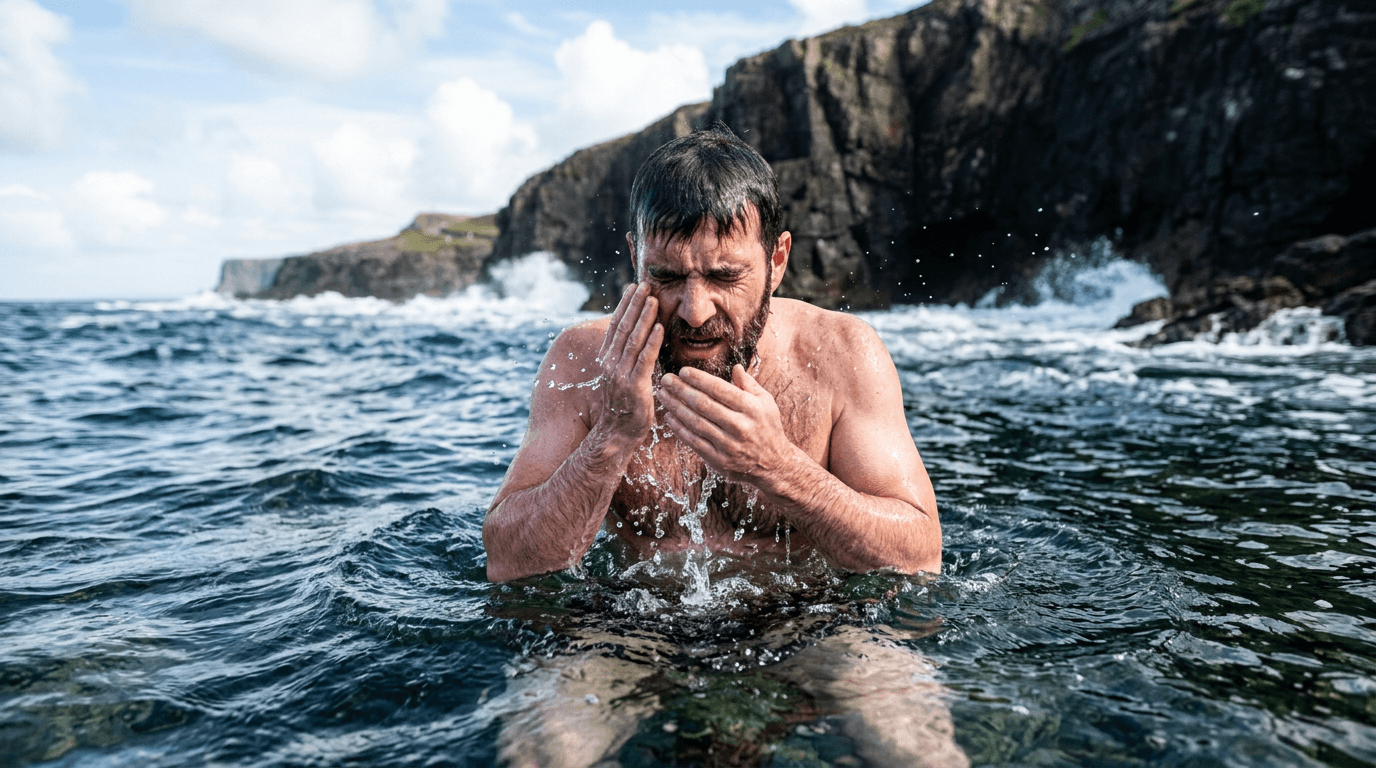
The most immediate danger facing any wild swimmer in Ireland has nothing to do with currents or waves; it has to do with temperature. The waters surrounding the island are undeniably cold year-round. Even at the height of summer in August, sea temperatures rarely exceed 15°C to 16°C (59°F to 61°F). In the depths of winter and early spring, it regularly plummets to 7°C to 9°C (44°F to 48°F). For visitors accustomed to the balmy waters of the Mediterranean or the Caribbean, the Irish Sea and the Atlantic Ocean represent a massive physiological shock.
When a human body suddenly enters water below 15°C, it triggers an involuntary physical response known as "Cold Water Shock." This is a deeply ingrained evolutionary defense mechanism, but in a swimming context, it can be lethal if not managed correctly. The sudden cooling of the skin causes blood vessels to constrict rapidly, forcing the heart to work exponentially harder to pump blood to vital organs. This leads to an immediate, uncontrollable spike in heart rate and blood pressure.
Simultaneously, the cold triggers a "gasp reflex." This involuntary sharp intake of breath is the most dangerous aspect of cold water shock. If your head is submerged when you gasp, you will inhale water directly into your lungs, leading to panic and potential drowning within seconds. Furthermore, the shock causes hyperventilation, making it incredibly difficult to coordinate your breathing with your swimming strokes. Even Olympic-level pool swimmers can find themselves paralyzed and struggling to stay afloat during the first two minutes of sudden cold water immersion.
- How to Mitigate the Risk: Never jump or dive into unknown Irish waters. You must enter the water slowly, ideally walking in gradually to allow your body time to acclimatize. Splash cold water on your face, the back of your neck, and your chest before fully submerging your torso. This intentionally triggers the "mammalian dive reflex," which actually helps lower your heart rate and counteract the panic of the cold shock.
- The Two-Minute Rule: Once you are waist-deep, focus entirely on your breathing. Take long, slow, deep breaths out. It takes approximately 90 to 120 seconds for the initial shock response to pass. Do not attempt to swim until your breathing has completely normalized and you feel in control of your body.
2. The Mechanics of the Ocean: Reading Irish Tides
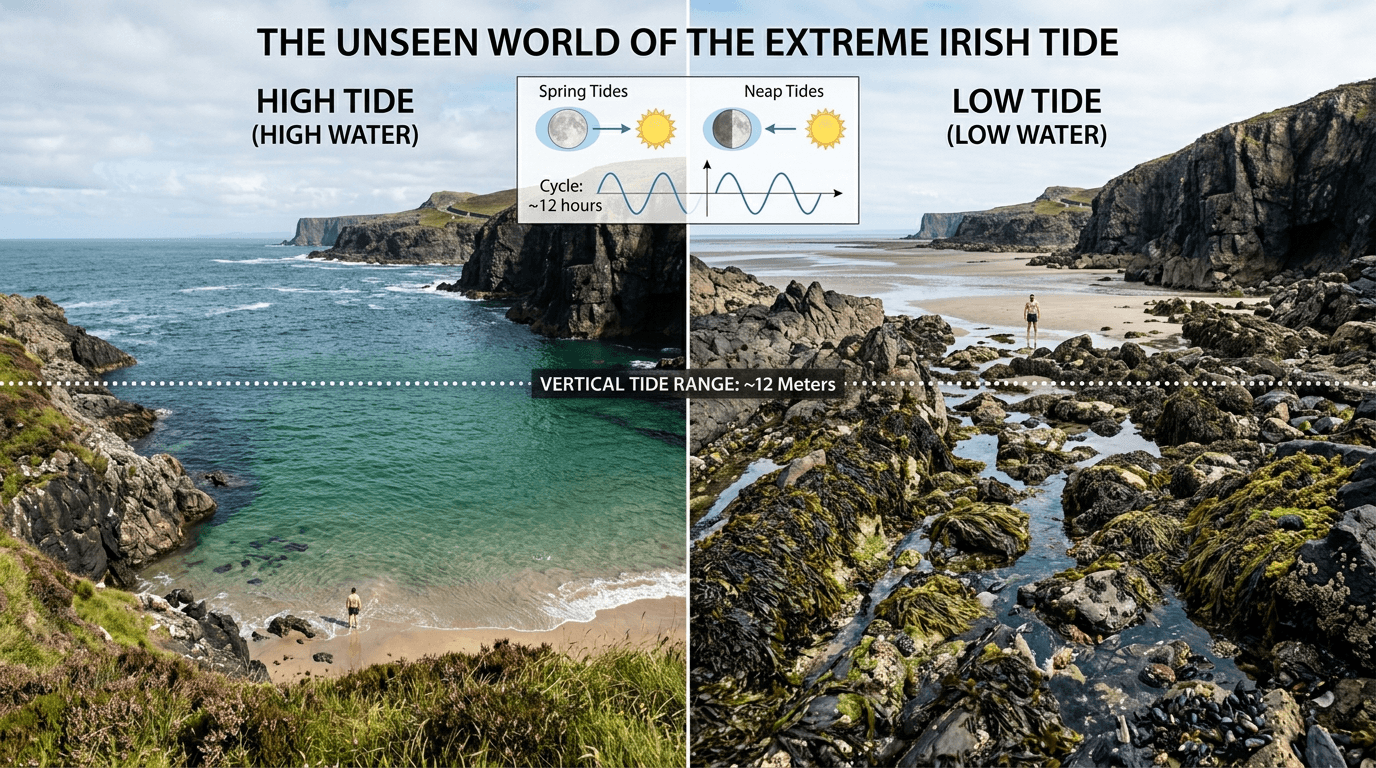

The sea level around Ireland is never static. Twice a day, massive volumes of water are pulled toward the coast and then dragged back out by the gravitational pull of the moon and the sun. Understanding how these tides work is non-negotiable for wild swimming. A sheltered, idyllic sandy cove at low tide can transform into a treacherous, wave-battered rock face at high tide just a few hours later.
Irish tides operate on a semi-diurnal cycle, meaning there are generally two high tides and two low tides every 24 hours and 50 minutes. The difference in water height between low and high tide—known as the tidal range—can be extreme, particularly on the west coast where the Atlantic is funneled into narrow bays and estuaries. Furthermore, tides vary significantly throughout the month. When the sun and moon align (during full and new moons), their combined gravitational pull creates "Spring Tides," which result in the highest high tides and the lowest low tides, along with the strongest water currents. Conversely, "Neap Tides" occur during quarter moons, resulting in a much weaker tidal pull and less water movement.
Knowing exactly what the tide is doing dictates not only where you can safely swim, but whether you can access a beach at all. Many of the most beautiful hidden coves are completely cut off by water at high tide, posing a severe risk of stranding if you are unaware of the incoming water.
- The Rule of Twelfths: Tides do not rise and fall at a consistent speed. The water moves incredibly slowly during the first and last hours of the tide, but it surges rapidly during the middle hours. Specifically, in the third and fourth hours of an incoming tide, half of the entire ocean's volume for that cycle will rush into the bay. Swimming during this mid-tide window exposes you to the strongest lateral currents.
- Local Variations: A tide table for Dublin Bay will not give you the correct times for a beach in Galway. You must consult highly localized, daily tide charts using reliable tools like the Irish Marine Institute website or specialized surfing apps. If you are planning to swim in enclosed areas that rely on tidal shifts, ensure you read our dedicated guide: Natural Tidal Pools in Ireland: Swimming in Nature’s Infinity Pools.
3. The Silent Killer: Identifying and Surviving Rip Currents
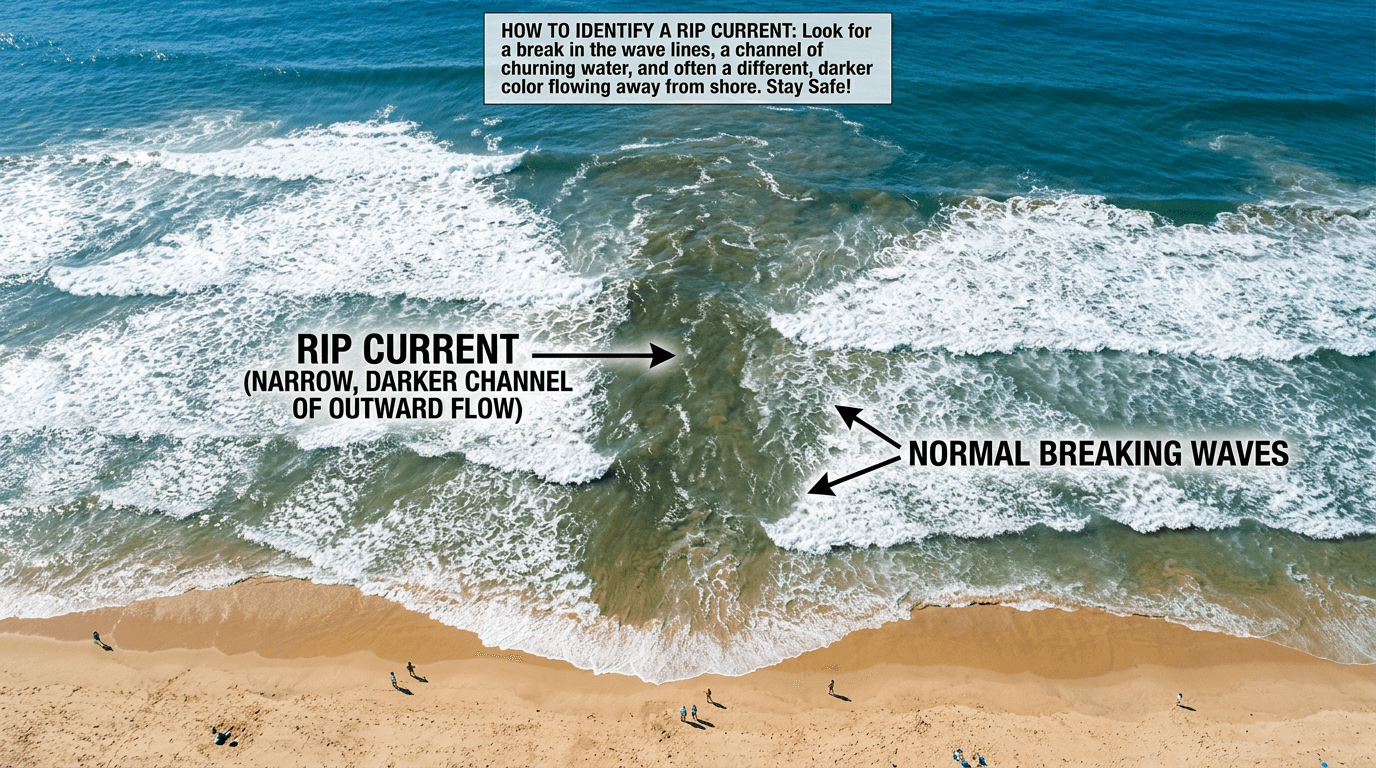
While towering waves look intimidating, the greatest cause of coastal rescues in Ireland is something entirely invisible to the untrained eye: the rip current. Rip currents are powerful, narrow channels of fast-moving water that flow away from the shore, cutting through the breaking waves. They are formed when water pushed up onto the beach by waves needs to find a way back out to sea, naturally funneling into deeper channels or along groynes and headlands.
Rip currents do not pull you under the water; they pull you out to sea. The natural human reaction when caught in a rip is to panic and swim directly against the current toward the beach. This is a fatal mistake. Rip currents can move at speeds of up to 2.5 meters per second—faster than an Olympic sprinter can swim. Fighting the current will lead to total physical exhaustion in a matter of minutes, leaving the swimmer unable to stay afloat.
Learning to visually identify a rip current from the beach before you enter the water is an essential survival skill. They are tricky because they often look like the safest place to swim to an absolute beginner.
- How to Spot a Rip Current: Look for a noticeable gap in the breaking waves; rip currents often appear as a strip of suspiciously calm, darker water between areas of white water. You might also notice a localized "river" of churning, choppy water moving away from the shore, or a line of sea foam, seaweed, and debris being carried rapidly outward.
- The Survival Protocol: If you feel yourself being pulled out to sea, the most important thing to do is remain calm and conserve your energy. Do not fight the water. Instead, use the "Float to Live" technique: roll onto your back, extend your arms and legs like a starfish, and focus on your breathing. To escape the rip, you must swim parallel to the shoreline until you are out of the narrow outward-flowing channel. Once you are in the breaking waves, let the natural motion of the ocean assist you back to the beach.
4. Wind, Weather, and Swell: The Atmospheric Factors
In Ireland, you can experience four seasons in a single hour. The weather forecast is not a mere suggestion; it is the ultimate deciding factor for any coastal activity. An offshore breeze might make the beach feel warm and pleasant, but it drastically alters the safety dynamics of the water.
Understanding the relationship between wind direction and water conditions is crucial. "Onshore winds" blow from the sea toward the land. They tend to create messy, choppy waves that are difficult to swim in, but they naturally push swimmers and floating objects back toward the beach. "Offshore winds," however, blow from the land out toward the sea. These winds flatten the breaking waves, making the ocean look deceptively calm and inviting, resembling a glassy lake. This is a trap.
Offshore winds will quickly and silently push swimmers away from the shore. This is particularly dangerous if you are using a tow float, an inflatable paddleboard, or simply swimming further out than your depth. Once you realize you have drifted, you will find yourself swimming against both the tide and the wind to return to the beach, which is incredibly exhausting.
- The Swell Factor: Wind creates "swell"—the organized lines of energy that travel across the ocean and become waves when they hit the shallows. Even on a perfectly calm, windless day in Kerry, a storm hundreds of miles out in the mid-Atlantic can generate a massive groundswell that creates dangerous "dumping" waves on the beach.
- Preparation: Always check a detailed marine weather forecast before swimming, paying close attention to wind speed, wind direction, and swell height. If the sea looks rough, angry, or churned up with brown sand, simply do not get in. The ocean will still be there tomorrow.
5. Essential Safety Gear: Visibility and Buoyancy
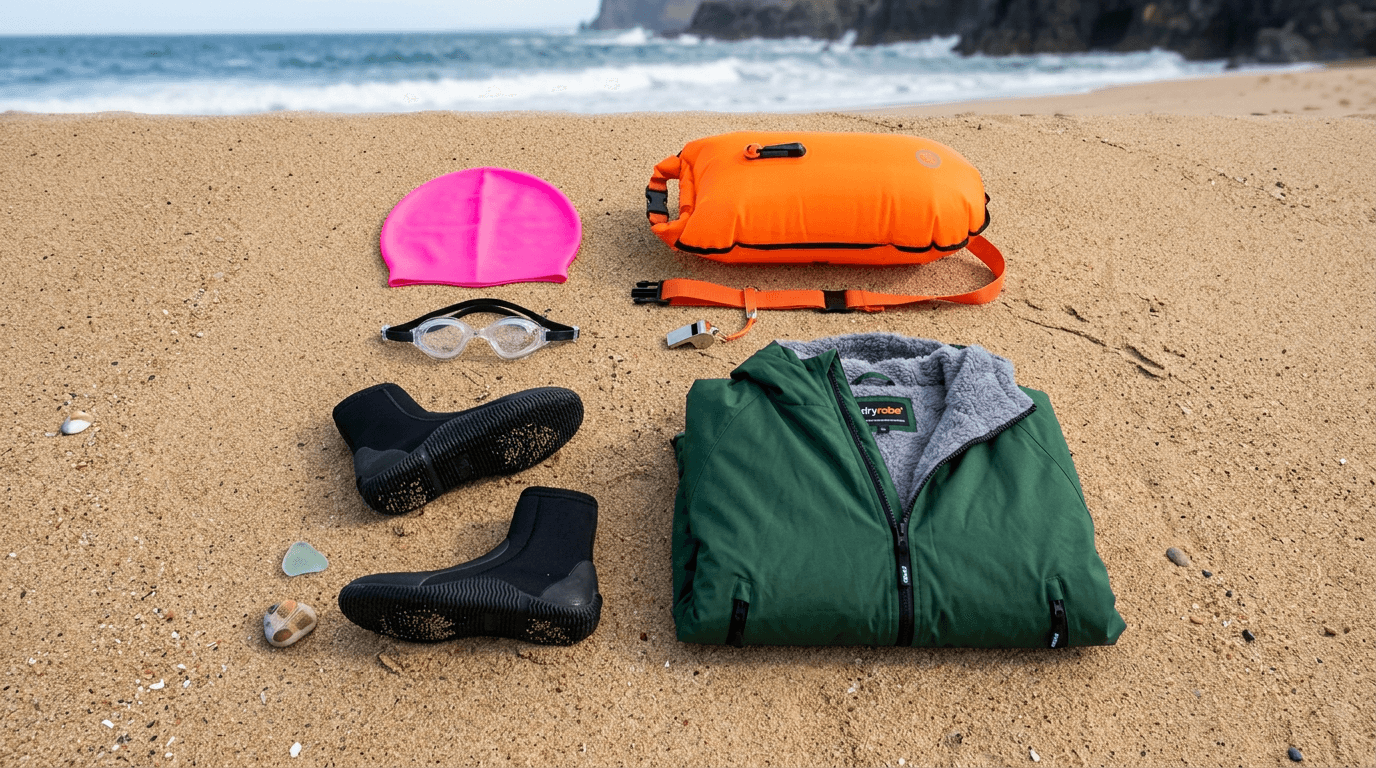
Wild swimming requires more than just a swimsuit and a towel. The Irish coastal environment necessitates specific safety equipment to ensure you are visible to boats and rescue services, and to provide emergency buoyancy if you suffer from a cramp or fatigue.
The single most important piece of safety gear you can own is a brightly colored silicone swimming cap (neon pink, orange, or green). In the dark, often grey waters of the Atlantic, a swimmer wearing a black wetsuit and no cap is virtually invisible to a rescue boat or helicopter from more than fifty yards away. Your head is the only thing above water, so it needs to stand out vividly against the ocean.
Equally important is the use of a "Tow Float." This is a brightly colored inflatable dry bag that attaches to your waist via a short leash and floats behind you as you swim. It creates zero drag, but it serves two vital purposes. First, it vastly increases your visibility to jet skis, fishing boats, and onlookers on the shore. Second, while it is not a certified life-saving device, it provides something buoyant to hold onto and rest upon if you suddenly feel tired, swallow water, or experience a muscle cramp in deep water.
- Footwear Matters: Irish beaches are often rugged, lined with sharp rocks, hidden barnacles, and occasionally weaver fish (which possess a venomous dorsal fin). Neoprene swimming booties protect your feet from lacerations and provide essential grip when clambering over slippery, algae-covered rocks to enter the water.
- The Full Kit: For a comprehensive breakdown of everything you need to stay safe and comfortable, including the debate over wetsuits versus "skins" (swimsuits), be sure to read our dedicated equipment guide: What to Pack for Wild Swimming in Ireland: Dryrobes, Booties & Post-Swim Gear.
6. The "After Drop": Surviving the Post-Swim Chill
Many novice swimmers believe the danger ends the moment they step out of the water and onto the sand. In reality, the most physically challenging part of a cold-water swim often occurs five to ten minutes after you have exited the ocean. This physiological phenomenon is known as the "After Drop."
When you are in cold water, your body cleverly restricts blood flow to your skin and limbs, keeping the warm blood concentrated in your core to protect your vital organs. When you get out of the water and begin to warm up, your blood vessels dilate again. The cold blood that was trapped in your freezing arms and legs rushes back into your core, causing your deep body temperature to plummet rapidly.
This means you will often feel significantly colder ten minutes after getting out of the water than you did while swimming. You may experience violent, uncontrollable shivering, loss of dexterity in your hands (making it impossible to button a shirt or tie shoelaces), and mild confusion.
- The Recovery Protocol: The key to managing the After Drop is to get dry and dressed as quickly as humanly possible. Remove your wet swimwear immediately—standing around in a wet swimsuit on a breezy beach will drain your body heat instantly. Layer up with loose-fitting, warm clothing, starting with a woolen hat, as you lose significant heat through your head.
- Warm from the Inside Out: Do not jump into a piping hot shower immediately, as this can cause blood pressure to drop dangerously low, leading to fainting. Instead, warm up slowly from the inside out. Drink a hot, sugary beverage like tea or hot chocolate, and walk around briskly to generate natural body heat.
7. Why You Need a Local Coastal Expert

The guidelines detailed above are the absolute minimum safety requirements for wild swimming in Ireland. However, reading about rip currents on a blog is entirely different from standing on a windswept beach in West Cork trying to identify one in real life.
The Atlantic coast is not a theme park. It is wild, raw, and deeply complex. The most experienced swimmers in Ireland share one common trait: they possess a profound respect for local knowledge. A beach that is perfectly safe for a gentle dip on a Tuesday morning might be a treacherous, swirling hazard by Thursday afternoon simply because the wind direction shifted by a few degrees.
The Limitation of Apps and Maps: While tide apps and weather forecasts are essential tools, they cannot tell you that a particular cove has a hidden submerged rock ledge, or that the sandbank shifted during last week's storm, creating a new, invisible rip current. They cannot tell you which specific bay is sheltered from a northerly gale, or where the safest entry and exit points are located on a rocky shore.
The Safest Approach: If you are a visitor wanting to experience the magic of Irish sea swimming, the absolute safest and most enriching way to do it is to hire a Local Coastal Guide.
These are professionals who swim these specific stretches of water every single day. They know the tides intimately, they understand exactly how the local currents pull, and they know the hidden, sheltered coves that the guidebooks have never heard of. Furthermore, a guide manages the logistics of safety. They carry the emergency first aid equipment, they provide the tow floats, and they make the critical "go or no-go" decisions based on real-time conditions.
Similarly, the logistics of the "After Drop" are drastically improved when you are not relying on a cold rental car. Utilizing a Private Driver for your coastal excursions means you step out of the freezing ocean and into a pre-heated vehicle. Your driver manages the navigation of the narrow coastal boreens while you wrap your hands around a flask of hot tea in the back seat, allowing you to focus entirely on the euphoric rush of the swim rather than the stress of the journey.
Conclusion: Respect the Wild
Wild swimming in Ireland is not about conquering the ocean; it is about surrendering to it safely. The euphoric high of emerging from the freezing Atlantic, skin tingling and senses completely alive, is an unparalleled travel experience.
But that joy is entirely dependent on your preparation. Respect the cold, study the tides, learn to spot the dangers, and most importantly, recognize when to rely on the expertise of those who call these rugged shores home. The water will welcome you, provided you approach it on its own terms.
Swim Safely with a Local Guide
Don't let the complexities of tides and currents keep you out of the water. Let a local expert manage the safety while you enjoy the thrill of the Atlantic.
Table of Contents
Share this post
More from the Blog

Cork to Blarney Castle Day Trip: The Stone, the Gardens and What Else to See
Plan a Cork to Blarney Castle day trip. Kiss the stone, explore the Poison Garden, and add Cork city, Fota or Kinsale for a full day out.

Cork to Cobh Day Trip: Titanic, Colourful Houses and Harbour History
Plan a Cork to Cobh day trip by train, car or private driver. Explore Titanic history, St Colman's Cathedral, Spike Island and the best harbour views.

Cork to Killarney Day Trip: Lakes, Mountains and Muckross in One Day
A Cork to Killarney day trip is a longer escape into Kerry. Here's how to plan the drive, what to see in Killarney National Park, and why a private driver helps.