
Galway & Clare Sea Swimming: Salthill, Blackrock & Pollock Holes
The West Coast of Ireland operates on a different frequency than the rest of the island. Here, the weather does not just happen; it asserts itself. The Atlantic Ocean rolls in unhindered from the Americas, crashing against a jagged limestone coastline that has been battered into submission over millennia. Yet, in the face of this raw, untamed aquatic power, you will find some of the most dedicated, joyous, and thriving sea swimming communities on the planet. From the bustling, bohemian energy of Galway City to the stark, lunar beauty of the County Clare coastline, swimming here is less of a hobby and more of a mandatory daily ritual.
Sea swimming in Galway and Clare offers a completely different atmospheric experience than the secluded, hidden coves of the deep southwest or the historic, structural bathing shelters of Dublin. This stretch of the Wild Atlantic Way is highly exposed, wildly dramatic, and deeply ingrained in the local folklore. It is a place where university students, seasoned fishermen, artists, and international visitors all strip down to their swimsuits in the freezing wind, united by the singular, electric shock of the ocean.
However, embracing the water on the West Coast requires a deep understanding of the environment. The tides here move with astonishing speed, the wind can whip up a heavy swell in a matter of minutes, and navigating the unique geology—from sheer diving towers to intricate natural rock pools—demands respect and local insight. You cannot simply wander blindly into the surf here without a plan.
"Jumping off Blackrock at high tide isn't just about the physical thrill; it's a baptism into the city itself. When you hit that freezing water and come back up gasping for air, looking back at the Galway skyline, you finally understand what it means to be alive on the edge of Europe. It washes the city stress right out of your bones." — Martin, Salthill Resident and Daily Swimmer
In this comprehensive guide, we will journey down the coastline, starting at the vibrant Salthill Promenade in Galway, scaling the iconic Blackrock diving tower, and traveling south into the Burren to uncover the crystal-clear natural swimming pools of Kilkee. We will explore the unwritten rules of the Prom, the vital safety considerations for these specific locations, and how local experts can turn a logistical challenge into the highlight of your vacation.
(This deep-dive is a core chapter of our master guide: Wild Swimming in Ireland: Sea Coves, Tidal Pools, Saunas & Everything You Need to Know. Because the Atlantic swell here is notoriously powerful, we strongly advise reading our foundational Wild Swimming Safety in Ireland: How to Read Tides, Rip Currents & Weather guide before your trip).
1. The Salthill Promenade: The Heartbeat of Galway
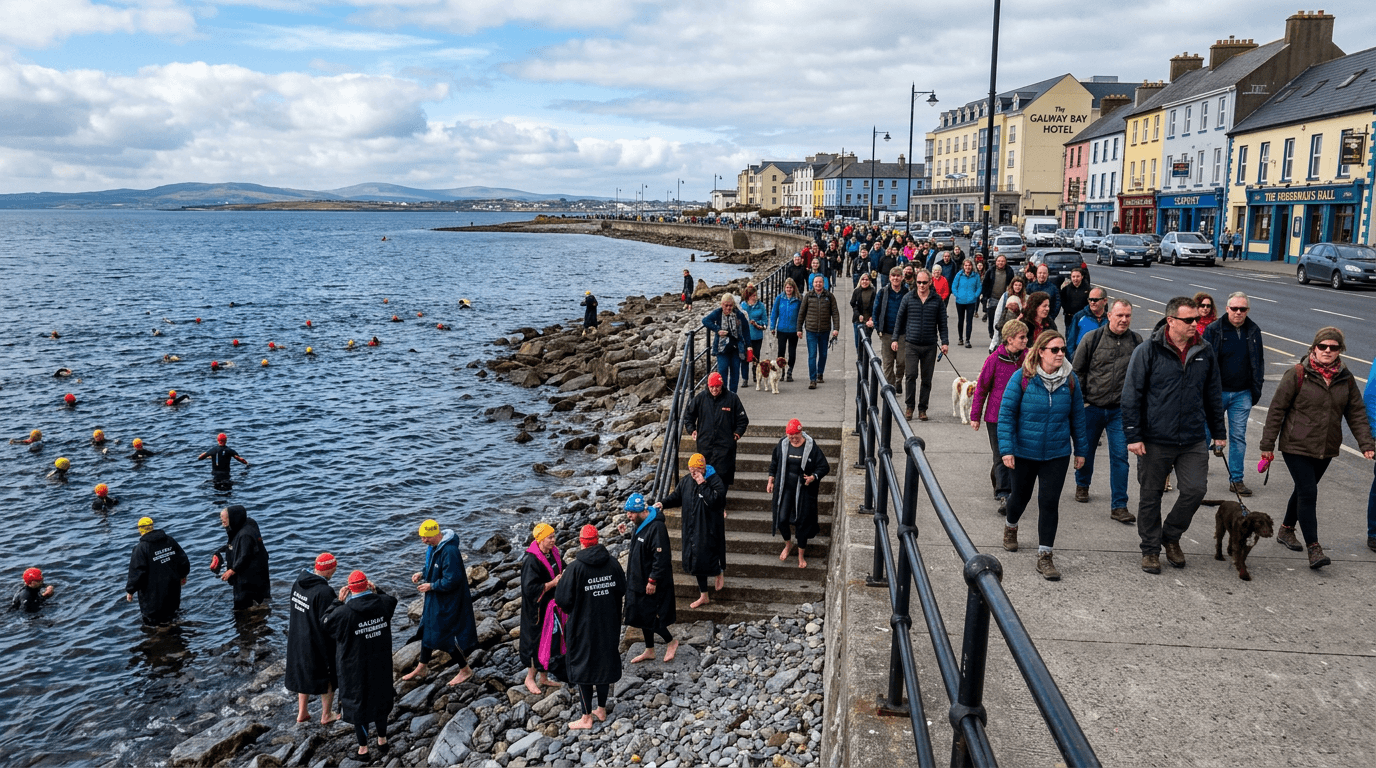
To understand Galway, you must first walk the "Prom." The Salthill Promenade stretches for over two miles along the northern shore of Galway Bay, offering sweeping, panoramic views across the water to the dark, rolling hills of County Clare. It is the longest seaside promenade in Ireland, and regardless of whether it is a blistering summer afternoon or a howling, rain-soaked November morning, it is constantly vibrating with human activity.
The culture of swimming at Salthill is deeply intertwined with the act of walking the Prom. There is an age-old local tradition that dictates you must walk to the very end of the promenade and physically "kick the wall" for good luck before turning back. But for thousands of locals, the walk is merely a warm-up. All along the rocky shoreline that borders the pedestrian path, you will see small, dedicated enclaves of swimmers descending the stone steps, stripping off their layers, and wading into the bracing waters of Galway Bay.
- The Beaches: Salthill is essentially a succession of small beaches separated by rocky outcrops. Grattan Beach and Ladies Beach offer gradual, sandy entries into the water, making them incredibly popular for families and those who want a gentle acclimatization to the cold. The water here is relatively sheltered from the worst of the open ocean swell, providing a safe, manageable environment for wild swimming beginners.
- The Atmosphere: The energy here is relentlessly social. Swimmers leave their brightly colored dryrobes draped over the railings, and the air is thick with the smell of salt and the sound of chatter. It is arguably the most accessible wild swimming spot in the country, given its immediate proximity to a major urban center.
2. The Icon: Blackrock Diving Tower

At the very end of the Salthill Promenade stands the undisputed symbol of Galway's swimming culture: the Blackrock Diving Tower. This striking, multi-tiered concrete structure juts out into the sea, silhouetted against the sky like a brutalist monument to aquatic bravery. Since the 1950s, it has served as the ultimate proving ground for locals and the most sought-after photo opportunity for visiting wild swimmers.
Swimming at Blackrock is entirely dictated by the lunar cycle. At low tide, the sea retreats dramatically, leaving the tower stranded above a rocky, kelp-covered seabed. During these hours, swimming is largely confined to wading in the shallows further down the beach. However, as the tide rushes back in, flooding the bay and rising up the concrete pillars of the tower, Blackrock transforms into a theater of adrenaline.
- The Jumping Culture: High tide at Blackrock is a spectacle. Swimmers line up on the various levels of the diving boards, ranging from a few feet above the water to the intimidating top tier. Plunging from the top board into the freezing, dark green water of Galway Bay is a rite of passage. The water is deep, but the shock of the cold combined with the impact of the jump requires strong swimming ability and absolute confidence.
- Safety Protocols: Do not attempt to jump from Blackrock if you have never experienced cold water shock. The sudden immersion can cause involuntary gasping. We highly recommend climbing down the ladders or steps first to acclimatize your body to the temperature before attempting a dive. Furthermore, always check the depth of the water and observe the locals before leaping; the tidal height changes rapidly.
3. Beyond the City: Silverstrand and Barna
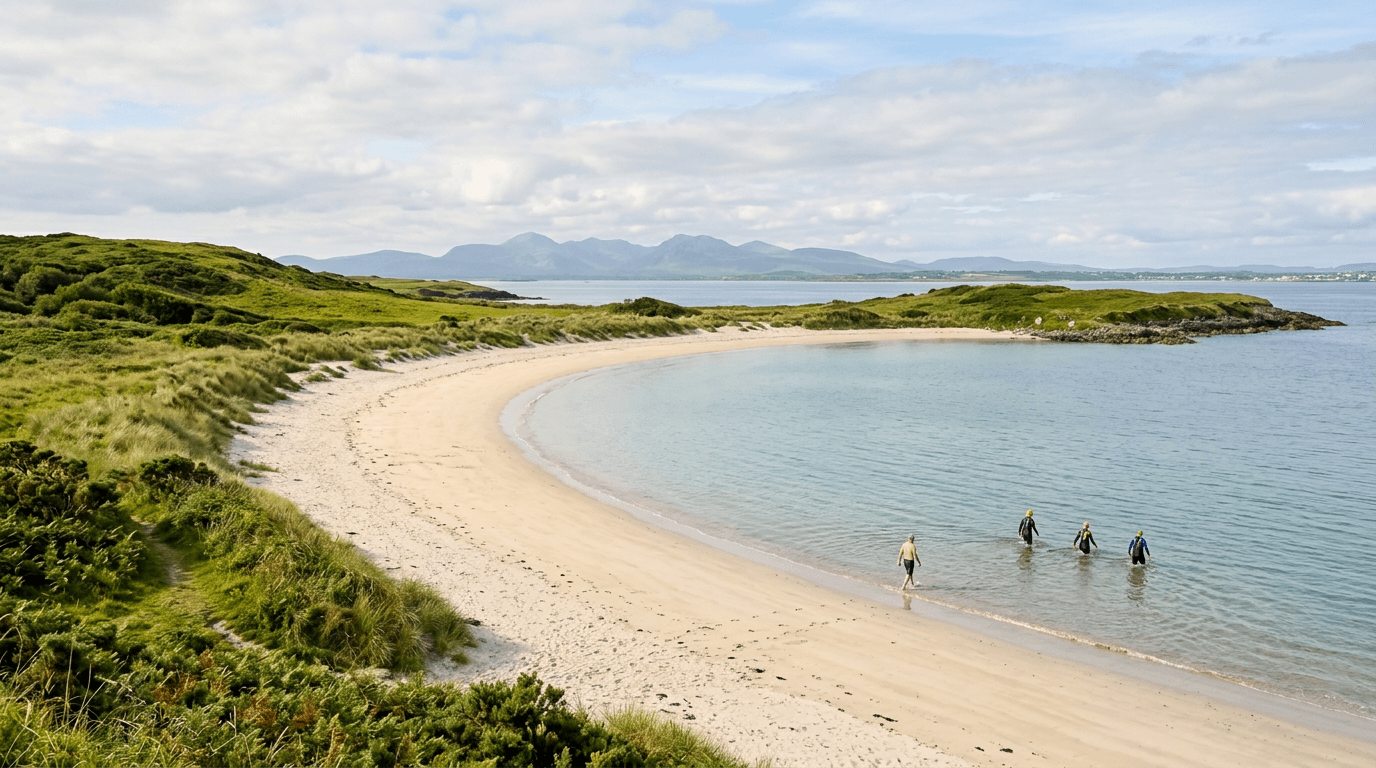
While Salthill commands the lion's share of the attention, those willing to venture just a few miles further west along the coast road toward Connemara will be richly rewarded. As you leave the city limits, the landscape quickly sheds its urban skin, becoming wilder, quieter, and deeply scenic.
Silverstrand (Trá na gCeann) in the village of Barna is a stunning, Blue Flag-awarded sandy beach facing directly out into Galway Bay. It is flanked by a protective cliff on one side and a grassy headland on the other, providing excellent shelter from the prevailing westerly winds. At low tide, a vast expanse of hard-packed sand is revealed, perfect for walking. At high tide, it offers some of the cleanest, most invigorating swimming on the Galway coast, without the intense crowds of the Prom.
- The Connemara Gateway: Swimming at Silverstrand feels like standing on the threshold of the true wilderness. As you float in the water, you can look west toward the Gaeltacht (Irish-speaking regions) and the rugged peaks of Connemara. It is common to see traditional Galway Hookers (boats with distinctive red sails) gliding across the bay in the distance.
- The After-Swim: Barna village is heavily celebrated for its culinary scene. After a freezing dip at Silverstrand, retreating to a local pub in the village for a bowl of world-class seafood chowder and a slice of heavily buttered brown bread is an essential part of the experience.
4. Crossing into Clare: The Burren Coastline
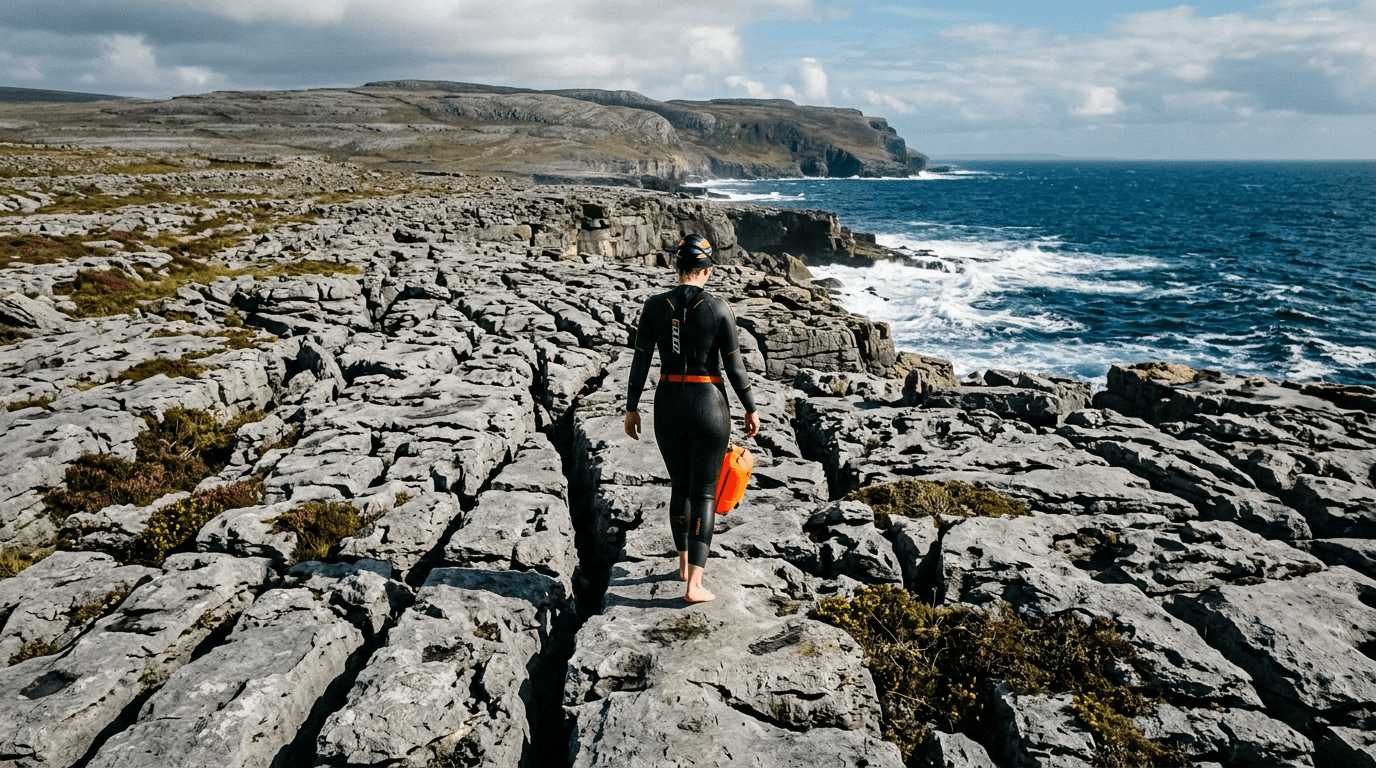
If you gaze across Galway Bay from the Salthill Prom, the landmass staring back at you is the northern edge of County Clare. The coastline of Clare is globally renowned for two things: the colossal, vertical drop of the Cliffs of Moher, and the alien, limestone pavement of the Burren. Swimming in Clare is an exercise in engaging with some of the most dramatic and ancient geology on earth.

The coastline from Ballyvaughan down to Doolin is rugged and heavily exposed to the Atlantic weather fronts. While there are sandy beaches like Fanore (a legendary surfing destination), the true wild swimming spots here are often rocky, hidden inlets where the limestone shelves gently slope into the sea. The water in Clare is famously clear, filtered by the limestone bedrock, giving it a vibrant, almost Caribbean turquoise hue when the sun shines, belying its freezing temperature.
Swimming in the Burren region is a sensory overload. You walk barefoot across smooth, grey rock formations that have existed for hundreds of millions of years, stepping carefully around deep fissures (grikes) filled with rare alpine and Mediterranean wildflowers that bloom side-by-side. You slide into the crisp, clear water, surrounded by an ancient landscape that looks more like the surface of the moon than the coast of Ireland. For those looking to combine this stark beauty with intense heat, there are incredible mobile saunas tucked along this coast, which we cover extensively in our Best Outdoor Saunas in Ireland: Coastal Wood-Fired Warmth guide.
5. The Masterpiece: The Pollock Holes of Kilkee
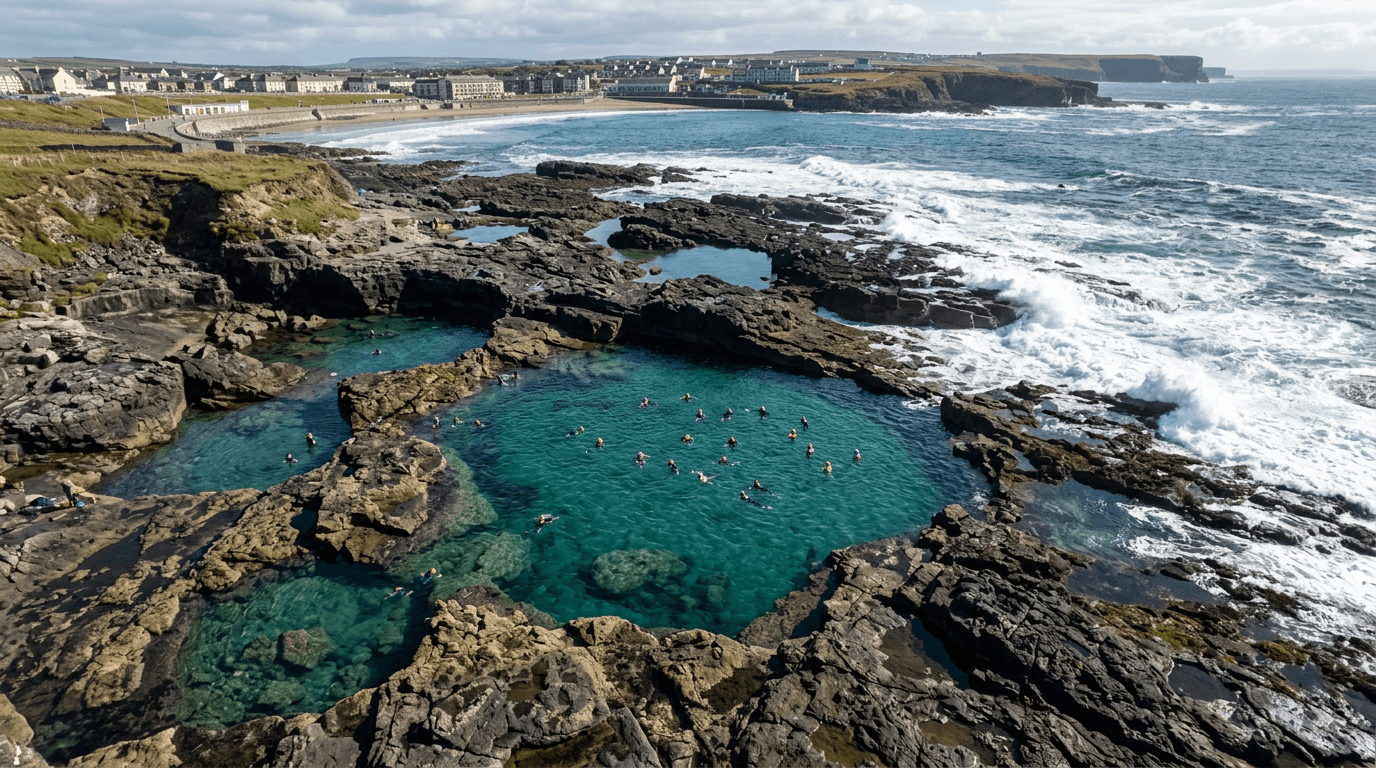
If you continue driving south down the Clare coastline, past the massive sea cliffs and the traditional music hubs, you will eventually reach the Victorian seaside resort town of Kilkee. Kilkee is built around a beautiful, horseshoe-shaped bay, but its greatest secret lies just beyond the main beach, hidden in the flat, expansive reef known as the Duggerna Rocks.
Here, nature has carved out an intricate network of massive, crystal-clear tidal pools known as the Pollock Holes. These are not small rock pools where children hunt for crabs; these are vast, deep, natural swimming pools, some the size of an Olympic diving well, completely replenished by the ocean twice a day.
- The Phenomenon: Swimming in the Pollock Holes is a surreal experience. The pools are protected from the violent crashing waves of the open Atlantic by a massive natural breakwater of reef. Because the water in the pools is temporarily cut off from the main ocean during low tide, the sun warms it slightly, making it a few degrees warmer than the open sea.
- The Clarity: The water clarity in the Pollock Holes is unrivaled. As you swim, you can look down through twenty feet of pristine, glass-like water to see the vibrant kelp forests, darting fish, and the complex rock formations of the pool floor. It feels like swimming in a giant, natural aquarium.
- The Timing: The Pollock Holes are heavily dependent on the tidal cycle. They are only accessible, and safe to swim in, for a window of about two hours before and two hours after low tide. At high tide, the ocean completely reclaims the reef, and the pools disappear entirely beneath the crashing waves.
6. The Post-Swim Ritual: Chowder & Culture
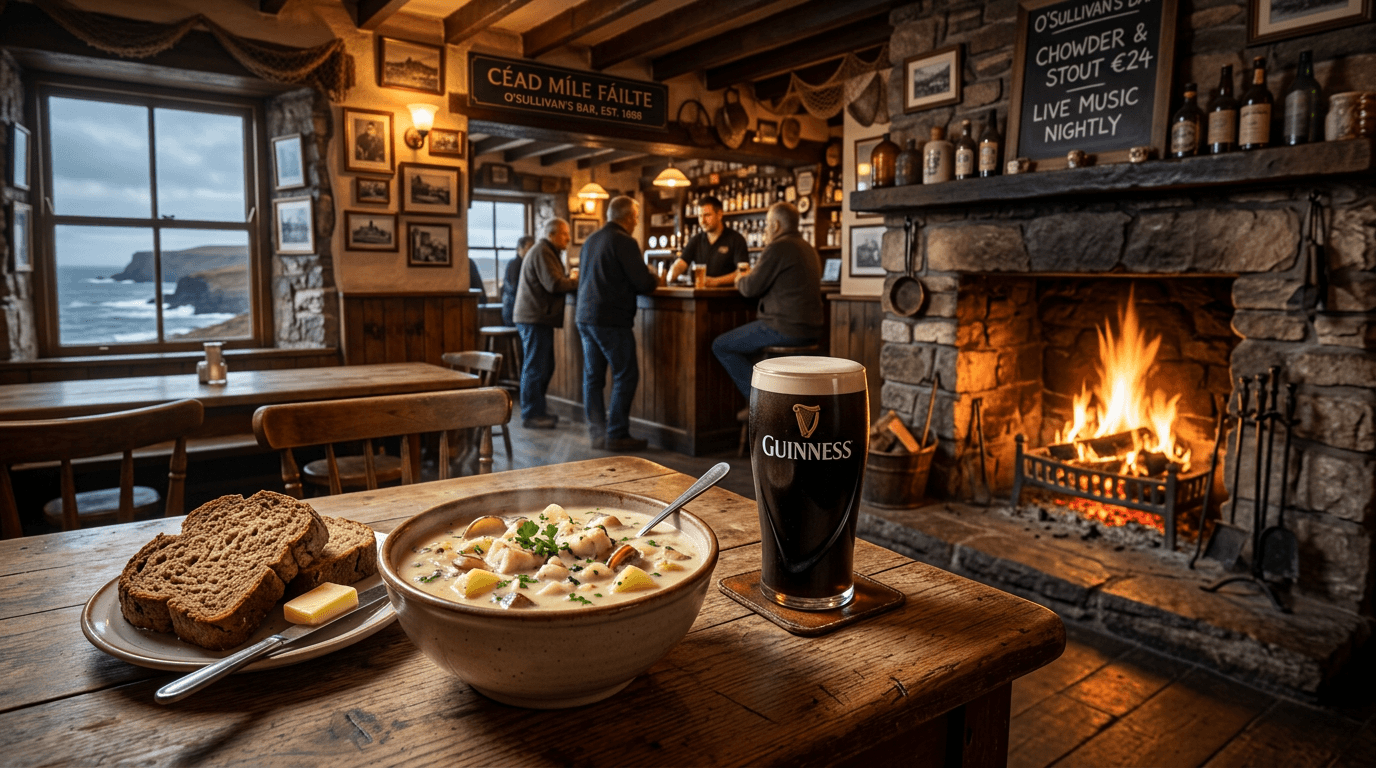
The wild swim is only the first act of the play. In Galway and Clare, the post-swim recovery is elevated to an art form. The immediate priority is combating the "After Drop"—the sudden plummet in core body temperature that occurs once you leave the water. After wrestling your way into your dry clothes on a windy pier, the hunt for warmth begins.
This region of Ireland is a culinary powerhouse, heavily focused on what is pulled directly from the ocean. The ultimate, unbeatable post-swim meal is a steaming bowl of traditional Irish seafood chowder. Packed with locally caught salmon, smoked haddock, mussels, and potatoes in a rich, creamy broth, it thaws the body from the inside out.

Finding the best chowder, the pub with the warmest turf fire, or the café with the best artisan coffee requires local insight. Many visitors miss out on the finest culinary experiences simply because they do not know which unassuming, brightly painted pub in a Clare village houses a world-class chef.
7. Logistics: Navigating the West Coast
The beauty of the West Coast is matched only by the difficulty of its logistics. If you are planning to explore the wild swimming spots of Galway and Clare, you must be prepared for the realities of the infrastructure.
The Salthill Parking Squeeze: On a sunny Saturday, or during a high tide when the jumping tower is active, finding a parking space along the Salthill Promenade is akin to winning the lottery. The traffic crawls to a standstill, the residential side streets are gridlocked, and you can easily spend forty-five minutes circling in a rental car while your desire to swim slowly evaporates.
The Burren Driving Challenge: Driving the coastal roads of Clare to reach spots like Kilkee or Fanore is visually stunning, but physically demanding. The roads are incredibly narrow, tightly winding, and often shared with large tour buses attempting to navigate the hairpin bends of the Cliffs of Moher route. Driving a manual rental car on the left side of these roads while shivering from a cold swim is stressful and exhausting.
The Value of Local Guides: This is where the true value of local expertise becomes apparent. The ultimate way to experience this rugged coastline is to hand the logistics over to a professional.
Booking a Local Private Driver means you bypass the parking nightmares entirely. You are dropped off directly at the Blackrock tower or the edge of the Pollock Holes. When you emerge from the water, you step immediately into a heated vehicle, rather than a cold rental car parked a mile away.
Furthermore, combining your swimming itinerary with a Local Food Guide or a Coastal Walking Guide guarantees that you aren't just ticking locations off a list. A walking guide knows the exact hour the Pollock Holes become safely accessible. A food guide knows exactly which pub in Barna has the fire lit and the freshest oysters waiting. By utilizing local experts, you transform a potentially stressful road trip into a seamless, deeply authentic cultural immersion, supporting the local economy while you focus entirely on the magic of the Atlantic.
Conclusion: The Shock and the Awe
Swimming the coastline of Galway and Clare is not a passive vacation activity; it is a full-body engagement with the elements. It is the shock of the cold water at Blackrock, the awe of the ancient rocks in the Burren, and the sheer joy of floating in the crystal clarity of Kilkee.
The West Coast will test you, thrill you, and welcome you into its vibrant, shivering community. Respect the tides, pack your warmest layers, and let the local experts guide you to the edge. The water is waiting.
Enhance Your West Coast Dip
Don't let driving fatigue or parking stress ruin the euphoria of your wild swim. Connect with a local expert to handle the logistics, guide you to the safest spots, and find the best post-swim chowder.
Find a Private Driver or Local Guide in Galway & Clare Here →
Table of Contents
Share this post
More from the Blog

Cork to Blarney Castle Day Trip: The Stone, the Gardens and What Else to See
Plan a Cork to Blarney Castle day trip. Kiss the stone, explore the Poison Garden, and add Cork city, Fota or Kinsale for a full day out.

Cork to Cobh Day Trip: Titanic, Colourful Houses and Harbour History
Plan a Cork to Cobh day trip by train, car or private driver. Explore Titanic history, St Colman's Cathedral, Spike Island and the best harbour views.

Cork to Killarney Day Trip: Lakes, Mountains and Muckross in One Day
A Cork to Killarney day trip is a longer escape into Kerry. Here's how to plan the drive, what to see in Killarney National Park, and why a private driver helps.