
Sea Kayaking for Beginners in Ireland: What Your First Session Will Actually Feel Like
Sea Kayaking for Beginners in Ireland: What Your First Session Will Actually Feel Like
You are standing on a slipway somewhere on the west coast of Ireland. Your guide is showing you how to hold a paddle — low angle, not a canoe paddle, don't white-knuckle it. The wetsuit feels like a second skin you haven't grown into yet. The sea in front of you is grey-green and flat, and it is absolutely, unmistakably the Atlantic Ocean.
This is what the first five minutes feel like. Not terrifying. Not what the brochure promises either. Just real, and a little uncertain, and already far more interesting than you expected.
If you've been curious about sea kayaking in Ireland but assumed it was for people who already know what they're doing, this is for you. Sea Kayaking in Ireland: A Complete Guide covers the full picture of paddling the Irish coast — this article is for the specific experience of doing it for the very first time.
What Happens Before You Ever Touch the Water
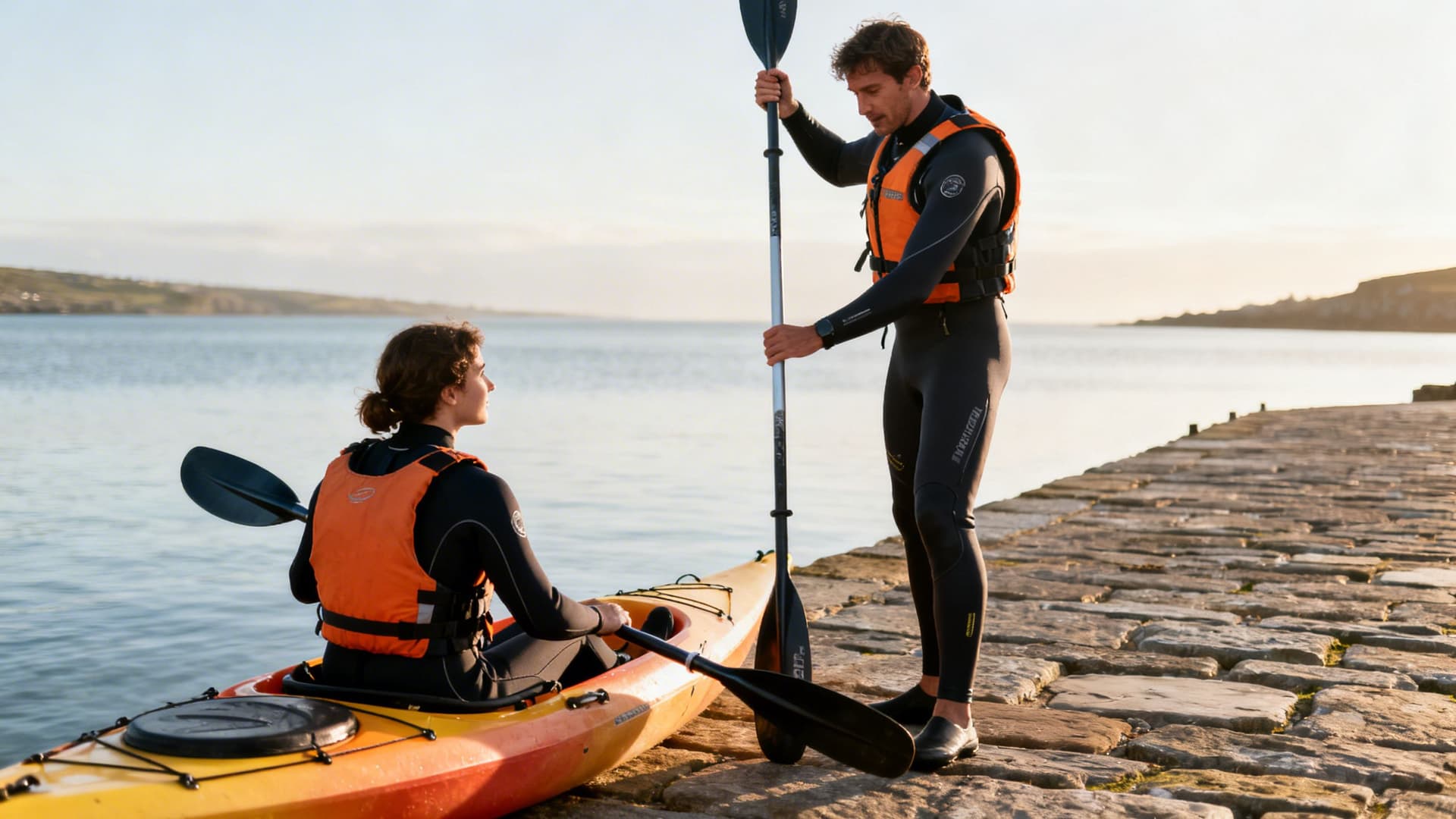
Your guide will spend twenty to thirty minutes with you on shore before you launch. This is not a formality. It is the most important part of the session, and a good guide will not rush it regardless of whether the swell is rising.
You'll learn how to hold a paddle properly — horizontal grip, loose wrists, the torso doing most of the rotation rather than your arms. You'll practise a forward stroke standing on dry land, which feels slightly absurd until you're on the water and your body already knows what to do. You'll get a clear explanation of how to wet exit: what to do if you capsize. Most beginners spend the first hour quietly hoping this topic won't come up. The guide covers it anyway, directly, because a paddler who knows exactly what to do if they flip is a paddler who doesn't panic.
You'll also hear about the water you're about to paddle. Not a generic safety speech — a specific account of this stretch of coast today. Where the current runs, whether there's any swell expected to push in from the southwest, which direction the wind is likely to turn. A local guide has paddled the same water in every condition. That briefing is not standard procedure. It is the entire reason you chose a guided session over a hire-it-yourself afternoon.
The First Twenty Minutes on Water
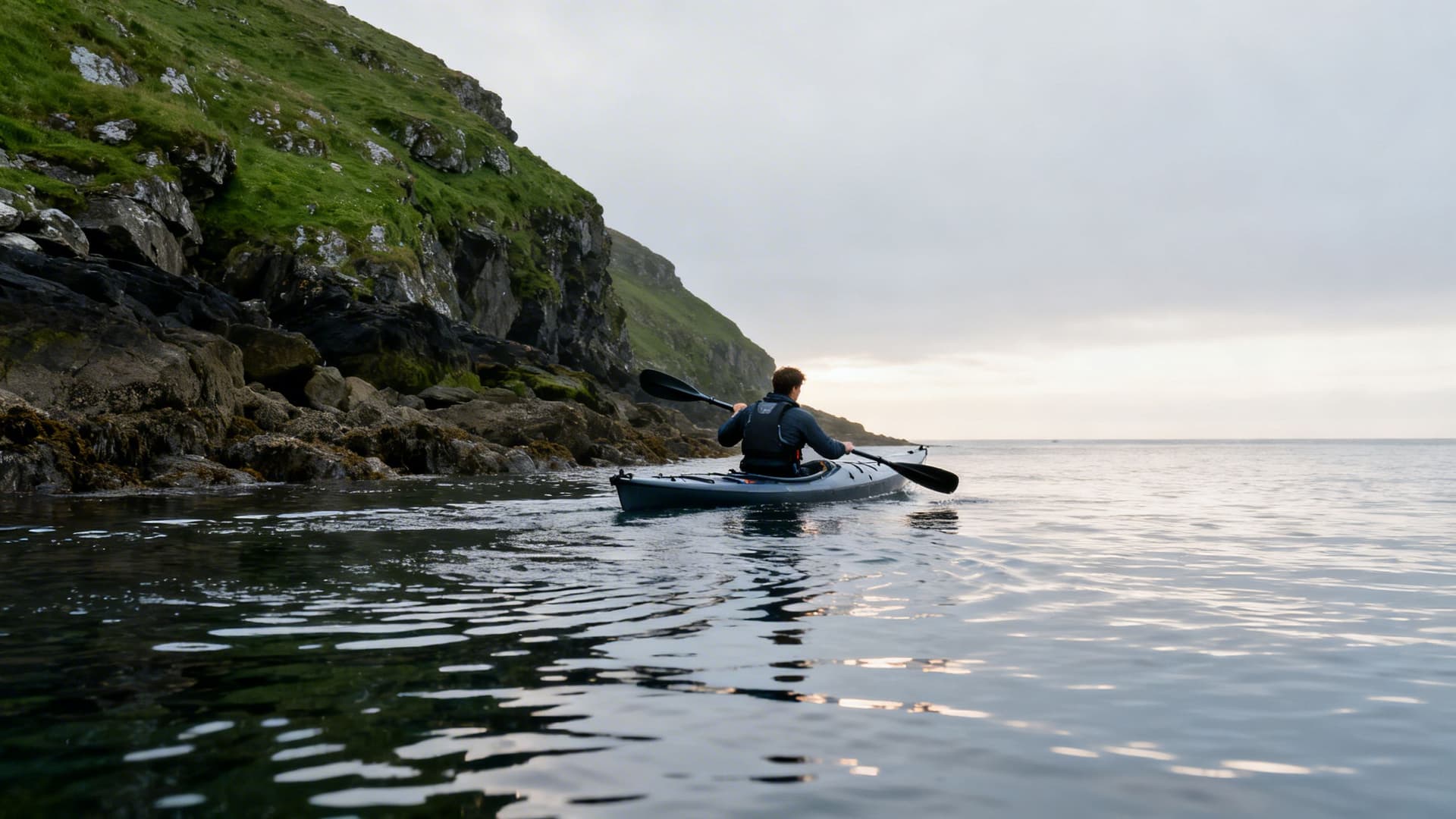

You will feel unstable. This is expected, and it passes faster than you think.
The kayak sits lower than you imagined. The water is right there, a few inches from your hip. The first strokes feel tentative — every paddler on their first session instinctively tries to use the paddle to keep themselves upright rather than to move forward. Your guide will remind you to look at the horizon, not at the water beside you. Almost immediately, your body stops bracing and starts paddling.
Around the fifteen-to-twenty-minute mark, something shifts. You stop thinking about balance and start thinking about direction. The paddle feels less like a balancing pole and more like a tool. You take a stroke, the kayak responds, and for the first time it feels like you're doing something rather than just surviving it.
This is the turning point that happens in almost every beginner session on the Irish coast. The guides who do this every summer watch for it. Once you've passed it, the rest of the morning opens up.
Where You'll Be by Lunchtime
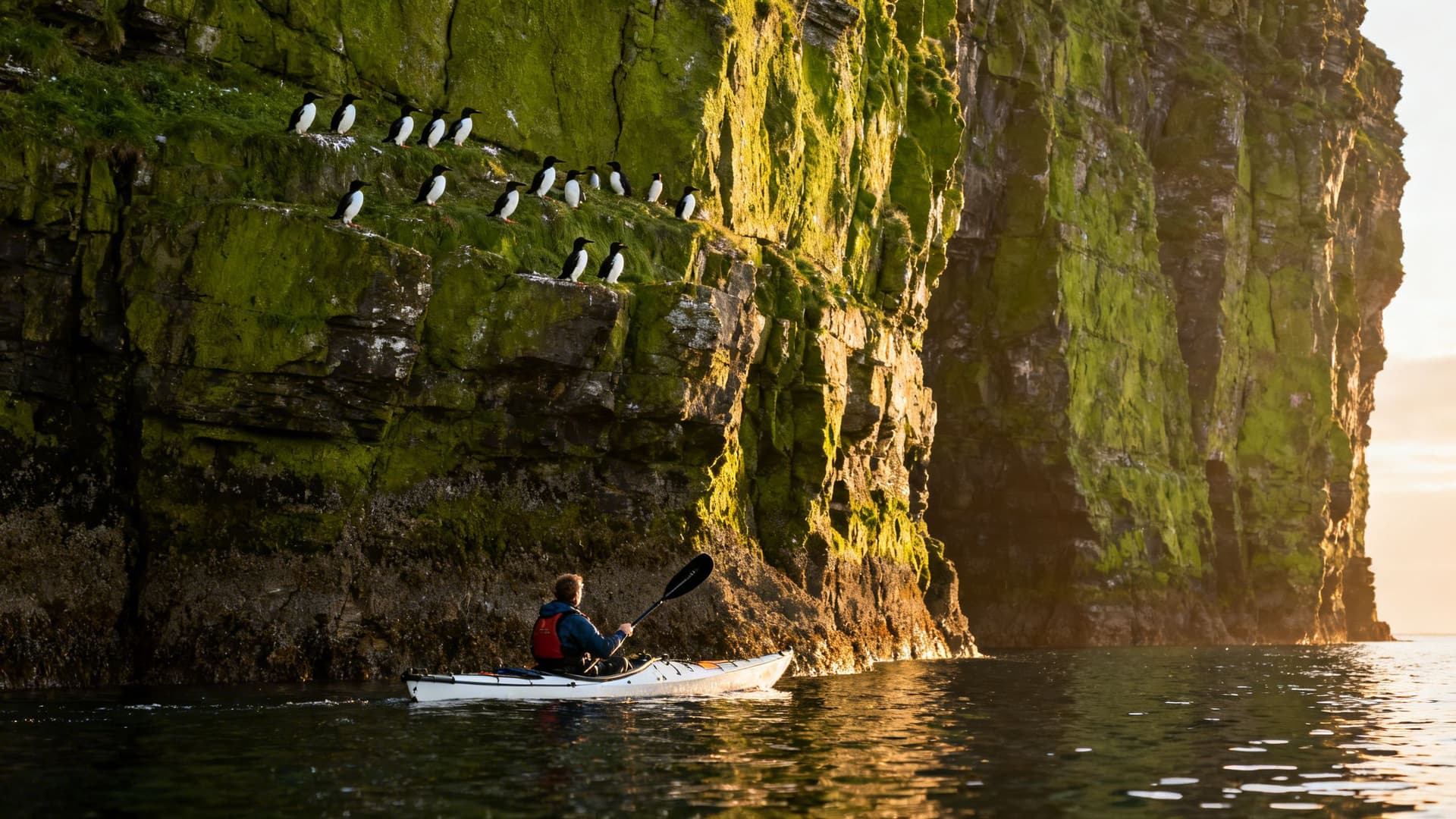
People are consistently surprised by how much ground they cover and how quickly confidence arrives.
By late morning on a standard beginner session, you'll typically be a kilometre or more from your launch point — which means you're seeing a stretch of Irish coastline that most visitors never access. Not from a cliff path above it, and not from a road running parallel to it, but from water level, inside the geography. Cliffs that looked flat from the viewing point above have depth and texture from below. Caves you didn't know existed open up as you round headlands. Seabirds that ignore the tourist trail entirely — guillemots, razorbills, choughs on the cliff face — carry on as though you've always been there.
The physical exertion is real but not brutal. By lunchtime your shoulders will have had a genuine workout and your forearms will remind you that paddling uses muscles that a hotel gym does not. You'll also, almost certainly, be hungry in a specific way that happens after a morning spent in salt air on moving water.
Why the Atlantic Coast Is Not a Lake in a Park
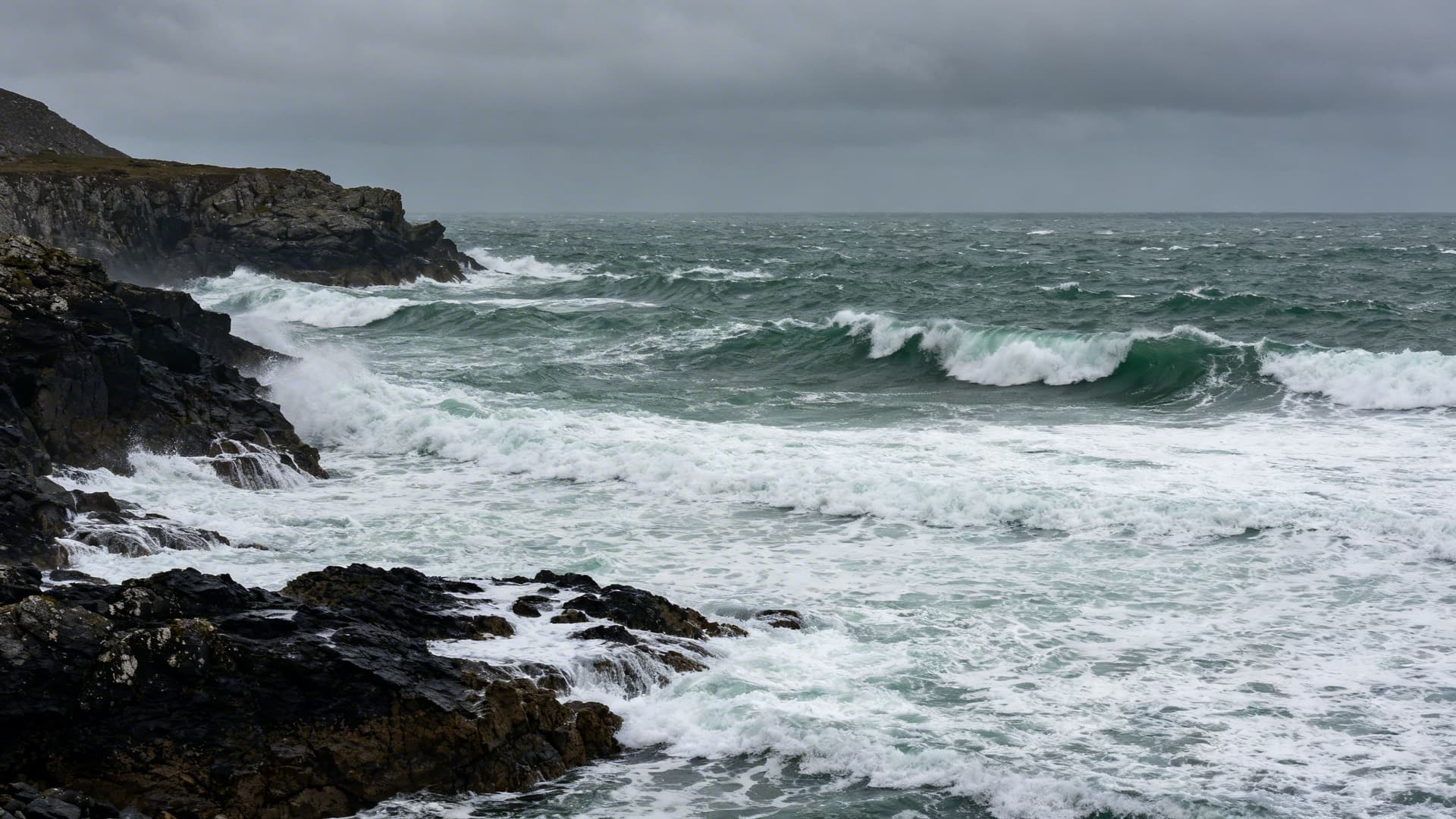
If you've tried kayaking on flat inland water before — a lake, a canal, a harbour — the Irish Atlantic coast is a different proposition, and this matters for beginners.
The west coast has tidal currents that change over the course of a session. Atlantic swell can build from the southwest with very little warning visible at launch. Water temperature even in summer rarely climbs above 15°C — cold enough that an unexpected capsize without proper kit is a serious event, not just an inconvenience. None of this makes the coast dangerous for beginners. But it does mean that what makes it genuinely safe for beginners is a guide who knows it well.
A guided session isn't just instruction in paddling technique. It is access to a body of local knowledge that a beginner has no other way of obtaining: which bays are sheltered when the swell picks up, which passages are tidal traps that look benign and are not, what the sky over the Atlantic tells you about the next two hours. These are things that take seasons to learn. Your guide has done exactly that. For What to Pack for Sea Kayaking in Ireland: A Practical Kit List, the same principle applies to gear — local conditions determine what you actually need in a way that a general-purpose kit list cannot.
What a Guide Changes About Your First Session
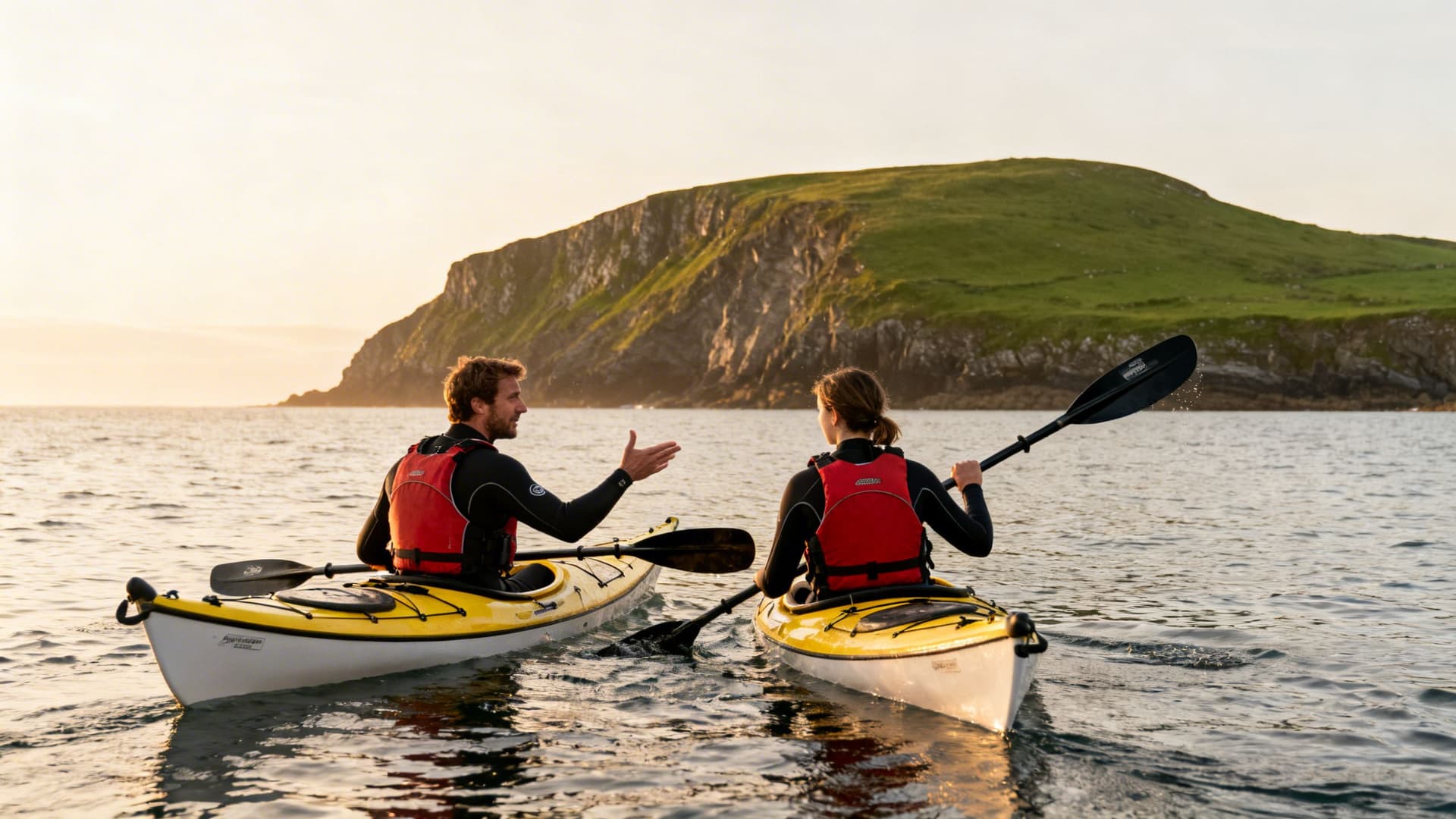
There is a version of this where you hire a kayak from a shed at a beach car park, push out alone, and have a reasonable time if the conditions are kind. That version exists, and some people do it.
A guided first session is a different experience in kind, not just in degree. You learn technique that actually sticks because it's being corrected in real time on real water, not from a YouTube video watched the night before. You go somewhere specific — somewhere your guide has chosen because it suits a beginner's first outing and because it's worth seeing. You come back knowing what you're doing, not just having survived.
The safety case is the obvious one on the Atlantic coast: conditions change, local knowledge is not optional, and the sea does not adjust itself to your level of experience. But the guide also makes the session better in every other way. You see more. You learn more. You finish with a clear sense of what the next step would be if you want one.
There are experienced guides running beginner sessions along the west coast sea kayaking guides from Donegal to Kerry. They're local, they know their water, and they'll tell you honestly if the morning isn't suitable for going out.
Frequently Asked Questions
Do I need any experience to try sea kayaking in Ireland?
No experience is necessary for a guided beginner session. Your guide will cover everything you need on shore before you launch — paddle technique, how to steer, and what to do if you capsize. The session is designed specifically for people who have never sat in a sea kayak before.
How fit do I need to be for a beginner sea kayaking session?
A reasonable baseline of fitness helps, but you don't need to be an athlete. A standard beginner session covers between two and four kilometres at a comfortable pace over two to three hours. The technique your guide teaches you makes paddling efficient — you're not fighting the water. If you can walk for a few hours without difficulty, you can paddle.
What should I wear for sea kayaking in Ireland?
Your guide will provide a wetsuit, buoyancy aid, and paddle. If the weather is cool, a thermal underlayer is worth bringing. Avoid cotton — it holds water and gets cold quickly. Old trainers or water shoes that you don't mind getting wet are useful. Your guide will tell you exactly what to bring when you book. For a full breakdown, When to Sea Kayak in Ireland: A Month-by-Month Guide to Conditions, Light, and the Atlantic Swell covers how conditions change across the seasons and what that means for what you wear.
Is sea kayaking in Ireland suitable for children?
Many guides run family sessions suitable for older children — typically ten or twelve and above, depending on the operator. Younger children are sometimes accommodated in tandem kayaks with an adult. Check with your guide when booking. The Atlantic coast requires children to follow safety instructions, so it's worth having an honest conversation with the guide about your specific group before you commit to a session.
What Comes After the First Session
Most people who try a guided beginner session on the Irish coast come back. Not necessarily the next day — but the experience tends to stay with them in a way that a boat tour or a cliffside walk does not. You went somewhere that required something from you. You came back knowing how to do something you didn't know before.
If the first session catches you, Sea Kayaking in Ireland: A Complete Guide is the place to start thinking about where to go next — Connemara, the Dingle Peninsula, the Donegal coast, the islands. All of it is accessible once you know how to be on the water.
Start with one morning. Start nervous, if that's where you are. The turning point comes earlier than you think.
Table of Contents
Share this post
More from the Blog

Cork to Blarney Castle Day Trip: The Stone, the Gardens and What Else to See
Plan a Cork to Blarney Castle day trip. Kiss the stone, explore the Poison Garden, and add Cork city, Fota or Kinsale for a full day out.

Cork to Cobh Day Trip: Titanic, Colourful Houses and Harbour History
Plan a Cork to Cobh day trip by train, car or private driver. Explore Titanic history, St Colman's Cathedral, Spike Island and the best harbour views.

Cork to Killarney Day Trip: Lakes, Mountains and Muckross in One Day
A Cork to Killarney day trip is a longer escape into Kerry. Here's how to plan the drive, what to see in Killarney National Park, and why a private driver helps.