
What to Pack for Sea Kayaking in Ireland: A Practical Kit List
The moment you realise you've packed wrong is always the same. You're in a guesthouse the night before, and something you assumed would be there isn't — or something you assumed you'd need turns out to have been unnecessary. Sea kayaking in Ireland has a specific packing logic, and it's different from what most people expect. The Atlantic doesn't behave like a lake or a river, and the conditions that define Irish coastal paddling — cold water, variable weather, tidal movement — each make demands on your kit that flatwater paddling doesn't.
The Sea Kayaking in Ireland: A Complete Guide covers the full picture of what Irish coastal paddling involves. This article is for the specific question of what to bring, what to leave behind, and how to think about the difference.
Safety Equipment: The Gear the Atlantic Doesn’t Forgive You for Leaving Behind
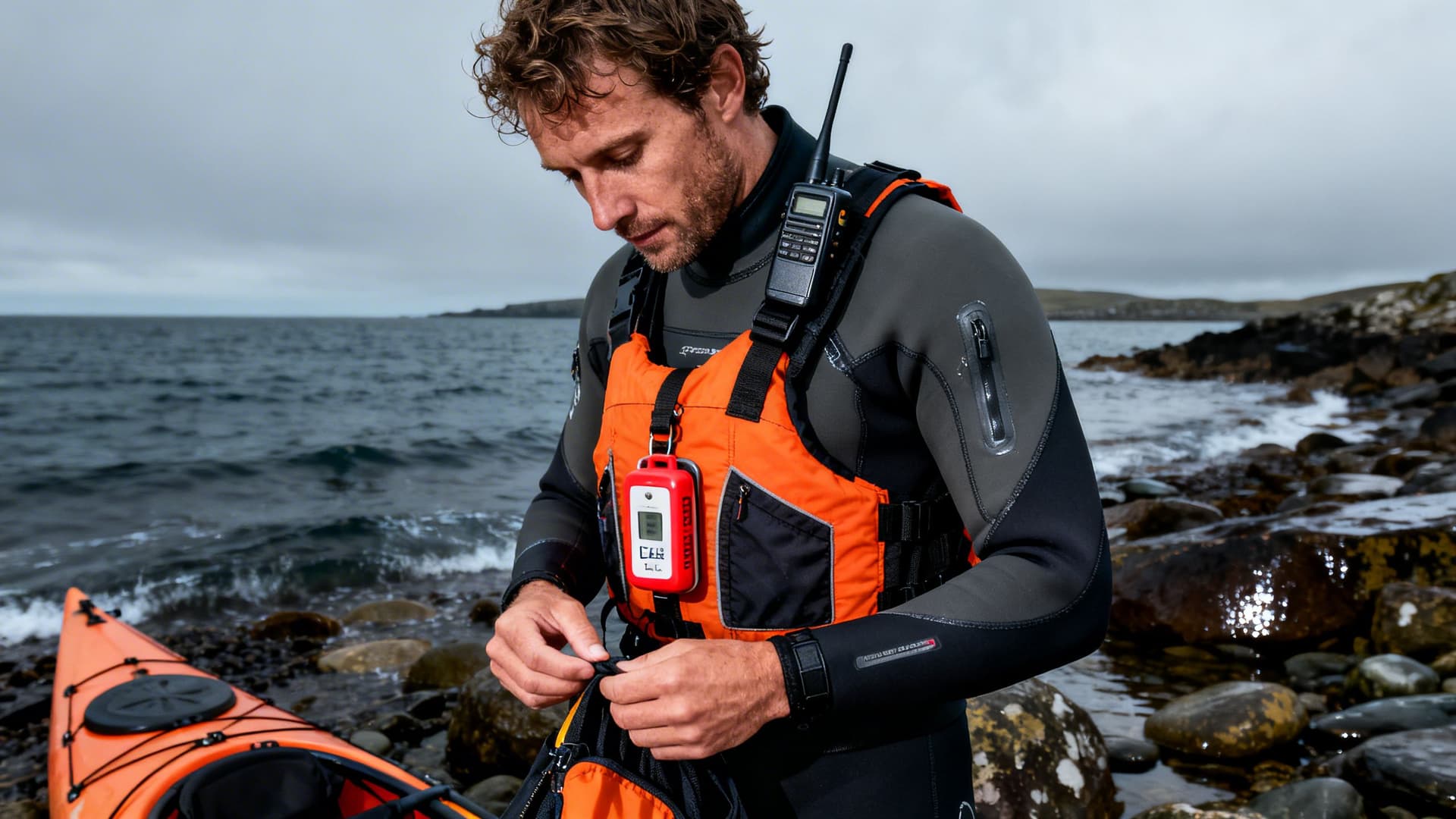
The safety kit for sea kayaking is not the same as the safety kit for a leisure paddle on a sheltered lake. On the Atlantic coast, the consequences of getting into difficulty — capsize in cold water, being blown offshore in a sudden squall, disorientation in sea fog — are serious enough that the equipment you carry is not optional. It is the difference between a recoverable situation and one that isn't.
A personal flotation device (PFD) is the baseline. It must be worn, not stowed in the cockpit. A PFD you haven't put on is equipment in name only. Alongside it: a personal locator beacon (PLB) clipped directly to the chest harness of the PFD, not packed in a dry bag. If you go in, it goes in with you, and you can activate it with cold hands in darkness. That is the requirement it needs to meet.
A VHF marine radio rounds out the core safety kit. Phone signal on the Irish Atlantic coast is unreliable in the places that matter most — the outer islands, the exposed headlands, the sea caves. VHF reaches the Irish Coast Guard on Channel 16 regardless of mobile coverage. Know how to use it before you launch.
Carry a bilge pump, a paddle float for re-entry, and a tow line. These are self-rescue tools. If you paddle with a guide, they carry emergency equipment at a higher specification. But self-rescue capability matters because the person in difficulty and the person with the emergency kit are sometimes separated by a hundred metres of confused water in conditions that make that distance count.
Those who’ve paddled Sea Kayaking in Connemara: Ireland’s Wild Atlantic Coast from the Water will know how quickly the weather and tide picture can change on that coastline. The same logic applies to kit preparation.
Dry Suits vs Wetsuits: The Decision That Matters
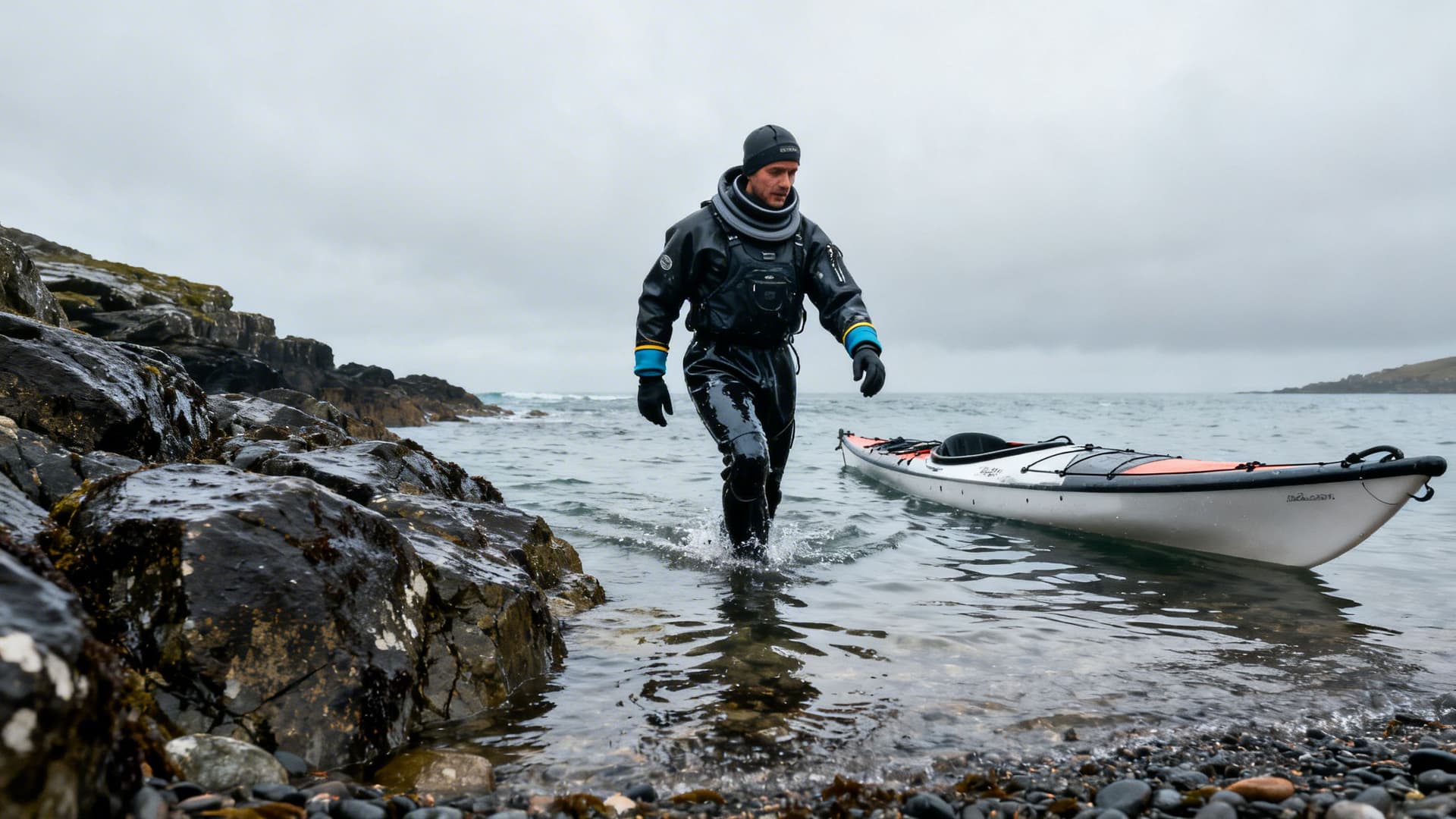

Irish sea surface temperatures range from 8°C in February to 16°C in August. Cold water immersion at those temperatures is incapacitating within minutes and fatal within hours if you’re unprotected. This is not worst-case thinking — it is the standard operating environment for sea kayaking in Ireland year-round.
The right answer for most people, in most Irish conditions, is a dry suit.
A dry suit creates a sealed system between you and the water. The seals at the wrist and neck (latex or neoprene) prevent water entering. You layer underneath according to the air temperature — fleece base layers in winter, lighter synthetic in summer. When you capsize — not if, when — your core temperature stays stable. You don't start a countdown.
A wetsuit works on a different principle: a thin layer of water enters and your body heat warms it, providing insulation. For summer paddling in sheltered bays with air temperatures above 18°C and experienced companions nearby, a good wetsuit (3–5mm full suit) is acceptable. For anything more exposed, anything in colder months, or anything where your swimming ability in cold water hasn’t been tested, a dry suit is not a luxury — it is the correct tool.
Most guided operations in Ireland provide dry suits as part of their kit package. If you’re organising independently, dry suit hire is available in most coastal towns with a paddling scene. Factor this into your planning before arrival.
What Your Guide Provides and What You Carry Yourself
One of the practical advantages of guided sea kayaking is the kit rationalisation it allows. When you understand what an experienced guide carries, you can pack more precisely for your own needs rather than trying to replicate an entire rescue kit for a day session.
A good guide brings: emergency flares (handheld and parachute), a comprehensive first aid kit with hypothermia protocol gear (foil blankets, chemical heat packs), a spare paddle, group tow lines, VHF radio at marine-grade specification, and enough food and water for the group to remain at sea significantly longer than planned. They also carry the local knowledge that shapes every decision about route and timing — which is, in practice, the most important safety asset of all.
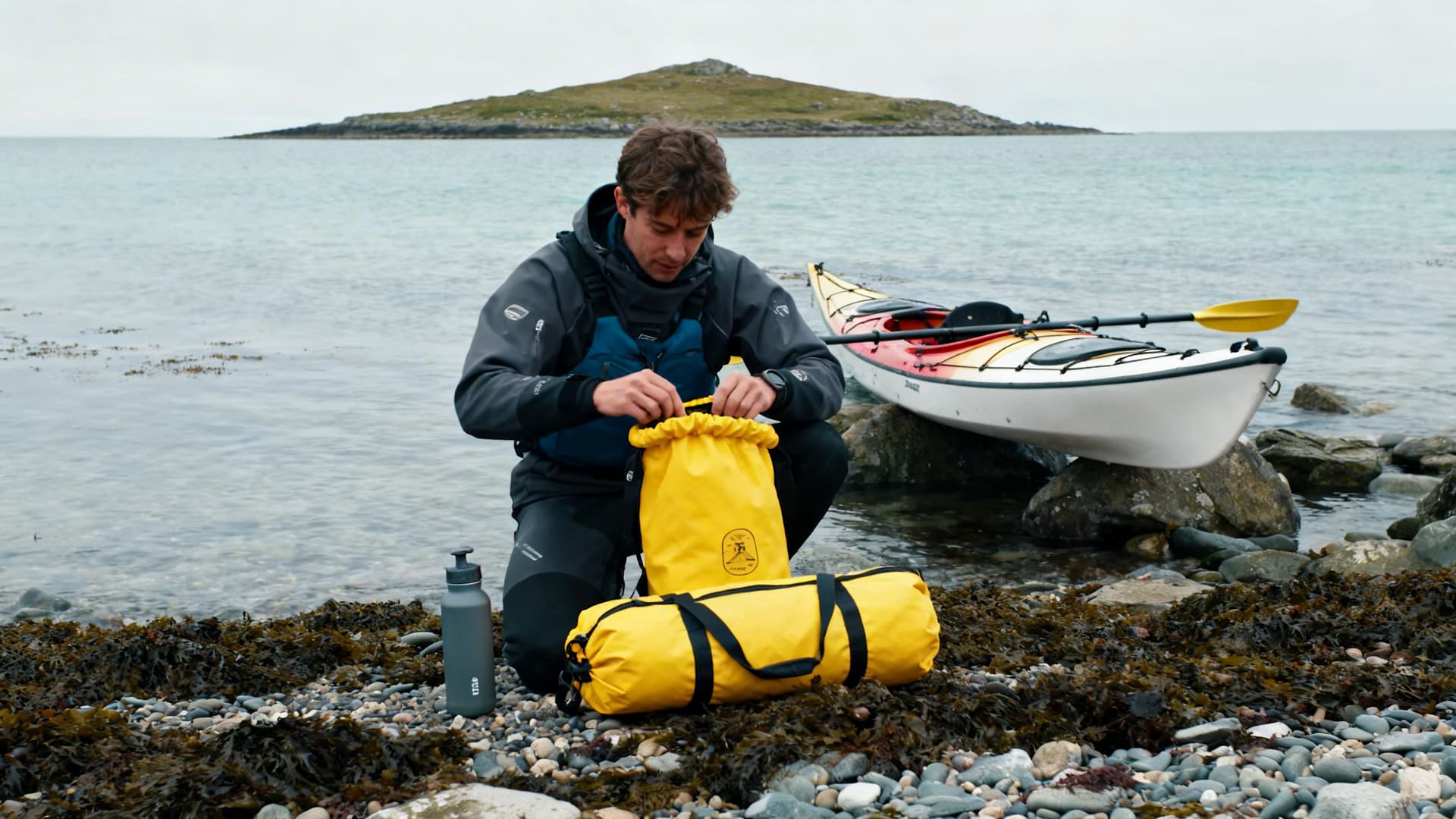
What you carry for yourself: your personal PFD (worn), your PLB (clipped on), water (hydration is easy to neglect on cold water), food for the duration, a dry bag with a dry change of clothing for the return, sunscreen (the reflection off Irish water in summer is significant), and any prescription medication.
A good rule for day kit: everything that needs to stay dry goes in a roll-top dry bag rated to appropriate depth. Everything that needs to be immediately accessible — PLB, VHF, first aid basics — goes on your person or on the deck of the kayak within reach without removing your spray deck.
Pack weight matters on a sea kayak. A well-loaded touring kayak sits lower in the water and handles differently. Unnecessary weight in the bow affects trim and makes the boat less responsive in conditions. If you’re joining a guided day trip, a 15-litre dry bag with personal kit is enough.
Navigation, Tides, and Communication Beyond Your Phone
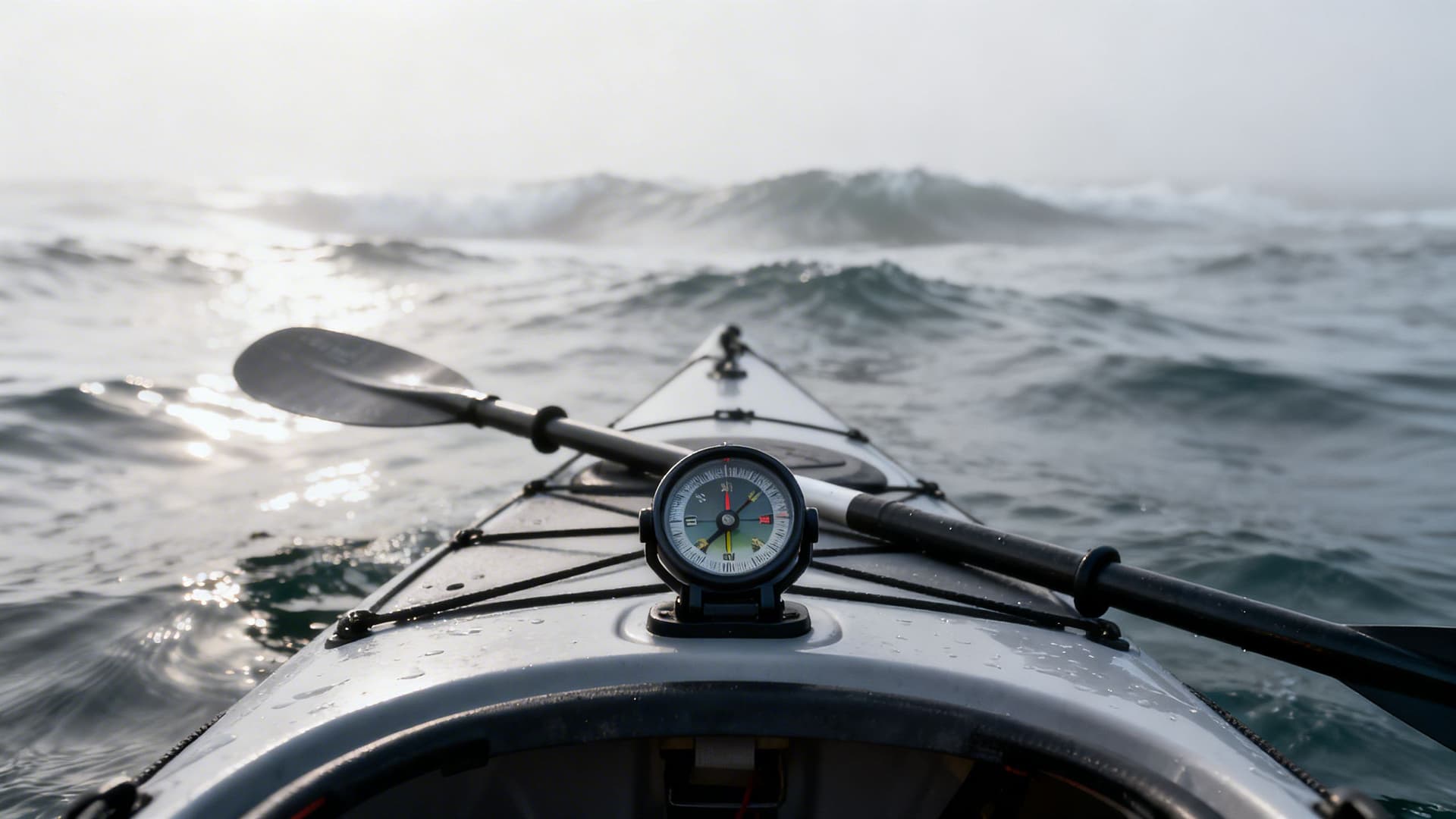
Navigation kit is where a lot of recreational paddlers are under-prepared. The issue is the assumption that a phone does everything. On coastal waters in Ireland, that assumption has a predictable failure mode: you’re three kilometres offshore, the signal drops, your battery is depleted by the cold, and the screen is invisible in the glare.
A deck-mounted compass is the primary navigation tool for sea kayaking. It mounts on the foredeck, remains visible while you’re paddling, and requires nothing from a battery or a network. Learning to navigate by compass bearing in combination with tidal flow and chart knowledge is a skill that takes time — but having the compass is the first step.
A waterproof chart, laminated and secured under the deck bungee, gives you reference points that a phone cannot. For paddling off the Connemara coast or around the Dingle Peninsula, Irish Sea Fisheries Board charts and Admiralty charts cover the relevant waters at the detail you need.
Tides matter more on the Irish coast than almost anywhere in northern Europe. A tidal range of 4 to 5 metres means the same location can look entirely different — and present completely different hazards — at different states of tide. A tidal app downloaded offline before you leave the mobile signal zone, combined with awareness of your target tidal state for key passages, is part of navigation rather than an optional extra.
The Wild Swimming in Connemara: Cold Water and the Western Shore speaks to similar cold-water conditions and the planning mindset they require. The logic carries across water sports on this coastline.
Why a Local Guide Changes What You Need to Pack
A guided sea kayaking trip with someone who knows the Irish coast changes the packing equation in two important ways. First, as described above, you don’t need to replicate their emergency kit — their gear is your safety net, and you can focus your own pack on personal kit. Second, their knowledge removes a category of uncertainty that no amount of equipment solves.
The sea caves accessible only on specific tidal combinations, the passage through the Lettermullan islands that requires local knowledge to time correctly, the exposed crossing where the weather window matters more than anything in your dry bag — these things are navigated by experience, not equipment. You can carry every piece of safety kit on the market and still find yourself in a situation you can’t manage without knowing the water.
The Connemara sea kayaking guides we work with have that knowledge across every season. For first-time visitors, it’s also worth noting that a guided trip means your equipment list gets simpler, not longer — they fill the gaps you don’t know are gaps yet.
Frequently Asked Questions
Do I need to own a dry suit to go sea kayaking in Ireland?
No. Most guided operations include dry suits in their kit package — check when booking. For independent paddling, dry suit hire is available from kayak centres in Clifden, Westport, Dingle, and other coastal hubs. Budget to hire one rather than assume a wetsuit will be adequate; Irish water temperatures make the difference consequential.
What bag should I use for personal gear on a day trip?
A roll-top dry bag in the 10–15 litre range is sufficient for a day session. Look for a bag rated to at least 3 metres submersion. Pack a full dry change of clothes, any food and water beyond what’s on deck, and your phone wrapped in a waterproof case inside the bag. Keep the bag clipped to a point in the cockpit so it doesn’t float away if you capsize and need to wet-exit.
Is a phone app enough for tidal planning?
A tidal app is a useful tool but not a complete solution. Download your tidal data offline before leaving mobile coverage, and cross-reference with a physical chart for the specific area you’re paddling. For key passages — sea caves, tidal channels, headland crossings — talk to your guide or a local paddling club before committing to a tidal window you haven’t personally verified.
What footwear works for sea kayaking?
Neoprene boots (3–5mm) are the standard recommendation. They keep your feet warm in cold water, grip on wet rock when launching and landing, and fit inside most kayak footrests without issue. Avoid trainers — they soak through immediately and offer no insulation. Avoid sandals — they come off in water and provide no protection against sharp rocks during landings.
Conclusion
The right kit for sea kayaking in Ireland is specific rather than general, and the cold water context makes most of it non-negotiable. A dry suit, a PLB clipped to a worn PFD, a VHF radio, and a deck-mounted compass cover the fundamentals. Everything else is personal preference within a well-understood framework.
For the broader context of planning a kayaking trip along the Irish coast, Sea Kayaking in Ireland: A Complete Guide covers routes, regions, and what makes each stretch of coastline different. If you’re heading specifically to the west coast, Sea Kayaking in Connemara: Ireland’s Wild Atlantic Coast from the Water goes into the detail of what conditions and access look like in practice — and why what you pack there matters as much as where you go.
Table of Contents
Share this post
More from the Blog

Cork to Blarney Castle Day Trip: The Stone, the Gardens and What Else to See
Plan a Cork to Blarney Castle day trip. Kiss the stone, explore the Poison Garden, and add Cork city, Fota or Kinsale for a full day out.

Cork to Cobh Day Trip: Titanic, Colourful Houses and Harbour History
Plan a Cork to Cobh day trip by train, car or private driver. Explore Titanic history, St Colman's Cathedral, Spike Island and the best harbour views.

Cork to Killarney Day Trip: Lakes, Mountains and Muckross in One Day
A Cork to Killarney day trip is a longer escape into Kerry. Here's how to plan the drive, what to see in Killarney National Park, and why a private driver helps.