
Beyond the City: Jerpoint Abbey, Dunmore Cave, and Kilkenny’s Hidden Gems
Most visitors to Kilkenny step off the train, walk the Medieval Mile, visit the castle, and then leave.
They are missing half the story.
County Kilkenny is a landscape of rolling green farmland, ancient river valleys, and ruined monasteries that rival anything in Europe. If you are willing to venture 20 minutes outside the city limits, you will find sites that are quieter, more atmospheric, and deeply connected to the ancient past.
For the traveler who wants to escape the crowds and touch the mossy stones of history, here are the three essential stops in the county—and how to get to them.
1. Jerpoint Abbey: The Stone Carvings and the Lost Town
Located about 20km south of the city near the town of Thomastown, Jerpoint Abbey is arguably the finest Cistercian ruin in Ireland. Founded in the 12th century, it was a thriving monastic city until Henry VIII dissolved the monasteries in 1540.
The Cloisters and The "Weepers"
The highlight of Jerpoint is the sculpted cloister arcade. Unlike many ruins that are just bare walls, Jerpoint retains incredible artistic detail. Look closely at the stone pillars; you will see carvings of knights, ladies, dragons, and bishops. These figures are known as "weepers." They provide a humorous and human look at medieval life—showing fashion, armor, and even mythical creatures.
The Legend of Santa Claus
Meet a Local Guide

Hi There
Just a short distance from the Abbey lies the ruined Church of St. Nicholas. According to local legend (and some very enthusiastic local historians), the remains of St. Nicholas of Myra (the inspiration for Santa Claus) were brought here by Crusader knights and buried in the churchyard. While historians debate the accuracy, standing before the cracked effigy slab of a cleric in a quiet Irish field and wondering if you are looking at Santa’s tomb is a unique travel memory you won't forget.
The Lost Town
Jerpoint wasn't just an Abbey; it was a town. Today, if you look at the bumpy fields surrounding the ruin, you are looking at the foundations of a "Lost Town" that disappeared when the Abbey closed. A good guide can help you "read the landscape" and spot the ghostly outlines of the streets and houses that once stood there.
(Travel Tip: You are very close to the studios of Jerpoint Glass here. Combine this trip with a visit to the blowers. See: Made in Kilkenny: Crafts & Shopping).
2. Dunmore Cave: The Viking Massacre
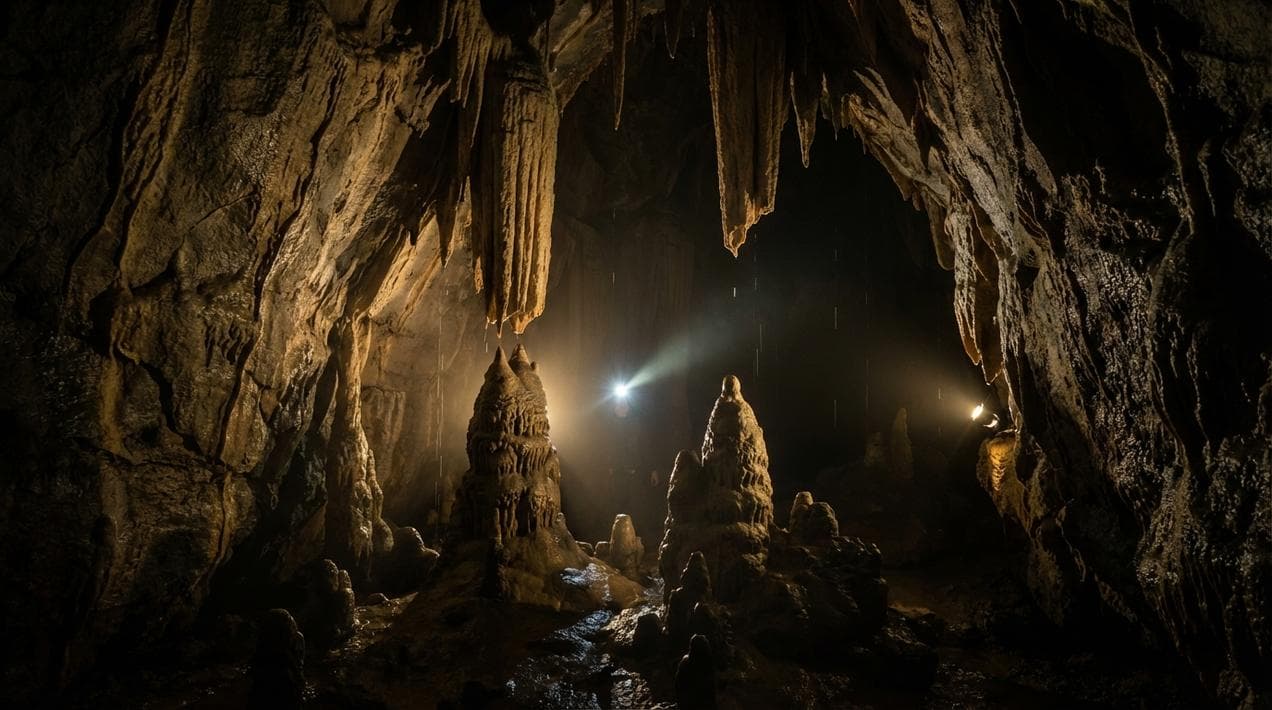
If Jerpoint is peaceful and spiritual, Dunmore Cave (located 10km north of the city) is dark and foreboding.
This is not just a geological curiosity; it is a crime scene.
The History
The Annals of the Four Masters (an ancient Irish text) records that in 928 AD, the Vikings of Dublin marched on Kilkenny. The local women and children fled to Dunmore Cave for safety. The Vikings discovered the hiding spot and, rather than fighting their way in, they lit massive fires at the entrance to smoke the refugees out. It is estimated that 1,000 people died inside. In 1973, archaeologists confirmed the horror of the story when they found the skeletal remains of over 40 women and children deep in the crevices, along with a hoard of Viking silver coins.

The Visit Today
The cave is now managed by the OPW (Office of Public Works). You descend a steep staircase into the limestone darkness. The contrast between the bright green Irish fields above and the cool, silent underworld below is striking. The tour explains both the stunning geology (massive stalagmites like the "Market Cross") and the grim history.
3. Kells Priory: The "Seven Castles"
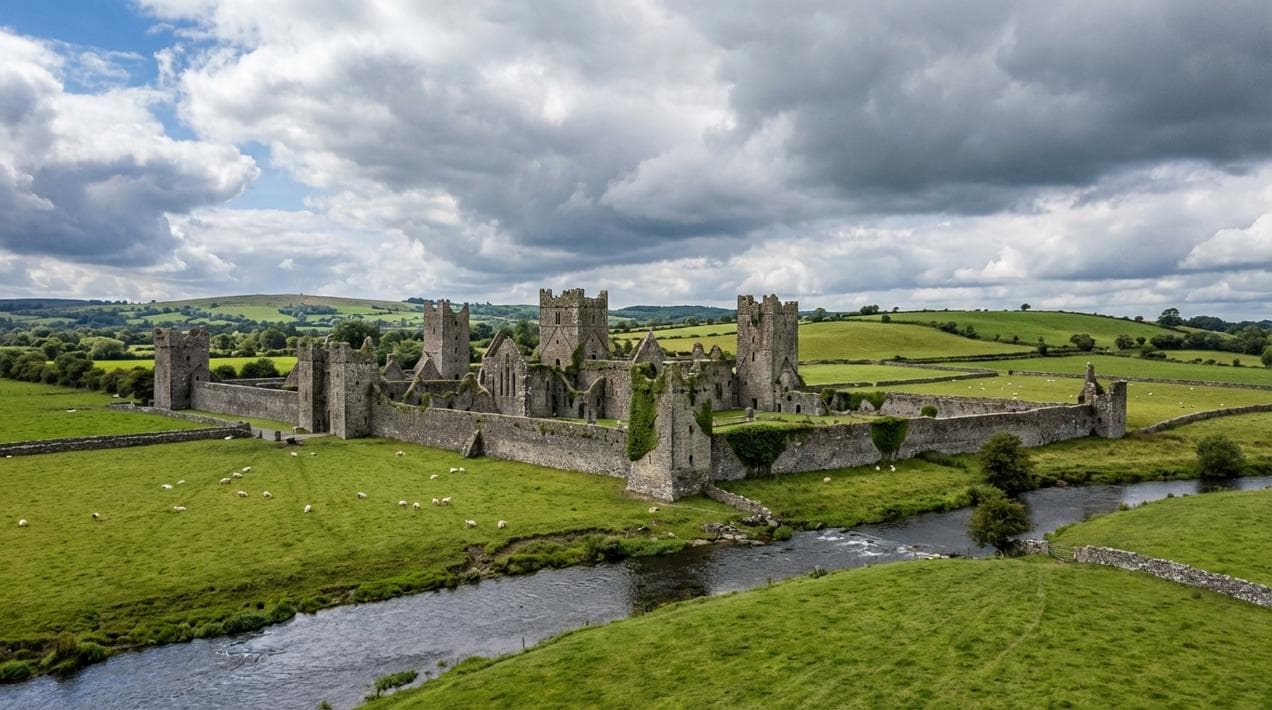
Often overlooked by tour buses, Kells Priory is one of Ireland's most spectacular and extensive medieval monuments.
Located in the village of Kells (not to be confused with the Book of Kells in Meath), this Augustinian priory looks more like a fortress than a church. It is surrounded by a massive fortified wall studded with seven tower houses, earning it the nickname "The Seven Castles of Kells."
- The Experience: Unlike the ticketed entry at Jerpoint or Dunmore, Kells is often open and free to roam (check local signage). It sits in a sheep field by the King’s River. You can walk the perimeter walls and explore the towers. It is vast, silent, and incredibly photogenic.
The Logistics: Why You Need a Car (and a Driver)
Here is the hard truth for US travelers: You cannot easily do this circuit by public transport.
- The Bus Problem: Rural Irish buses are infrequent. You might get a bus to Thomastown, but you will still have a 2.5km walk on a road with no sidewalks to get to Jerpoint Abbey. Dunmore Cave has virtually no direct bus service from the city.

- The Driving Reality: The roads leading to Kells and Jerpoint are classic Irish "R-roads"—narrow, winding, and lined with high hedges. For an American driver used to wide interstates, navigating these roads (on the left side) while looking for signage can be white-knuckle stressful.
The Solution: The Driver-Guide
To see the county properly, hiring a private driver-guide is the smartest logistical move.
- Efficiency: A driver can link these dispersed sites into a perfect 5-hour loop: City -> Dunmore Cave -> Kells Priory -> Jerpoint Abbey -> City.
- Safety: You enjoy the views of the River Nore valley; they watch the road.
- Lunch: A local driver knows exactly where to stop for lunch in the village of Bennettsbridge or Thomastown, ensuring you get a toasted sandwich and chowder that isn't in a tourist trap.
- Access: Drivers can get you right to the gate of Kells Priory, saving you the long walk from the village.
Explore the Hidden County
Don't let the lack of public transport keep you trapped in the city. The true magic of Kilkenny lies in the "Lost Towns," the caves, and the river valleys of the countryside.
Hire a local driver-guide who knows every backroad and boreen, and discover the Ireland that the tour buses drive right past.
Table of Contents
Share this post
More from the Blog

Cork to Blarney Castle Day Trip: The Stone, the Gardens and What Else to See
Plan a Cork to Blarney Castle day trip. Kiss the stone, explore the Poison Garden, and add Cork city, Fota or Kinsale for a full day out.

Cork to Cobh Day Trip: Titanic, Colourful Houses and Harbour History
Plan a Cork to Cobh day trip by train, car or private driver. Explore Titanic history, St Colman's Cathedral, Spike Island and the best harbour views.

Cork to Killarney Day Trip: Lakes, Mountains and Muckross in One Day
A Cork to Killarney day trip is a longer escape into Kerry. Here's how to plan the drive, what to see in Killarney National Park, and why a private driver helps.