
Best Dublin Sea Swimming Spots: Forty Foot, Vico & Seapoint
If you want to understand the modern soul of Dublin, you should not look in the bottom of a Guinness glass in Temple Bar. Instead, you need to look toward the horizon line of Dublin Bay at seven o'clock on a freezing Tuesday morning. Long before the city center offices have opened their doors, the rugged coastline stretching from the northern peninsulas down to the affluent southern suburbs is already alive with activity. Thousands of Dubliners—armed with neoprene gloves, oversized changing robes, and flasks of scalding hot coffee—are participating in the city’s most defining daily ritual: the sea swim.
Sea swimming in Dublin is not a new phenomenon, but it has evolved dramatically from its austere Victorian origins. What was once a Spartan health pursuit reserved for eccentric locals has blossomed into a massive, vibrant, and inclusive cultural movement. The coastline here is uniquely blessed. The commuter train line (the DART) hugs the sweeping curve of the bay, providing glimpses of secluded coves, imposing Martello towers, and concrete bathing shelters that have stood against the Irish Sea for over a century. It is a striking juxtaposition of urban living and raw, untamed nature, existing mere miles from the bustling city center.
However, swimming in the capital comes with its own unique set of challenges. The very popularity of these iconic locations means that navigating the logistics—finding the hidden stone steps, understanding the local etiquette, and above all, securing a parking space in some of Ireland’s most exclusive and congested neighborhoods—can be more stressful than the freezing water itself. You do not want your idyllic morning dip to end with a clamped rental car and a shivering two-mile walk back to a train station.
"There is a very specific camaraderie down at the bathing shelters. You will find a supreme court judge shivering next to a college student, both complaining about the wind. The sea is the great equalizer in Dublin. It strips away all the pretension." — Sarah, Daily Swimmer at Seapoint
In this comprehensive guide, we will take you on a journey through the "Big Three" of Dublin sea swimming: the legendary Forty Foot, the visually stunning Vico Baths, and the accessible shores of Seapoint. We will explore their rich histories, the specific water conditions you can expect, and how to conquer the logistical hurdles of visiting them safely and comfortably.
(This guide is part of our master hub: Wild Swimming in Ireland: Sea Coves, Tidal Pools, Saunas & Everything You Need to Know. Before visiting any of these locations, please ensure you have read our foundational guide on Wild Swimming Safety in Ireland: How to Read Tides, Rip Currents & Weather).
1. The Legend of the Forty Foot (Sandycove)
If there is a holy grail of Irish sea swimming, it is the Forty Foot. Located on the rocky tip of Sandycove point, just south of Dun Laoghaire, this promontory jutting out into the Irish Sea is famous worldwide. It was immortalized in the opening pages of James Joyce’s masterpiece, Ulysses, where the character Buck Mulligan describes the sea as a "snotgreen, scrotumtightening" force of nature. Today, the Joyce Tower still watches over the swimmers, serving as a museum and a silent guardian of this historic bathing spot.
For over two hundred and fifty years, the Forty Foot was strictly a "gentlemen only" bathing area. This archaic rule meant that men frequently swam in the nude, a tradition that was fiercely protected by the local swimming club. It was not until the 1970s, following a series of organized protests by equal rights activists who boldly marched down the steps and jumped into the water, that the spot was finally integrated. Today, it is a gloriously inclusive space, welcoming men, women, teenagers, and tourists, though a very small, secluded section nearby is still occasionally used by traditionalist naturists early in the morning.
The physical layout of the Forty Foot is what makes it so beloved. It is not a beach; it is a deep-water rocky outcrop. The local council has installed sturdy stainless-steel handrails and concrete steps that lead directly down into deep water. This means there is no agonizing, slow wade into the freezing ocean. You simply walk down the steps, let go of the rail, and you are immediately submerged in deep, churning water.
- The Jumping Culture: At high tide, the Forty Foot is famous for its jumping points. There is a specific rock ledge that locals use to launch themselves into the water. However, this is strictly for those who know the depth and the hidden submerged rocks. As a visitor, you should always use the handrails and the steps to enter the water until you are completely familiar with the topography.
- The Christmas Day Dip: If you happen to be in Dublin on Christmas morning, the Forty Foot hosts one of the largest festive swims in the country. Thousands of people, many wearing Santa hats and absolutely nothing else of substance, queue for hours just to hurl themselves into the freezing winter water before returning home for turkey and pints.
2. Vico Baths: Dublin’s Amalfi Coast (Killiney)

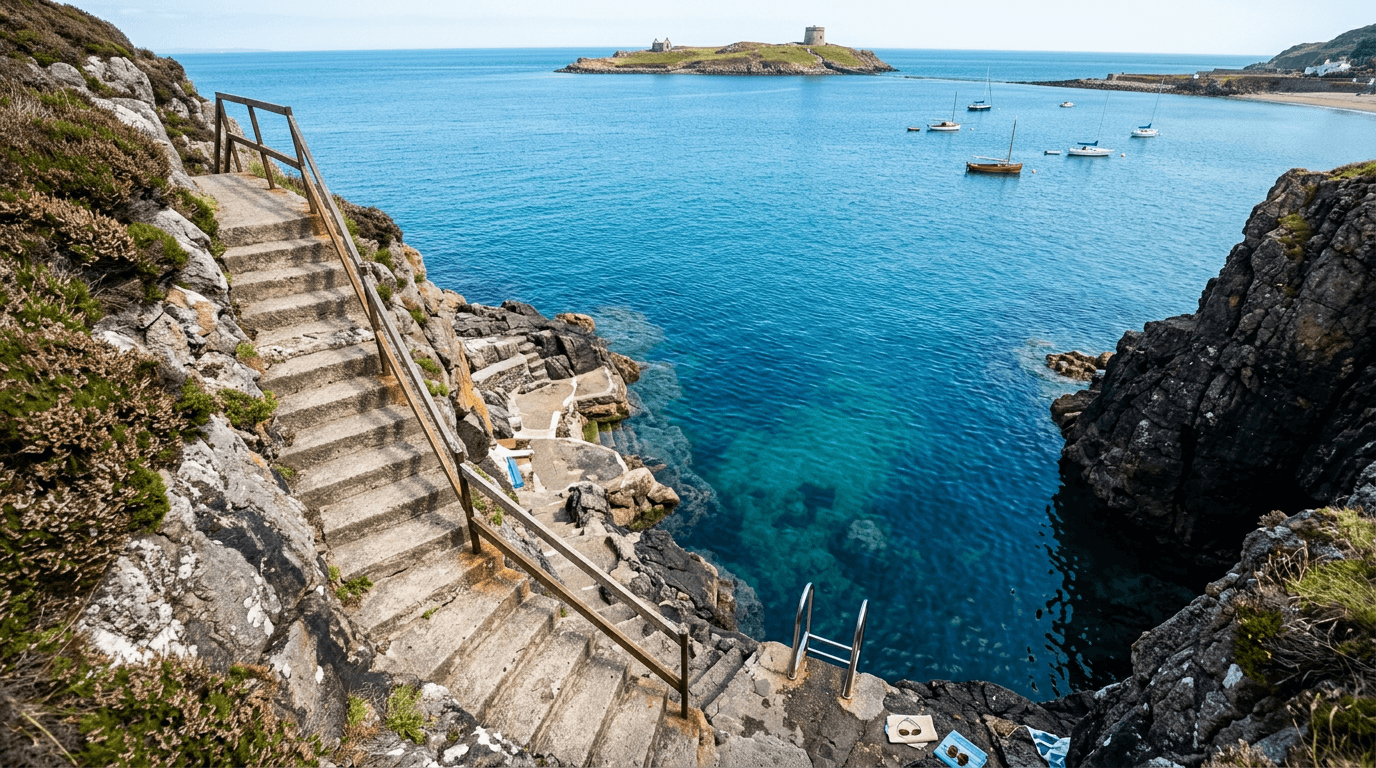
If the Forty Foot is the historic heavyweight, the Vico Baths represent the sheer cinematic beauty of the Dublin coastline. Tucked away on the steep, winding Vico Road in the hyper-affluent suburb of Killiney, this swimming spot requires a bit of effort to find, but the reward is a location that feels more like the Amalfi Coast or the French Riviera than the edge of the North Atlantic.
Accessing the Vico Baths feels like a secret mission. You must locate a small, unassuming gap in a stone wall on Vico Road, pass through a heavy iron gate, and descend a steep, winding series of concrete steps that cut through the dense coastal foliage. As you descend, the view opens up dramatically, revealing the sweeping expanse of Sorrento Bay, the rugged profile of Dalkey Island, and the sugarloaf mountains of Wicklow looming in the distance. The water here is often remarkably clear, taking on a deep, mesmerizing turquoise hue when the sun strikes it at the right angle.
The Vico Baths gained international notoriety during the 2020 lockdowns when Hollywood actor Matt Damon, who was stranded in Dalkey due to travel restrictions, was repeatedly photographed emerging from the sea here holding a SuperValu shopping bag containing his towel. This bizarrely normal celebrity sighting cemented the Vico Baths as the trendiest swimming spot in the capital, leading to a massive surge in its daily popularity.
- The Setup: The bathing area consists of a series of concrete terraces built into the cliff face, complete with a small, rudimentary changing shelter. Like the Forty Foot, this is a deep-water entry point. You climb down a sheer stainless-steel ladder directly into the deep ocean. It is exhilarating, but it is not suitable for weak swimmers or young children, as there is no shallow area to stand in.
- The Elements: Because it is highly exposed, the Vico Baths can be treacherous when the wind blows strongly from the east or the south. The waves can crash violently against the concrete terraces, making entering and exiting via the ladder incredibly dangerous. Always assess the swell from the top of the steps before you commit to the steep descent.
3. Seapoint: The Gentle Sloping Strand (Monkstown)
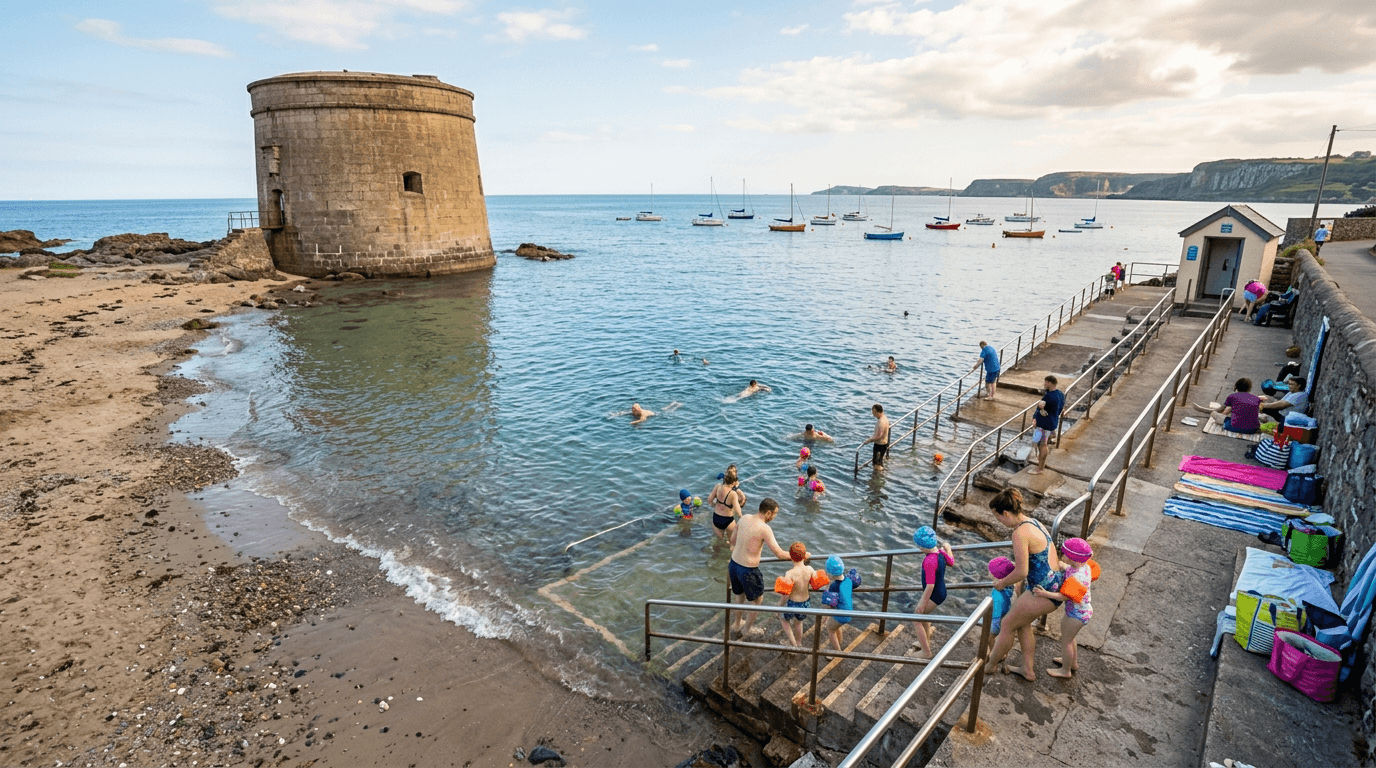
For those who find the deep-water plunges and crashing waves of Sandycove and Killiney a little too intimidating, Seapoint offers a significantly gentler, more forgiving introduction to the Irish Sea. Located between the bustling suburbs of Blackrock and Dun Laoghaire, Seapoint is characterized by its iconic, squat Martello tower and a long, curving stretch of sandy and stony shoreline that gently slopes into the water.
Seapoint is uniquely dictated by the tide. At high tide, the water comes right up to the concrete promenade and the historic bathing shelters, allowing swimmers to easily wade in or use the slipways and handrails. The water remains relatively shallow for quite a distance, making it an excellent location for beginner wild swimmers to acclimatize to the cold without the immediate panic of treading deep water. It is heavily utilized by local triathlon clubs for open-water training, as you can easily swim parallel to the shore for long distances in manageable conditions.
However, at low tide, the sea retreats dramatically, leaving behind a vast, expansive plain of wet sand and slippery green seaweed. To reach water deep enough to swim in during a low spring tide, you have to walk a significant distance out across the flats, which can be exhausting and painfully cold on your bare feet. Therefore, timing your visit to Seapoint to coincide with the high-water mark is essential for a pleasant experience.
- The Facilities: Seapoint arguably has the best infrastructure of the Southside swimming spots. It boasts large, well-maintained changing shelters, public toilets (during specific hours), and freshwater outdoor showers, which are an absolute luxury when you want to wash the stinging salt off your skin before putting your warm layers back on.
- The Vibe: The atmosphere here is decidedly more relaxed and family-friendly than the intense, fast-paced turnover at the deep-water spots. It is a place where people linger on the steps, drink tea from thermoses, and watch the ferries slowly gliding into Dublin Port across the bay.

4. Beyond the Big Three: The Northside Rocks
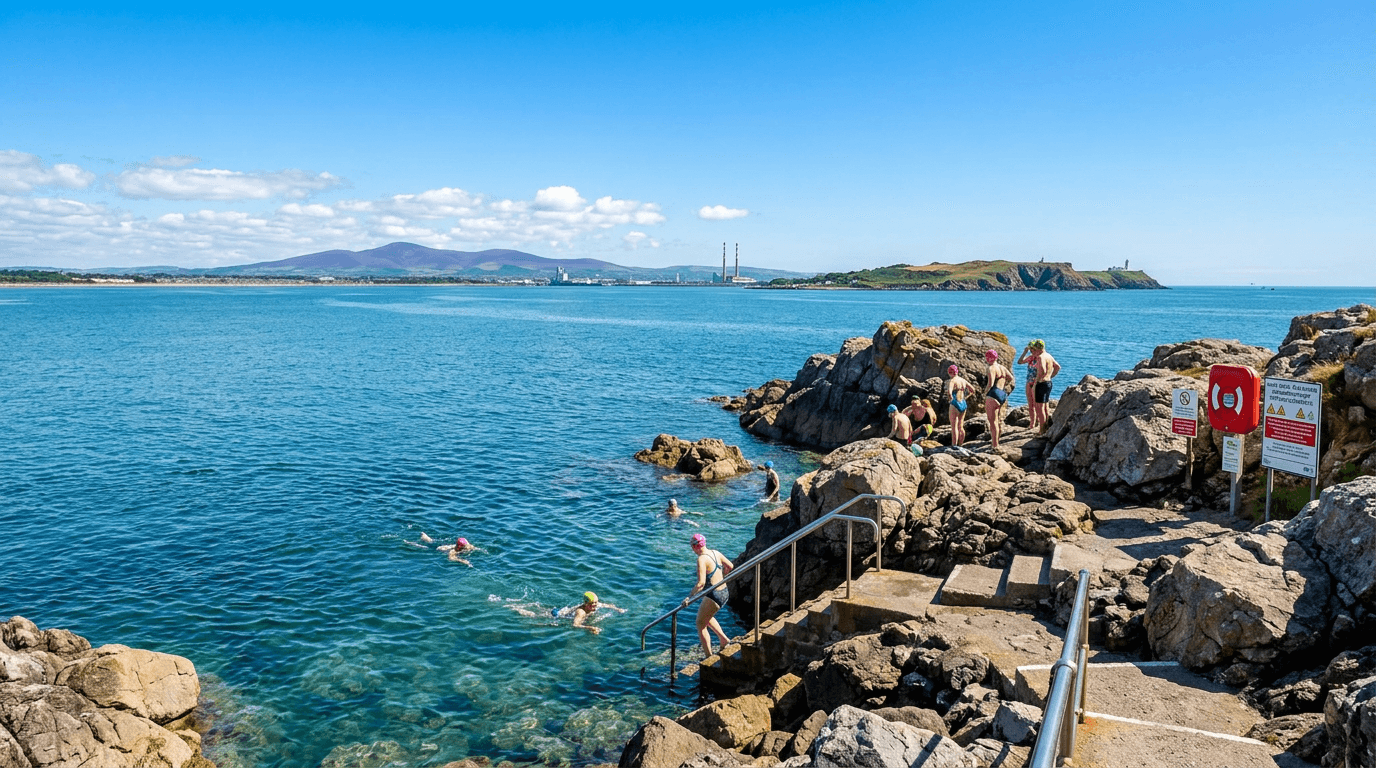
While the affluent southern suburbs tend to dominate the guidebooks and Instagram feeds, the Northside of Dublin boasts its own fiercely proud and equally spectacular swimming culture. If you want to escape the massive crowds that flock to Sandycove on a sunny weekend, heading north across the River Liffey is a brilliant strategy.
The coastal stretch between Portmarnock and Malahide is home to two beloved local spots: High Rock and Low Rock. As their names suggest, these are natural rocky outcrops that have been adapted for swimming. High Rock offers a brilliant, clean jumping point into deep water at high tide, while Low Rock, situated just a short walk further along the coast, provides a more gradual, forgiving entry point that is very popular with daily dippers and older residents.
Swimming on the Northside often provides a completely different visual perspective of the city. As you tread water off the coast of Malahide, you can look south across the vast expanse of Dublin Bay, taking in the entire sweeping curve of the coastline all the way down to the Wicklow Mountains. The water here is exposed to the open Irish Sea, meaning it is often exceptionally clean and clear, though it can catch the full force of easterly winds, reinforcing the need to understand your weather forecasts.
5. The Post-Swim Ritual: Warmth, Coffee, and Community
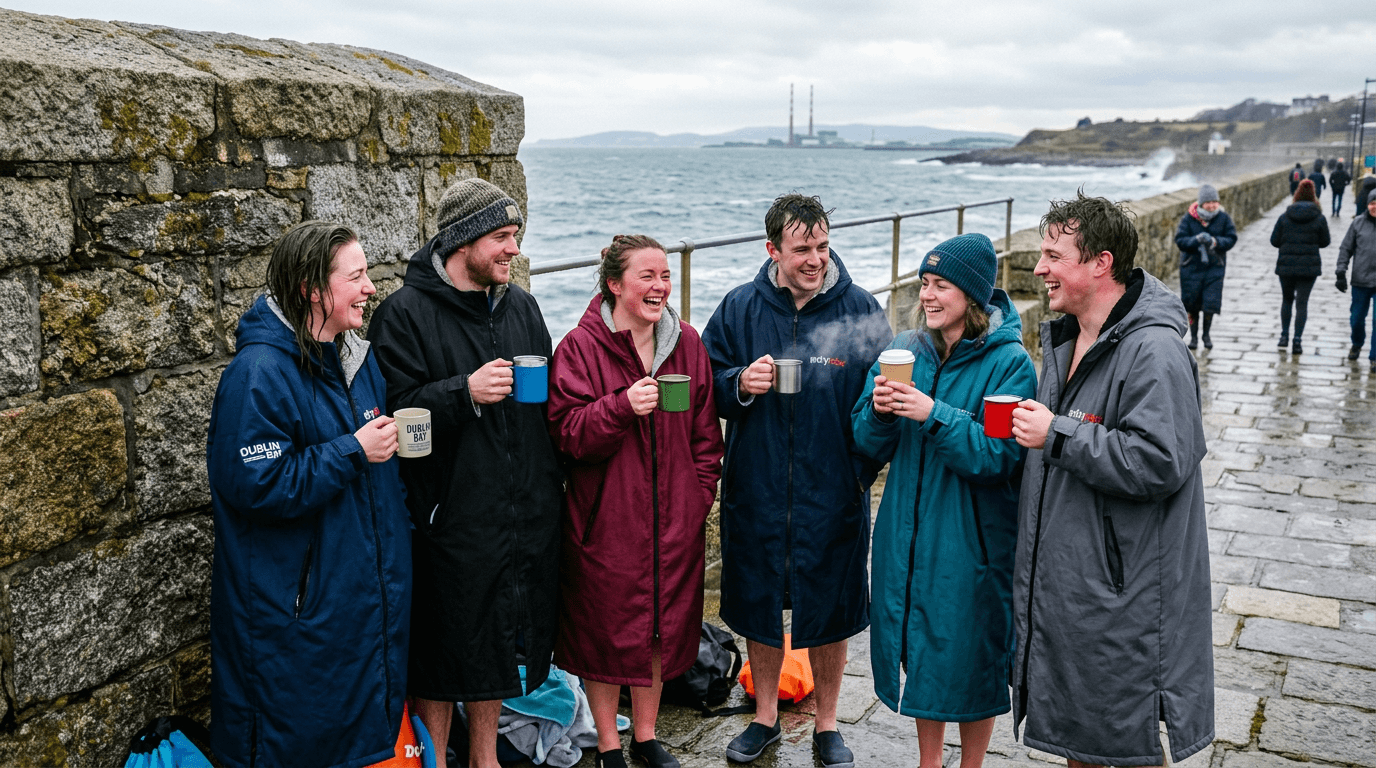
To truly understand swimming in Dublin, you must recognize that the actual time spent in the water—usually ranging from three to fifteen minutes—is only half of the experience. The other half is the elaborate, deeply social post-swim recovery ritual. Surviving the biting cold of the Irish Sea is a shared trauma that instantly bonds strangers together, turning the concrete steps into vibrant, buzzing social hubs.
The moment you exit the water, the race against the "After Drop" begins. This is where the local uniform comes into play. You will immediately notice that almost every swimmer is enveloped in an oversized, fleece-lined, waterproof changing robe (often referred to generically as a "Dryrobe," though many excellent local brands exist). These massive garments allow you to awkwardly strip off your wet swimsuit and pull on dry layers while remaining completely protected from the biting coastal wind.
- The Coffee Culture: The other non-negotiable element of the Dublin swim is the post-dip coffee. In recent years, a thriving ecosystem of high-quality, independent coffee vans and tiny cafes has sprung up directly adjacent to the popular swimming spots. Grabbing a flat white and a warm pastry is the ultimate reward.
- The Preparation: If you are visiting, do not underestimate the cold. Be sure to review our comprehensive guide on What to Pack for Wild Swimming in Ireland: Dryrobes, Booties & Post-Swim Gear to ensure you arrive looking like a prepared local rather than a freezing tourist.
6. The Logistics Nightmare: Parking and Access
Here is the harsh reality that most glossy travel brochures conveniently omit: visiting the Forty Foot or the Vico Baths in a rental car on a summer morning or a weekend is a logistical nightmare bordering on the impossible. These locations are situated in some of the most exclusive, densely packed, and highly regulated residential neighborhoods in the entire country.

The roads surrounding Sandycove and Killiney are incredibly narrow, winding, and completely devoid of large public parking lots. The few available on-street parking spaces are heavily restricted by "Pay and Display" meters or reserved exclusively for local residents with permits. The local parking enforcement teams are notoriously efficient; if you abandon your rental car on a double yellow line or block a resident's driveway while you run down for a quick swim, you will almost certainly return to find a yellow clamp securely attached to your wheel, accompanied by a hefty release fee.
While the DART train is a fantastic, scenic way to travel the coastline (with stations at Sandycove & Glasthule, Dalkey, and Seapoint), it presents its own problems for wild swimmers. After exiting water that is 8°C (46°F), you will likely be shivering violently. Having to walk fifteen minutes uphill to a train station, wait on an exposed, windy platform, and sit on a public train while attempting to regain your core body temperature is a miserable, and potentially unsafe, way to end a beautiful experience.
7. The Ultimate Solution: Private Drivers and Local Guides

If you want to experience the magic of Dublin's historic bathing spots without the agonizing stress of parking fines or freezing train rides, the smartest investment you can make is to hire a Private Driver or a specialized Coastal Guide.
A private driver transforms the entire experience from an endurance test into a seamless luxury. Imagine arriving at the Vico Road: your driver drops you exactly at the hidden iron gate. You do not spend thirty minutes circling the steep hills looking for a space. You descend the steps, enjoy your breathtaking swim in Sorrento Bay, and when you emerge, shivering and triumphant, you climb straight into a pre-heated luxury vehicle waiting at the top of the hill. You can change into your warm clothes in total privacy and comfort, sipping a hot tea as your driver effortlessly navigates the narrow lanes back to your city center hotel.
Furthermore, if you are nervous about navigating the deep-water entries or the local jumping etiquette, a local coastal guide is invaluable. They swim these spots daily. They know the exact depth of the water at any given hour, they know which steps are too slippery to use, and they can provide you with the necessary safety floats and thermal gear, ensuring your Dublin sea swim is memorable for all the right reasons.
Conclusion: A City Connected by Water
Dublin is a city defined by its relationship with the water. The River Liffey may divide the capital in two, but the sweeping coastline of the Irish Sea unites its people. Joining the locals for a morning dip at the Forty Foot or the Vico Baths offers a profound, authentic connection to the city that you simply cannot find in a crowded museum or a tourist pub.
It requires bravery to step into that cold water, and it requires careful logistical planning to get there and back comfortably. But as you float on your back, looking up at the Martello towers and the distant mountains, your skin tingling with the absolute clarity of the cold, you will understand exactly why thousands of Dubliners refuse to start their day any other way.
Experience the Coast Without the Cold Commute
Don't let parking stress or freezing walks ruin your wild swimming experience. Hire a local professional to manage the logistics, the heat, and the navigation.
Table of Contents
Share this post
More from the Blog

Cork to Blarney Castle Day Trip: The Stone, the Gardens and What Else to See
Plan a Cork to Blarney Castle day trip. Kiss the stone, explore the Poison Garden, and add Cork city, Fota or Kinsale for a full day out.

Cork to Cobh Day Trip: Titanic, Colourful Houses and Harbour History
Plan a Cork to Cobh day trip by train, car or private driver. Explore Titanic history, St Colman's Cathedral, Spike Island and the best harbour views.

Cork to Killarney Day Trip: Lakes, Mountains and Muckross in One Day
A Cork to Killarney day trip is a longer escape into Kerry. Here's how to plan the drive, what to see in Killarney National Park, and why a private driver helps.